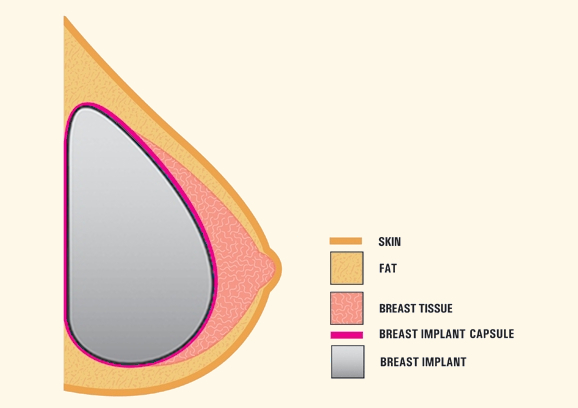
Capsular Contracture occurs when the Breast Implant’s pocket is too tight. When a Breast Implant is placed, the body forms a pocket to hold the implant in place. Without this pocket, the Breast Implants would not stay in a predictable position. When the pocket becomes too tight, it can move the breast implant or make the breast feel firm. Breast Augmentation Revision is used when capsular contracture causes visible changes in the Breast Augmentation.
Breast Augmentation Revision – Capsular Contracture Before and After Pictures
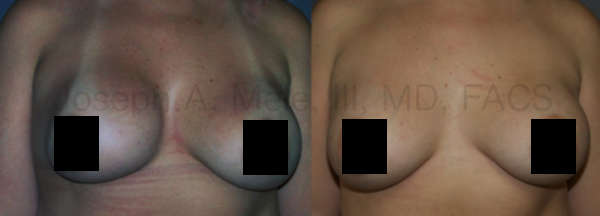
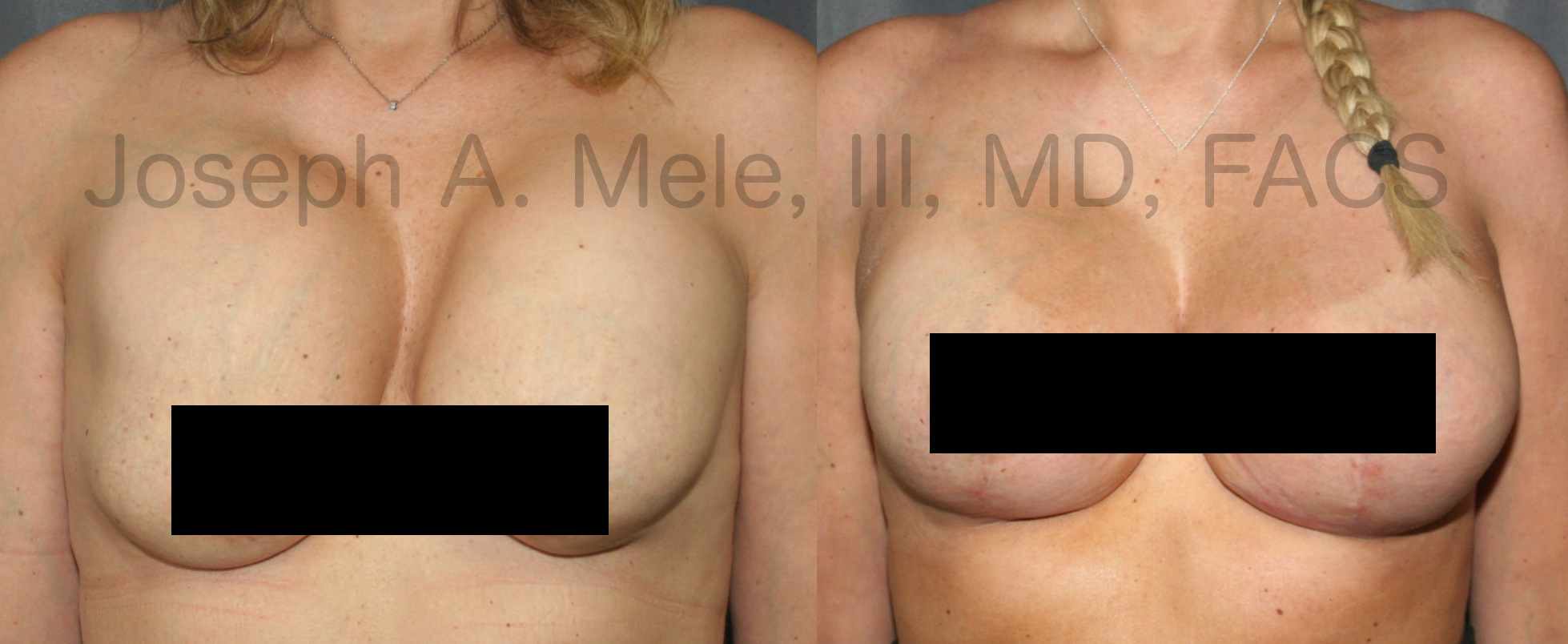
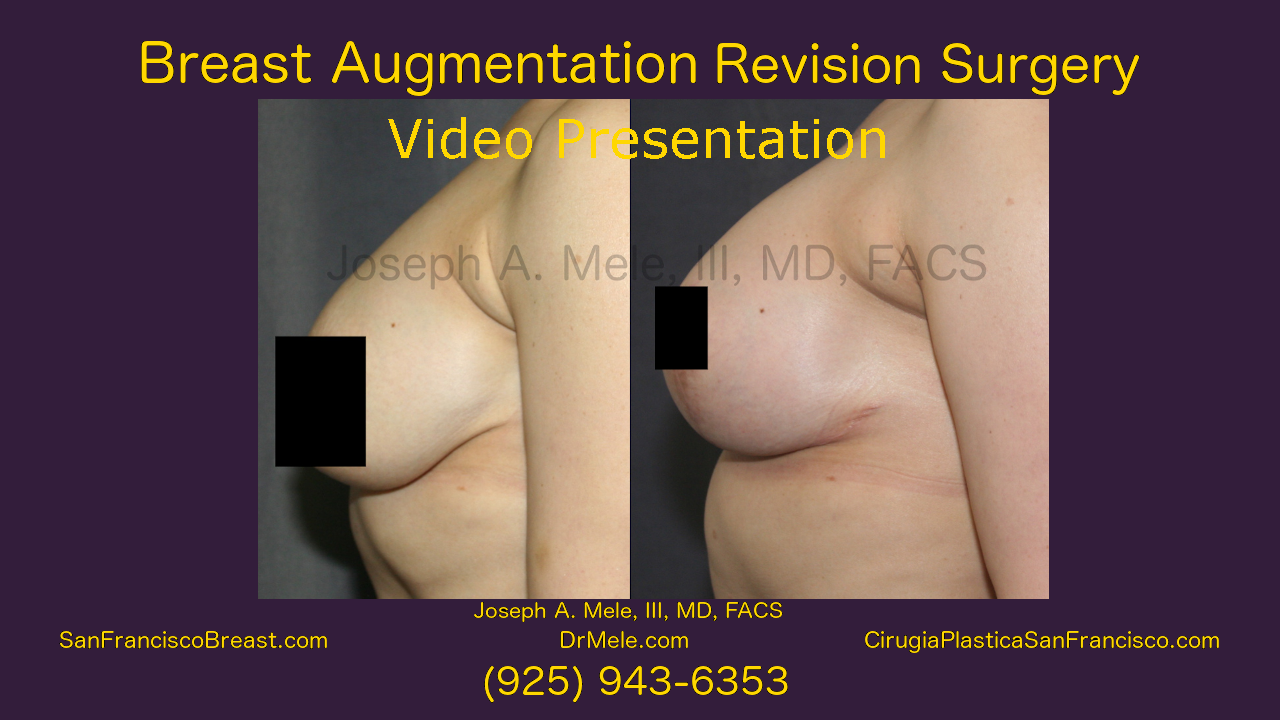
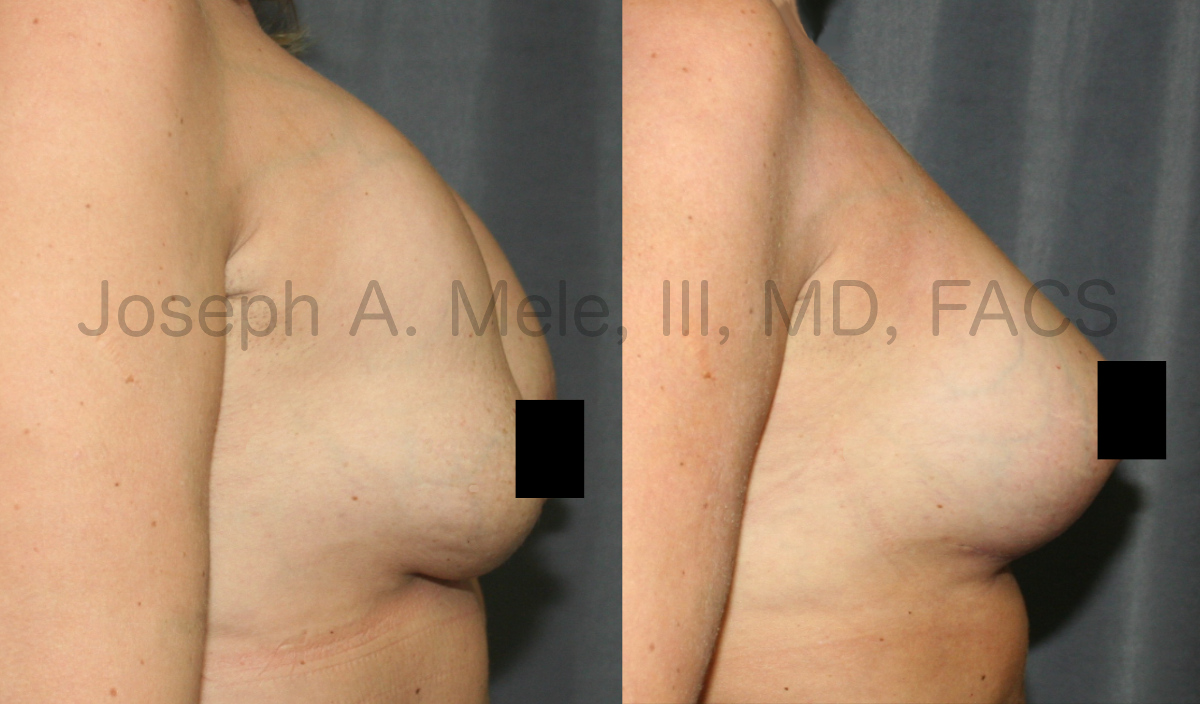
Breast Augmentation Revision: Left – before shows capsular contracture and superior malposition; Right – after capsulotomy/capsulectomy the right Breast Implant is lowered to a better position.
Breast Augmentation Revision for Capsular Contracture
The Breast Augmentation Revision before and after pictures above show an example of the correction of capsular contracture. The picture on the left shows Grade III capsular contracture. As the capsule contracts, it squeezes the Breast Implant causing an apparent reduction in size of the breast implant. In this case, the lower pole of the breast implant is being squeezed more than the upper pole. The result is superior Breast Implant Malposition.
Correction of Capsular Contracture
Capsular Contracture is treated with either release of the capsule (capsulotomy) or removal of the capsule (capsulectomy). A Capsulotomy allows the capsule to expand, resulting in a softer breast augmentation. A capsulotomy can also be performed selectively in cases of malposition, to move the breast implant back into the proper position. Capsulotomy works best for thin, tight capsules.
A Capsulectomy is used when the capsule is thick. By completely removing the pocket around the implant, a new pocket is allowed to form. The Breast Implants may also be changed to help prevent recurrence. Capsulectomy is also used for breast implant removal when a silicone breast implant leaks. This allows for removal of all the contained silicone gel.
Breast Augmentation Revision Results
In the before and after pictures above, the right side shows the results. The right breast implant was lowered and is much softer. The upper pole of the breasts are now even, which increases the number of necklines that can be worn. The nipples and inframammary folds are also even, improving the appearance out of clothing too.
Breast Augmentation Revision Consultation
If you are considering breast augmentation revision, call (925) 943-6353 to schedule your personal consultation appointment.
In trying to answer some of the most frequently asked questions about Breast Augmentation Revision, I have provided information here and on my main web sites. Information on the Internet, however, cannot replace a consultation with a Board Certified Plastic Surgeon. If you are having problems with your Breast Implants, seek the advice of a qualified professional, preferably a member of the American Society for Aesthetic Plastic Surgery.
What Are the Most Common Reasons for Breast Augmentation Revision?
The most common reasons for Breast Augmentation Revision include:
The desire to Change Size
Breast Implant Deflation
Capsular Contracture
Breast Implant Malposition (often caused by capsular contracture)
Changing Breast Implant Size
One of the most common reasons for Breast Augmentation Revision is to change the size of the Breast Implants. The overwhelming majority of the time, the goal is to increase the size of the Breast Implants. The procedure is usually simpler, and has a much easier recovery, than the initial Breast Augmentation. The pocket is opened, the old implants removed, the pocket is enlarged (capsulotomy or capsulectomy), and new implants are placed. When the goal is to decrease the size of the Breast Implants, the procedure is the same except the pocket is not enlarged, and sometimes it needs to me tightened (capsulorrhaphy). Breast Implants can also be changed from Saline to Silicone Gel, and less frequently from Silicone Gel to Saline.
Breast Implant Deflation
Breast Implant Deflation and Replacement: Problem – Patient’s left saline breast implant has deflated. Solution – Patient desired larger breast implants so both sides were replaced with larger breast implants.
With the advent of improved manufacturing and materials, the risk of breast implant deflation is reduced. What happens when a breast implant deflates depends on what is it filled with. Saline Breast Implants go flat, and the solution is safely absorbed by the body. Silicone Breast Implants have a firm center, and initially there may be no sign of a leak. Over time, the gel can leak out of the capsule, and you may feel a lump. Any lump in the breast should be promptly investigated. The sooner a broken implant is replaced, the simpler the procedure will be. The big three US breast implant manufacturers all have warranties: Allergan, Mentor and Sientra.
Capsular Contracture
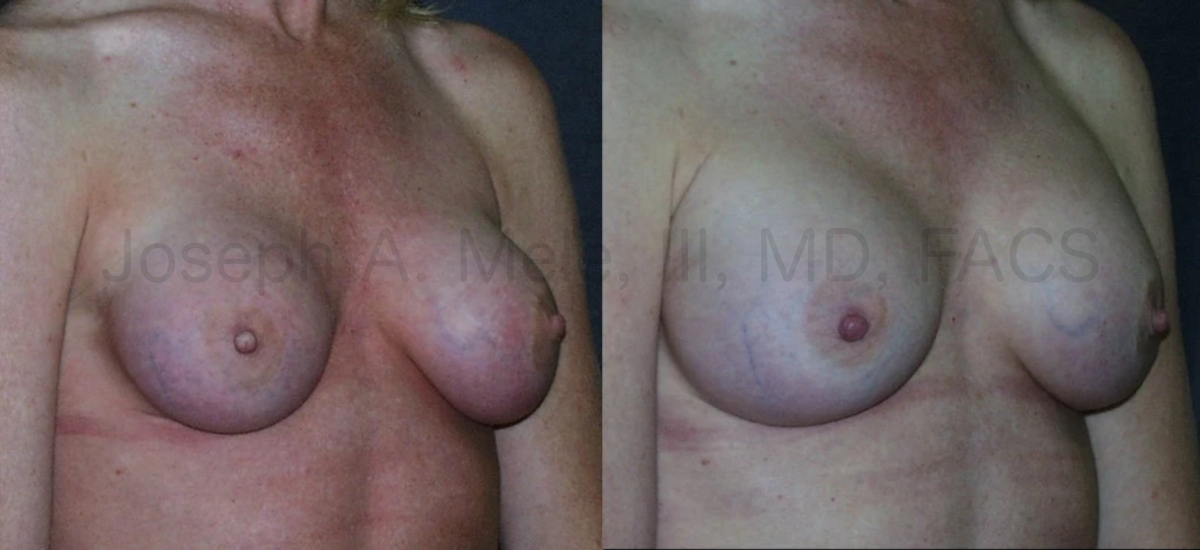
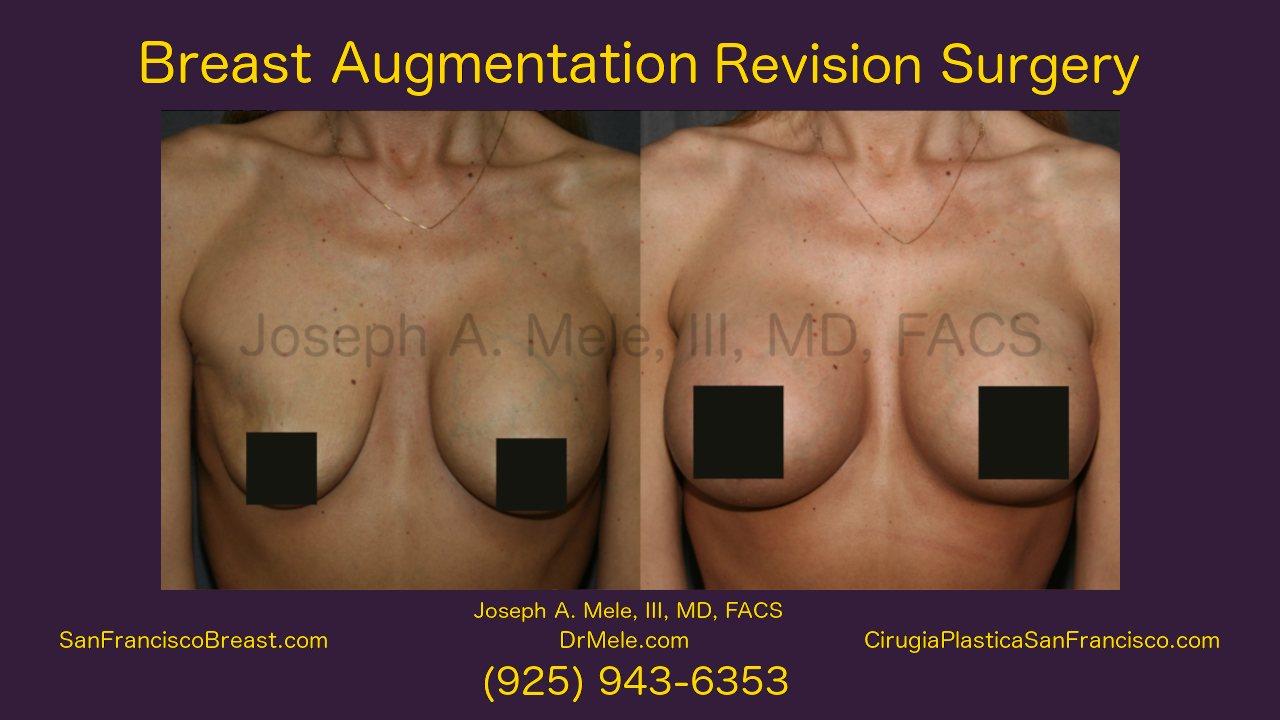
Capsular Contracture Before and After Capsulectomy: Problem – Capsular Contracture leads to firmer, smaller and more centralized breast implants. Solution – Capsulectomy removes the tight scar, softening and expanding the implants.
Capsular Contracture is the term for hardening of the Breast Implants. The breast implants themselves do not get hard, but the scar capsule that lines the pocket in which the Breast Implant sits tightens. The scar squeezes the Breast Implants and can change the firmness, shape and position of the Breast Augmentation. In the before picture above the redness of the breasts is caused by congestion of the circulation. It the most severe cases of Capsular Contracture (Grade IV) not only is the shape of the breast changed, but the breast also become painful.
Treatment of Capsular Contracture includes one, or a combination of:
Capsulectomy (removing the scar)
Capsulotomy (opening the scar)
Breast Implant Replacement
Breast Implant Malposition
Breast Implant Malposition is a large topic by itself. When Breast Implant Malposition is caused by Capsular Contracture, the treatment is similar to that described above. When caused by Breast Implants that are too large for a woman’s frame, reducing the size of the Breast Implants may be an important part of the treatment. When implants are too low, the inframammary fold may need to be repaired, or completely reconstructed as is often the case in Breast Reconstruction after a mastectomy. Symmastia is also a form of Breast Implant Malposition that is seen when the breast implants migrate towards each other, breadloafing and forming a uniboob.
Problems With Breast Augmentation
If you have problems with your breast augmentation, seek the assistance of a Board Certified Plastic Surgeon, who has experience with the correction of Breast Augmentation. Although many of the skills required for Breast Augmentation are necessary for Breast Augmentation Revision, Breast Augmentation Revision Specialists have developed specific skills, and can help guide you to achieve safer and more predictable results.
On April 12, 1961, Soviet cosmonaut, Yuri Gagarin, used a space capsule like this to become the first human in orbit. That same year, the first breast implant was developed by American plastic surgeons Thomas Cronin and Frank Gerow.
Breast implant capsules have a bad reputation. Normally, they are only discussed when they are causing problems like capsular contracture or breast implant malposition. However, like a space capsule, the breast implant capsule provides protection, and without breast implant capsules, there would be no breast augmentation.
What is a breast implant capsule?
Whenever a breast implant is used for breast augmentation, your body makes an encapsulating sheet of scar that lines the breast implant’s pocket. This normally thin, soft scar is called the “capsule”, and it is incredibly important in maintaining your breasts’ enhancement.
Have you ever wondered how breast implants stay in place?
The capsule is responsible for keeping the breast implants in the proper position beneath the breasts. It forms in just a few weeks after breast augmentation surgery and keeps the breast implants from freely sliding around. Optimal breast implant position is a combination of careful placement during surgery and a proper capsule. The capsule will quickly line the surgical pocket and provide a smooth, strong interface between the breast implant and the soft tissues of the chest. By reinforcing the pocket, the capsule helps to maintain optimal breast implant placement.
The capsule protects the breast implant.
Not only does the capsule help keep the breast implant in position, it also protects the implant. The interior of the capsule is smooth and allows for nearly frictionless movement within its boundaries. The outer layers of the capsule provide enhanced vascular circulation and helps protect the breast implant from infection.
When good capsules go bad.
So what can go wrong with breast implant capsules? The perfect capsule is firm enough to maintain proper breast implant positioning, but soft enough to not be felt. Problems occur at the extremes, so like Goldilocks the capsule needs to be just right, not too hard and not too soft.
Too soft
When the Breast Implant Capsule is too soft, it does not provide enough support for the implant. Gravity pulls the implants down when standing or to the side when laying down. The larger the breast implants, the greater the force. Stomach sleeping also pushes the implants apart. A healthy capsule can resist the tendency toward Breast Implant Malposition, but a good bra helps too.
Treatment for implant malposition can include a capsulorrhaphy, to tighten the capsule, and close off the areas where the implant should not be going. If an overly large breast implant in compounding the problem, a smaller implant can help reduce recurrence. The use of an acellular dermal matrix (ADM) has also become more popular as a way to line, reinforce and thicken the capsule.
Too hard
When the Breast Implant Capsule is too hard, it can compress the implants, and cause Capsular Contracture. Capsular contracture can also result in breast implant malposition. If the capsule is tight only on one side, it will push the breast implant toward the soft side. If the capsule is tight all the way around, it can make the implant feel hard.
Treatment for capsular contracture includes capsulectomy, removing the thickened capsule, and capsulotomy, incising the capsule to allow it to expand. Both these techniques are performed in the operating room. An older, non-operative technique called closed capsulotomy was a way to split the capsule without surgery by forcefully compressing the implant. This has been largely abandoned as it has less predictable results, may lead to uncontrolled bleeding or implant rupture, and violates most breast implant warranties.
Just Right
The most common types of capsules are grade I followed by grade II. Grade I capsules are soft on not detectable from the outside, Grade II capsules feel firmer, but are not tight enough to cause visual changes. Both usually provide adequate support to allow the breast to age naturally, securely on the chest. If you are considering breast augmentation, or you have breast implants and are considering breast implant revision surgery, give me a call at (925) 943-6353 or contact my Walnut Creek Plastic Surgery Office using the contact form in the left column.
Breast Implant Revision Surgery is performed to improve the results of Breast Augmentation. While Breast Augmentation is both safe and effective, our bodies continue to change as we age. Breasts naturally change size and shape over time. This occurs with or without breast augmentation. While most changes are gradual, changes can happen relatively quickly with pregnancy and changes in weight.
Breast Implant Replacement
Breast implants can wear out too, requiring a new implant to be placed. The major US breast implant companies, Allegan and Mentor, do provide Breast Implant Warranties.
What Are the Common Reasons for Breast Augmentation Revision Surgery?
The most common reasons for Breast Implant Revision Surgery are a desire for a change in size, deflation of the breast implant, capsular contracture and breast implant malposition. It is important to clearly identify what problem(s) are bothersome, and to seek a consultation with a Board Certified Plastic Surgeon.
Below is number four of four of my latest Breast Implant Revision Videos. They appeared on KRON4′s Body Beautiful. The series covers Breast Augmentation, Breast Implants and Breast Augmentation Maintenance. The television show was broadcast live, so viewers could call in during the broadcast to have their questions answered. The (415) number shown in the video was only for the show; however, if you have Breast Augmentation or Breast Implant Revision questions, please call our San Francisco Bay Area Plastic Surgery Office directly at (925) 943-6353. If you prefer, you may also use the contact form on the left.
San Francisco Bay Area Breast Implant & Breast Augmentation Revision Video
San Francisco Bay Area Breast Implant Revision Questions
This Breast Augmentation and Breast Implant Revision Surgery video includes:
The type of trauma most likely to cause breast implant deflation
Common reasons for breast implant revision surgery
Changing breast implant size
Breast implant leaks
Capsular Contracture
Breast Implant Malposition
Breast Augmentation and Breast Implants Revision Resources
You are viewing number three of four Breast Implants Revision Video segments from Dr. Mele’s recent Body Beautiful television appearance. Here are links to the other segments:
Breast Augmentation remains one of the procedures that I perform most frequently. Whether you’ve always had small breast and want them larger, or you had larger breast and want them back, Breast Augmentation can help you achieve your goals.
Breast Implant Revision Surgery is performed to improve the results of Breast Augmentation. While Breast Augmentation is both safe and effective, our bodies change as we age. Breasts naturally change size and shape over time, and this happens even after breast augmentation. Changes can certainly be exacerbate by pregnancy and changes in weight, but most of the time the changes are gradual and sneak-up on us.
What’s New in Breast Implants and Breast Augmentation?
If you are considering Breast Augmentation or Breast Implant Revision surgery, you should know that new breast implants are available and more are on the horizon. New techniques are also being developed to help make your Breast Enhancement simpler, safer, more predictable and easier overall. Be certain to seek a Board Certified Plastic Surgeon for all your Cosmetic Breast Surgery needs.
Below is part three of four of my Breast Implant Revision Video that appeared on KRON4′s Body Beautiful. Options in Breast Augmentation, Breast Implants and Breast Augmentation Maintenance are reviewed. The television show was broadcast live, so viewers could call in during the broadcast to have their questions answered. The (415) number shown in the video was only for the show; however, if you have Breast Augmentation or Breast Implant Revision questions, please call our San Francisco Bay Area Plastic Surgery Office directly at (925) 943-6353. If you prefer, you may also use the contact form on the left.
San Francisco Bay Area Breast Implant & Breast Augmentation Revision Video
San Francisco Bay Area Breast Implant Revision Questions
This Breast Augmentation, Breast Implant Revision Surgery video includes:
The Breast Implants currently available
Saline Breast Implants – Natrelle (Allergan) and Mentor (J&J)
Silicone Gel Breast Implants (Natrelle and Memory-Gel)
Soft-Solid Silicone Breast Implants (GummiBear Implants)
Natrelle 410′s*
Mentor Contour Profile Gel (CPG)*
*The 3 yr and 5 yr data for the 410′s and CPG breast implants surpasses that of the breast implants that are already approved in this country. Why are they not approved? Only your FDA knows for sure.
Breast implant deflation
What are the signs and symptoms associated with a leaking breast implant?
How to check for a breast implant leak
How long do Breast implants last?
How are breast augmentation and breast lifts combined?
Breast Augmentation and Breast Implants Revision Resources
You are viewing number three of four Breast Implants Revision Video segments from Dr. Mele’s recent Body Beautiful television appearance. Here are links to the other segments:
Breast Implant Revision Surgery is performed to improve the results of Breast Augmentation. Breast Augmentation Revision can help with Breast Implants are the wrong size, in the wrong position, have developed capsular contracture or when other cosmetic deformities require correction. Specific techniques have evolved for the correction of the most common problems that can occur with Breast Implants. Some recently developed new techniques have significantly improved the results of breast implant revision for problems that have been difficult in the recent past.
San Francisco Bay Area Breast Augmentation
This segment of Body Beautiful focuses on before and after results. Breast Augmentation is reviewed, as well as the correction of specific breast implant problems like capsular contracture and implant malposition (bottoming out and symmastia). The following Breast Implant Revision Video was broadcast on KRON4′s live Medical Monday show, Body Beautiful. The television show allows viewers to call in during the broadcast and have their questions answered. The (415) number shown in the video was only for the show, so if you have Breast Augmentation or Breast Implant Revision questions, please call our San Francisco Bay Area Plastic Surgery office directly at (925) 943-6353, or use the contact form on the left.
San Francisco Bay Area Breast Augmentation & Breast Implant Revision Video
San Francisco Bay Area Breast Implant Revision Questions
This Breast Augmentation, Breast Augmentation Revision Surgery video includes:
Before and After Pictures of Breast Augmentation
Before and After Pictures of Breast Augmentation Revision including:
Before and After Pictures of Breast Augmentation Revision for a Breast Implant that is too low and a poorly formed inframammary fold (IMF)
Before and After Pictures of Breast Augmentation Revision for Grade III Capsular Contracture causing the Breast Implant to be too high (Capsulotomy/Capsulectomy)
Before and After Pictures of Breast Augmentation Revision for Grade IV Capsular Contracture causing the implant to ride up and appear significantly smaller
Before and After Pictures of Breast Augmentation Revision for Breast Implants that are too close (as seen in symmastia) and too far from the midline (often causing a large gap between the breast implants) and rippling on the inside of the breast (medial rippling)
Before and After Pictures of Breast Augmentation Revision for severe bottoming out with internal capsulorrhaphy (though a breast lift is the most frequently selected option)
Breast Augmentation and Breast Implants Revision Resources
You are viewing part two of four Breast Implants Revision Video segments from Dr. Mele’s recent Body Beautiful television appearance. Here are links to the additional segments:
Breast Augmentation remains one of the most popular cosmetic plastic surgery procedures. While often the procedure lasts a lifetime, breast augmentation revision is quite common. Breast Implant Revision has emerged as a specialty unto itself. While many of the tenants that lead to excellent Breast Augmentation results will also apply to Breast Augmentation Revision, new and specific techniques have evolved for the correction of the common problems that can occur with Breast Implants.
The most frequent reasons for Breast Augmentation Revision Surgery include the desire to change the size of the breast, breast implant deflation, problems with the position of the breast implants and tightening of the scar that normally forms around the breast. The last listed is called capsular contracture.
San Francisco Bay Area Breast Augmentation
What follows is a Breast Implant Revision Video segment from KRON4′s live Medical Monday show, Body Beautiful. The television broadcast allows viewers to call in and have their questions answered live. The (415) number shown in the video was only for the show, so if you have Breast Augmentation or Breast Implant Revision questions, please call our San Francisco Bay Area Plastic Surgery office directly at (925) 943-6353, or use the contact form on the left.
San Francisco Bay Area Breast Augmentation & Breast Implant Revision Video
San Francisco Bay Area Breast Implant Questions
This Breast Augmentation, Breast Augmentation Revision Surgery video includes:
What to consider before having Breast Augmentation
Is “routine maintenance” for Breast Implants required?
If my Breast Implants are too high, can they be lowered?
If my Breast Implants are too low, can they be raised?
If my Breast Implants are too wide, can they be moved towards the middle?
If my Breast Implants are too close together, can they be separated?
What causes Breast Implants to fail?
Can I maintain my body proportions and have Breast Augmentation?
What are the problems associated with Breast Implants which are too big?
Breast Augmentation and Breast Implants Revision Resources
You are viewing one of four Breast Implants Revision Video segments from Dr. Mele’s recent Body Beautiful television appearance. Here are links to the additional segments:
Breast Augmentation and Breast Implant Revision San Francisco Bay Area – 1 of 4 (You Are Here)
This patient had breast augmentation prior to becoming pregnant. Left: After pregnancy, the breast implant position remains unchanged; however, the breasts have dropped. Right: After breast augmentation revision, the breasts have been lifted and the breast implants exchanged, dramatically improving the breasts' shape and profile.
Pregnancy and Breast Augmentation
Pregnancy can change the volume and shape of breasts, and the result isn’t always positive. If you have been pregnant, you know firsthand. For the lucky few the changes are subtle, or even enhancing, but usually they are not. Many patients opt for breast augmentation after having children to restore what was lost. If you are trying to get pregnant, it is worth delaying your breast augmentation; however, if childbearing is not imminent, waiting may not be desirable.
Breast Implant Problems After Pregnancy
The breast augmentation revision before and after pictures above are of a woman who had breast augmentation at a young age, and enjoyed her breast implants for many years. After childbearing, her breast implants remained in a perky position, but the natural breast tissue sagged. Her breasts would have sagged and deflated whether she had breast implants or not, but with implants the result was normal elongated, deflated breasts, with the addition of disproportionate upper pole fullness from her breast implants.
The Breast Implant Revision Solution
The solution was a breast lift with breast implant exchange. The natural breast tissue was lifted to reduce the length of the breast and firm the natural breast tissue. The breast implant was exchanged to help with both shape and the post-partum changes in breast volume. Larger breast implants can be used to replace lost breast volume. Smaller implants, removal of the breast implants, or even breast reduction can help when the breast remain too large after lactation.
A desire to change breast implant size (larger or smaller)
Deflation of the breast implant
Firmness due to tightening on the breast implant capsule (capsular contracture)
Breast implant asymmetry or malposition like bottoming out, double bubble or symmastia (uniboob)
If you have one of these problems, a Board Certified Plastic Surgeon, like Walnut Creek Breast Implant Specialist Joseph Mele, MD, FACS, can help.
Tomorrow, Dr. Mele will be appearing on Body Beautiful. The show airs live on KRON, channel 4, September 12, 2011, at 11:00 AM. Breast augmentation and breast augmentation revision surgery will be discussed. If you have questions, call in to the KRON studios on Monday at 11:00AM, or send us your question through the contact form on the left. Every effort will be made to answer your questions during the show.
Breast Implant Revision Videos
Below are links to previous television appearances on KRON4 featuring Breast Augmentation Revision Videos and Breast Augmentation Revision Before and After Photos:
Breast Augmentation Scar Revision Before and After Pictures
Breast Augmentation Scar revision is another reason for Breast Implant Revision Surgery. Follow the link for a case presentation of breast augmentation scar revision for a wide-spread periareolar scar : Hypertrophic Breast Scar Revision
It has been an interesting summer in the San Francisco Bay Area. The rest of the country is trying out the West Coast’s favorite natural disaster – Earthquakes. Earlier this week a 5.5 earthquake hit Cokedale, Colorado and a 5.8 struck in Mineral, Virginia. We are not slacking on that department, as I was awakened Tuesday night by a mild 3.6 quake, one of 75-100 San Francisco Bay Area Earthquakes this week.
Maybe it’s Earthquake weather, but this summer’s weather has been a bit odd. While the rest of the country has been roasting, it has been a mild summer for San Francisco. Bay Area Breast Augmentation, on the other hand, remains hot. In office procedures such as Botox, Fillers and Chemical Peels are still the most frequently performed facial enhancements, but Breast Augmentation (Augmentation Mammoplasty) remains the most popular cosmetic plastic surgery procedure, with 300,000 breast augmentations performed in 2010 just in the US.
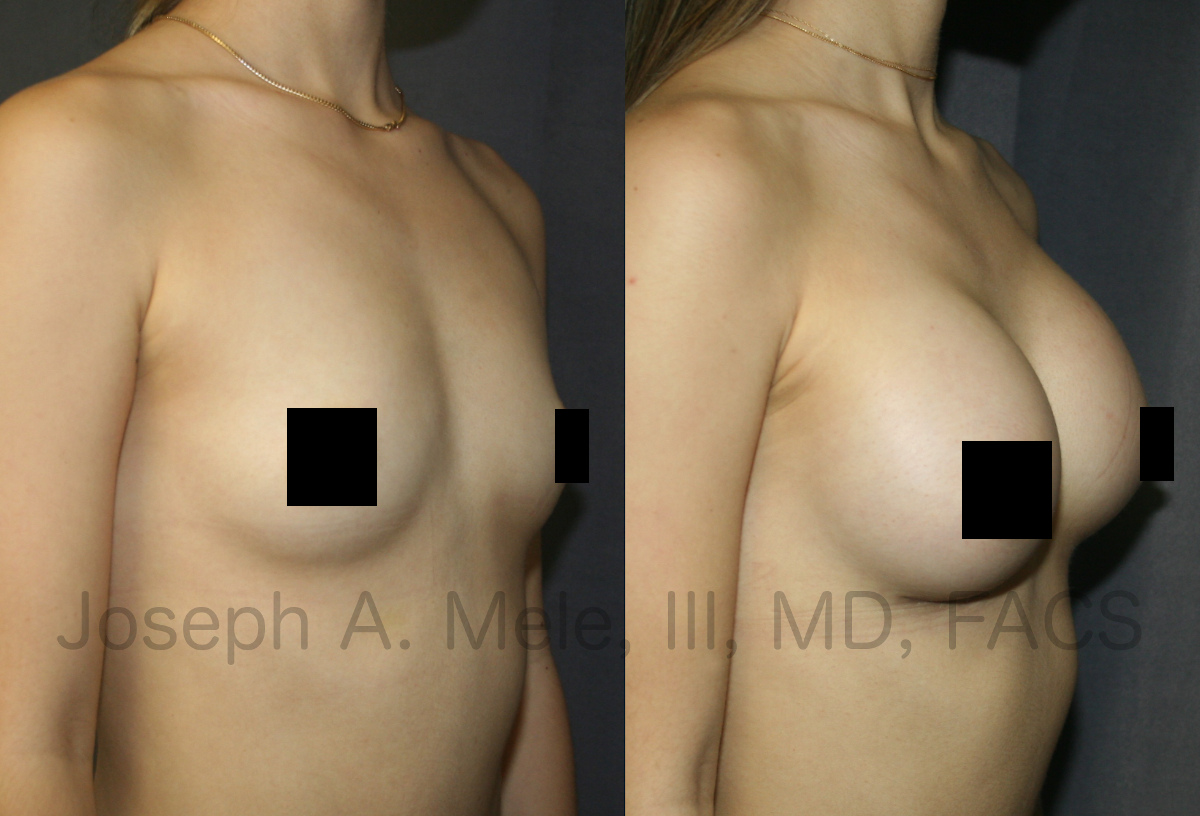
Breast Augmentation Before and After Pictures
Reasons for Breast Augmentation
Breast Augmentation is performed for many different reasons, and the choice to get Breast Implants is a personal one. The most common reasons include the correction of breasts that never fully developed, restoring volume lost after pregnancy or weight loss, congenital deformities and the loss of a breast due to breast cancer. Breast Implants help restore body proportions, enhancing the way clothing fits. Some commonly asked questions about Breast Augmentation are answered on my main web site, and links are provided below.
If you are interested in learning more about Breast Augmentation, or you have Breast Implants and are considering Breast Augmentation Revision, give one of San Francisco Bay Area’s premier Breast Implant Specialists a call at (925) 943-6353, or contact us through the contact form in the left column.
Capsular Contracture occurs when the scar that normally forms around a breast implant becomes too much scar. It is normal and desirable that a scar forms around the breast implant. The scar forms a pocket called the capsule. The capsule secures the breast implant and keeps it from migrating around under the skin. The capsule is very important to prevent malposition and bottoming-out of the breast implants. A normal capsule is soft and cannot usually be felt.
What is Capsular Contracture?
Capsular Contracture occurs when the capsule is too tight or too thick. While Wikipedia defines capsular contracture as an abnormal response of the immune system, it is more likely an exaggerated normal response. If the capsule is tight all around the breast implant, it can make the breasts feel hard and immobile. If the capsule is tight on just one side, it can push the implant. For example, when the scar is tight on the bottom, it moves the implant up. The result is the opposite of bottoming out.
Baker’s Grades of Capsular Contracture
Capsular Contracture is graded (Baker grades) as follows:
Grade I – Naturally soft. Not palpable
Grade II – Increased firmness. Scar is palpable. No visual distortion.
Grade III – Firm to touch. Immobile causing visual distortion.
Grade IV – Same as Grade III and painful.
Grades I and II are the most frequently seen capsular contractures and are not normally treated. Grades III and IV are less frequent, and are often treated with a Breast Augmentation Revision Surgery.
Capsular Contracture Treatment
Many non-operative treatments exist and none have been proven to be clinically effective. Massage, ultrasound, vitamin-E, antibiotics, steroids and the latest leukotriene inhibitors (Accolate) have been tried with occasional anecdotal improvement, but there are no large studies proving any of these techniques safe and effective for treating capsular contracture. They are frequently employed with grade II and early grade III capsular contracture in an attempt to reverse the progression to a tighter scar capsule.
The best method of treatment remains breast implant revision surgery. For grade III and IV capsular contractures, capsulotomy and capsulectomy are the mainstay of treatment. Capsulotomy is a surgical technique during which the capsule is incised to allow for expansion. This is most effective when the scar is thin and soft. Capsulectomy is the surgical removal of the scar. This is used when the scar is thick. There is a slightly greater risk of bleeding with the capsulectomy.
More Information about Capsular Contracture is Available Here
Additional articles about Capsular Contracture are available here on the San Francisco Plastic Surgery Blog. Just click these links: