On April 12, 1961, Soviet cosmonaut, Yuri Gagarin, used a space capsule like this to become the first human in orbit. That same year, the first breast implant was developed by American plastic surgeons Thomas Cronin and Frank Gerow.
Breast implant capsules have a bad reputation. Normally, they are only discussed when they are causing problems like capsular contracture or breast implant malposition. However, like a space capsule, the breast implant capsule provides protection, and without breast implant capsules, there would be no breast augmentation.
What is a breast implant capsule?
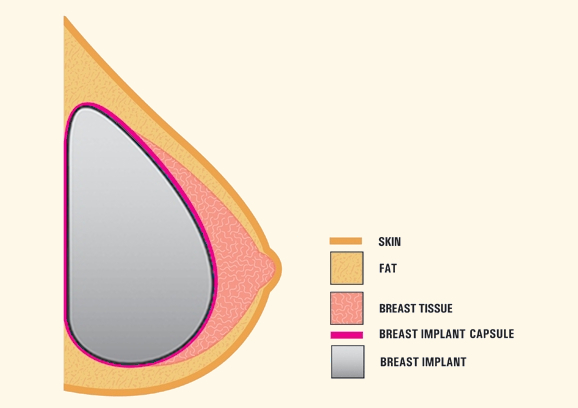
Whenever a breast implant is used for breast augmentation, your body makes an encapsulating sheet of scar that lines the breast implant’s pocket. This normally thin, soft scar is called the “capsule”, and it is incredibly important in maintaining your breasts’ enhancement.
Have you ever wondered how breast implants stay in place?
The capsule is responsible for keeping the breast implants in the proper position beneath the breasts. It forms in just a few weeks after breast augmentation surgery and keeps the breast implants from freely sliding around. Optimal breast implant position is a combination of careful placement during surgery and a proper capsule. The capsule will quickly line the surgical pocket and provide a smooth, strong interface between the breast implant and the soft tissues of the chest. By reinforcing the pocket, the capsule helps to maintain optimal breast implant placement.
The capsule protects the breast implant.
Not only does the capsule help keep the breast implant in position, it also protects the implant. The interior of the capsule is smooth and allows for nearly frictionless movement within its boundaries. The outer layers of the capsule provide enhanced vascular circulation and helps protect the breast implant from infection.
When good capsules go bad.
So what can go wrong with breast implant capsules? The perfect capsule is firm enough to maintain proper breast implant positioning, but soft enough to not be felt. Problems occur at the extremes, so like Goldilocks the capsule needs to be just right, not too hard and not too soft.
Too soft
When the Breast Implant Capsule is too soft, it does not provide enough support for the implant. Gravity pulls the implants down when standing or to the side when laying down. The larger the breast implants, the greater the force. Stomach sleeping also pushes the implants apart. A healthy capsule can resist the tendency toward Breast Implant Malposition, but a good bra helps too.
Treatment for implant malposition can include a capsulorrhaphy, to tighten the capsule, and close off the areas where the implant should not be going. If an overly large breast implant in compounding the problem, a smaller implant can help reduce recurrence. The use of an acellular dermal matrix (ADM) has also become more popular as a way to line, reinforce and thicken the capsule.
Too hard
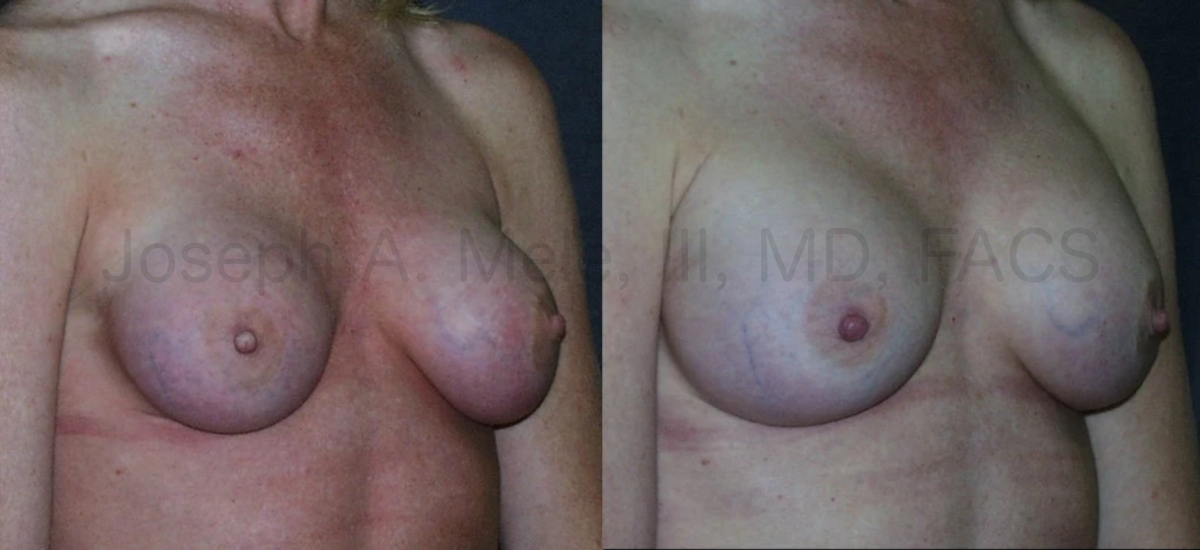
When the Breast Implant Capsule is too hard, it can compress the implants, and cause Capsular Contracture. Capsular contracture can also result in breast implant malposition. If the capsule is tight only on one side, it will push the breast implant toward the soft side. If the capsule is tight all the way around, it can make the implant feel hard.
Treatment for capsular contracture includes capsulectomy, removing the thickened capsule, and capsulotomy, incising the capsule to allow it to expand. Both these techniques are performed in the operating room. An older, non-operative technique called closed capsulotomy was a way to split the capsule without surgery by forcefully compressing the implant. This has been largely abandoned as it has less predictable results, may lead to uncontrolled bleeding or implant rupture, and violates most breast implant warranties.
Just Right
The most common types of capsules are grade I followed by grade II. Grade I capsules are soft on not detectable from the outside, Grade II capsules feel firmer, but are not tight enough to cause visual changes. Both usually provide adequate support to allow the breast to age naturally, securely on the chest. If you are considering breast augmentation, or you have breast implants and are considering breast implant revision surgery, give me a call at (925) 943-6353 or contact my Walnut Creek Plastic Surgery Office using the contact form in the left column.
Breast Augmentation remains one of the procedures that I perform most frequently. Whether you’ve always had small breast and want them larger, or you had larger breast and want them back, Breast Augmentation can help you achieve your goals.
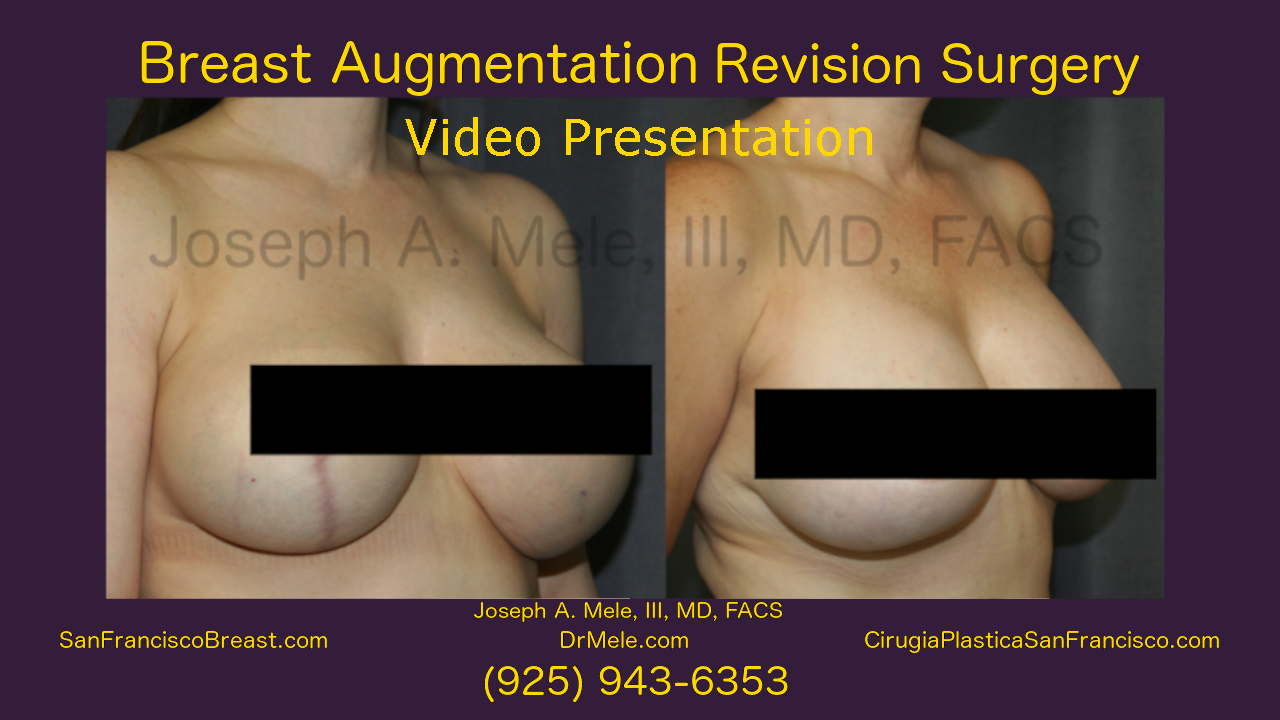
Breast Implant Revision Surgery is performed to improve the results of Breast Augmentation. While Breast Augmentation is both safe and effective, our bodies change as we age. Breasts naturally change size and shape over time, and this happens even after breast augmentation. Changes can certainly be exacerbate by pregnancy and changes in weight, but most of the time the changes are gradual and sneak-up on us.
What’s New in Breast Implants and Breast Augmentation?
If you are considering Breast Augmentation or Breast Implant Revision surgery, you should know that new breast implants are available and more are on the horizon. New techniques are also being developed to help make your Breast Enhancement simpler, safer, more predictable and easier overall. Be certain to seek a Board Certified Plastic Surgeon for all your Cosmetic Breast Surgery needs.
Below is part three of four of my Breast Implant Revision Video that appeared on KRON4′s Body Beautiful. Options in Breast Augmentation, Breast Implants and Breast Augmentation Maintenance are reviewed. The television show was broadcast live, so viewers could call in during the broadcast to have their questions answered. The (415) number shown in the video was only for the show; however, if you have Breast Augmentation or Breast Implant Revision questions, please call our San Francisco Bay Area Plastic Surgery Office directly at (925) 943-6353. If you prefer, you may also use the contact form on the left.
San Francisco Bay Area Breast Implant & Breast Augmentation Revision Video
San Francisco Bay Area Breast Implant Revision Questions
This Breast Augmentation, Breast Implant Revision Surgery video includes:
The Breast Implants currently available
Saline Breast Implants – Natrelle (Allergan) and Mentor (J&J)
Silicone Gel Breast Implants (Natrelle and Memory-Gel)
Soft-Solid Silicone Breast Implants (GummiBear Implants)
Natrelle 410′s*
Mentor Contour Profile Gel (CPG)*
*The 3 yr and 5 yr data for the 410′s and CPG breast implants surpasses that of the breast implants that are already approved in this country. Why are they not approved? Only your FDA knows for sure.
Breast implant deflation
What are the signs and symptoms associated with a leaking breast implant?
How to check for a breast implant leak
How long do Breast implants last?
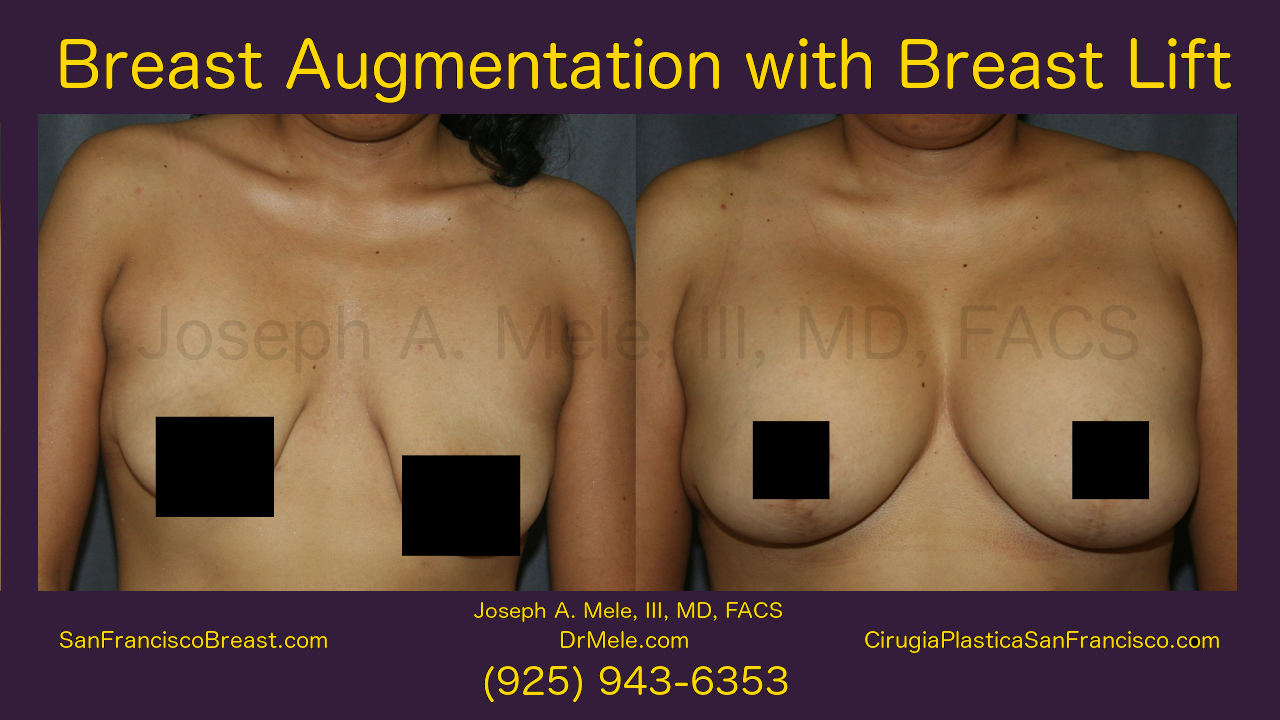
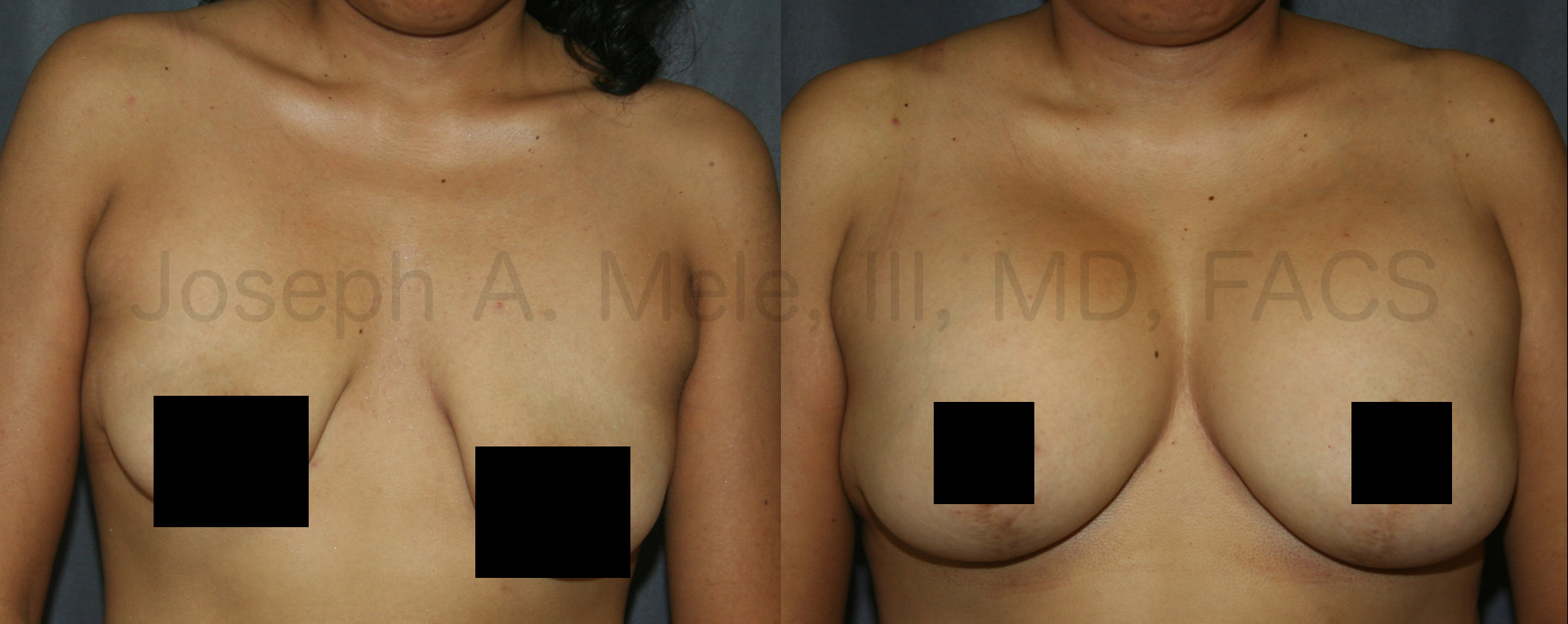
How are breast augmentation and breast lifts combined?
Breast Augmentation and Breast Implants Revision Resources
You are viewing number three of four Breast Implants Revision Video segments from Dr. Mele’s recent Body Beautiful television appearance. Here are links to the other segments:
Tubular breast deformity is a common, congenital breast abnormality found in both women and men. In men, the treatment is straight forward (see the bottom of this article). In women, however, additional aesthetic norms come into play, making the repair more complex.
Tubular Breast Deformity in Women
Tubular breast deformity is known by many names:
Tubular breast deformity
Tuberous breast deformity
Snoopy Nose or Snoopy’s Nose deformity
Constricted breast deformity
Women with mild constriction often come to see me to simply increase the size of their breast, not aware of the diagnosis. Women with more severe deformity, however, are often reluctant to show their breasts to others, and want to improve the size and the shape of their breasts. Correcting these types of problems is more challenging, but at the same time, quite rewarding.
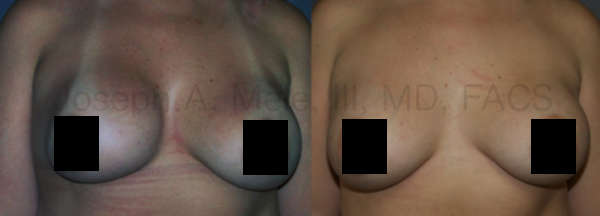
Mild tubular breast deformity with constricted base was corrected with sub-pectoral breast augmentation (behind the muscle) and internal release (no lift needed)
Tubular Breast Abnormality is a Congenital Breast Deformity
While present at birth, the full extent of the tubular breast deformity is often not appreciated until puberty. This is when the breasts normally develop, and the full extend of abnormalities are revealed. While women with tubular breasts have smaller than average sized breasts, not all small breasts are tubular breasts. While the extent to which the deformities manifest can vary widely, several specific abnormalities are present.
Signs and Presentation of Tubular Breast Abnormality
Besides smaller size, the main components of the tubular breast are a constricted base and a tubular shape to the breast. This can be exacerbated by herniation of the breast tissue into the areola, causing “puffy nipples”. Technically, the nipple is not affected, but the areola, the colored skin around the nipple, may project out from the breast mound. The overall effect is an elongated or tubular shape to the breast. The true tubular shape is most noticeable in more severe cases.
The colloquial name for tuberous breasts is the Snoopy Nose or Snoopy’s Nose deformity. Snoopy is Charlie Brown’s white beagle of Peanuts fame. Picture the front of Snoopy’s muzzle. If you are not familiar with Snoopy click the link above. His white face represents the breast mound, his black nose sits like a ball on the end, and represents the herniated breast tissue filling the areola.
Treatment of the Tuberous Breasts
As mentioned above, tubular breasts tend to not fully develop. Often patients with tubular breasts desire breast augmentation to increase the size of their breasts. For mild tubular breast deformity, a breast implant may be sufficient treatment. When the breasts are more tubular, additional maneuvers are necessary to provide an enhanced result.
If the areola is overly full, a periareolar lift can reduce the puffy nipples, and prevent the breast tissue from herniating. Unlike for men, the breast tissue is not usually removed, just pushed back into its normal anatomical position. The constricted base seen with tuberous breasts also tends to shorten the distance between the areola and the base of the breast. The lift has the additional benefit of moving the areola higher on the breast, helping to center the nipple on the breast mound.
Moderate tubular breast deformity with constricted base, elongated breast and mild areolar breast tissue herniation, best seen in right breast (your left). Both size and shape were corrected with breast augmentation and peri-areolar lifts.
Traditionally, tubular breast were treated with breast implants placed in front of the muscle. With a periareolar lift, it usually possible to place the implant behind the muscle. This gives a more natural appearing breast mound, and makes it easier to perform mammography in the future. While silicone and saline breast implants can both give good looking results, for smaller breast, a silicone gel implant may give a better feeling result. It is important to discuss the pro’s and con’s of each option with your Board Certified Plastic Surgeon.
Tubular Breast Deformity in Men
In men, tubular breast deformity presents as an overly full areola or “puffy nipples”. Since men like flat chests, tuberous breasts are easily treated in with resection of the excess tissue. The procedure is similar to that used for Gynecomastia. A small “smiley-face” incision is made from 4 to 8 o’clock around the lower edge of the areola, and the excess glandular tissue is removed. The procedure provides a smoother contour, and a quick recovery.
If you were peaking ahead, the preview screen on the video shows a side-by-side comparison of before and after pictures for breast reduction (reduction mammoplasty). I perform many different aesthetic breast enhancement surgeries. Sometimes reducing the volume and lifting the breasts is the best course of action. For patients with large breast and symptoms like lower neck and upper back pain, shoulder rutting from the bra straps and even recurrent rashes beneath the breasts, breast reduction surgery can provide an improved quality of life. It goes beyond being able to find clothes (and bras) that fit, but my patients are happy about that too.
Breast Reduction, Breast Augmentation and Breast Implant Revision Before and After Pictures
The 800 number in the video was used as part of the live show to allow viewers to have their questions answered by me, live, during the original broadcast. If you have questions, or would like to schedule a consultation appointment, please call (925) 943-6353, or use the contact form on the left side of this page.
Bay Area Breast Implants – Part 2 or 4
This cosmetic breast enhancement video includes information about:
Cosmetic breast enhancement including before and after pictures
I cannot emphasize this enough. If you are considering breast augmentation, be certain to review the benefits, and the risks, with a qualified Board Certified Plastic Surgeon, like myself. This is an important part of any breast augmentation consultation appointment. This is equally important if you have developed problems with your breast implants. A consultation with a Board Certified Plastic Surgeon is the best first step toward finding relief.
Additional Information on Cosmetic Breast Enhancement
Dr. Joseph Mele appears on KRON4's Body Beautiful.
To celebrate the debut of the new San Francisco Breast dot com (SanFranciscoBreast.com), a site dedicated to cosmetic breast surgery for the San Francisco Bay Area, I will be dedicating my appearance on Monday’s Body Beautiful on KRON4 to the breast. Breast augmentation, breast lifts, breast reductions, breast implant revisions, everything related to enhancing the breasts is open for discussion.
Body Beautiful is broadcast live at 11:00 AM on KRON4, so tune in and phone in with your breast questions. Whether you have had breast surgery, or are considering it, the show will cover a variety of topics. For a preview of what’s in store visit SanFranciscoBreast.com.
What’s new in Breast Enhancement Surgery?
The new web site is a comprehensive and authoritative review of the latest techniques in aesthetic breast surgery. Located in the San Francisco East Bay Area city of Walnut Creek, Plastic Surgeon, Joseph Mele, has lent his years of experience, and breast expertise, to this free patient education resource. The site is illustrated with graphics, videos and before and after pictures, and there is more to come. The list of topics covered is long and includes:
I look forward to hearing from you on Monday. If you will not be able to watch KRON4 at 11 AM on Monday, December 13, 2010, and you have a question you want answered, you can send your question via the contact form to the left. I will send you a personal response, and perhaps your question will be answered live during Body Beautiful.
San Francisco plastic surgery patients have an extensive new local resource encompassing all aspects of cosmetic breast enhancement surgery. I have consolidated my years of experience, and the common questions that my patients ask, to create a site that is both informative and understandable. If you are considering cosmetic breast surgery, SanFranciscoBreast.com is a comprehensive collection of consumer information.
The web site is illustrated with videos and before and after pictures. The list of topics covered is long and includes:
SanFranciscoBreast.com is a specialty site dedicated to all aspects cosmetic breast surgery. Since the site is focused only on the breast, it gives me the opportunity to describe each procedure in detail, and to provide you with specific information to help you make an informed decision.
Radiant Life – RLM Success Files features breast augmentation by Dr. Joseph A. Mele.
As seen in Radiant Life Magazine. (Click to enlarge.)
Radiant Life® Magazine is The Aesthetic Wellness Magazine, and is dedicated to innovations in cosmetic plastic surgery. The current issue of Radiant Life® features an article by Lindsay Haakenson on the latest innovations in Breast Augmentation entitled Breast Surgery 2.0.
Radiant Life Magazine approached me with a short deadline and the need for an example of modern breast augmentation. My staff contacted a few of our many satisfied patients. Jennifer was the first to respond, and she immediately agreed to both an interview with Radiant Life Magazine and the use of her pictures, and for that she gets my sincere thanks. This is a true testimonial* to how worthwhile breast augmentation surgery has been for her. Thanks goes out to my other happy patients who also graciously responded, and to Lindsay Haakenson for including me.
Jennifer first came into the office for a consultation after noticing her breast volume had decreased after pregnancy. She was interested in restoring what mother nature had both given and then taken away. She expressed a desire to maintain proportions with her body, and wanted a natural look that would be attractive, without being distracting.
The excerpt to the right is from the Breast Surgery 2.0. At the top are her breast augmentation before and after pictures. Before submuscular (subpectoral) breast augmentation, her breasts where asymmetrical, small, had a relatively low set nipple and a constricted base. The distance between the nipple and the inframammary fold was short, and the remaining breast tissue was firm. She had a mild form of what is sometimes referred to as a tubular breast.
The simplest way to correct a tubular breast is with a subglandular breast augmentation. Often a periareolar mastopexy is performed to lift and reshape a protruding nipple/areolar complex at the same time. Okay, that may not sound so simple, and in Jennifer’s case, the easiest way was not necessarily the best way.
Every patient requires careful thought and consideration. In Jennifer’s case, the tubular deformity was mild, and a periareolar breast lift was not needed. The lack of breast tissue higher on the chest meant that the upper pole of the implant was more likely to be seen. A saline implant was placed behind the muscle to help soften the upper pole of the implant, and to give a more teardrop shape. A periareolar incision was used, and this, as is usual, healed very well.
For a more pronounced tubular breast deformity, this approach may not work. Unlike the approach using a periareolar lift, it will not correct a bulging areola that is often seen in concert with the narrow constricted breast base. If you are considering breast augmentation, it is important to seek a qualified and experienced, board certified plastic surgeon, so that the safest and most predictable plan can be constructed.
I want to thank Jennifer for volunteering to share her results with you. The best part of my job is helping my patients. I am thrilled that Jennifer is happy with the results of her breast augmentation.
* As per the latest American Society of Plastic Surgeons Code of Ethics this is a true testimonial. I have not reimbursed my patient in any way for her kind words, and I have not paid Radiant Life Magazine to be included in this article. To read the entire Radiant Life Magazine article, click here. You need to be able to view pdf files in order to display the contents properly. To download the latest version of Adobe Reader for free click here.
Breast Augmentation Revision Surgery, has become a specialty unto itself. While most women will never require breast augmentation revision, a large minority will. The exact number is difficult to pin down; however, studies have indicated that in the ten years after breast augmentation, as many as 25%, will undergo a second breast augmentation related surgery.
Many times there is no complication, and the primary motivation for breast augmentation revision surgery is to change the size of the implants. Perhaps the most common breast implant revision surgery is to replace breast implants with a larger pair. This is the reason I place so much emphasis on defining the goal size for breast augmentation before surgery. Even so, minds and goals can change with time.
Other times breast implant revision surgery is less volitional, and may be due to gravity (requiring a breast lift), breast implant failure (breast implant deflation or breast implant rupture) or capsular contracture (tightening of the nature scar that surrounds the implant causing movement or firmness of the breast implants).
Other videos on this subject have been posted on the San Francisco Plastic Surgery Blog and they can be viewed here (see bottom of article for links) or on my YouTube channel. When you are watching this video, please note, the 800 number on the video was for the live show, to contact my office for additional information or to schedule a private consultation appointment, call (925) 943-6353.
On this episode of KRON’s Body Beautiful you can learn:
What are the main reasons for Breast Augmentation Revision surgery
Do breast implants wear out?
What is the capsule around the breast implants?
What is Capsular Contracture?
How long is the Breast Implant Warranty?
How many Breast Augmentations are performed each year?
How is Breast Implant Revision Surgery performed?
What is the recovery like after Breast Augmentation Revision?
Breast Augmentation Revision Surgery requires a careful analysis of the existing problem, a thoughtful discussion about the good (and bad) aspects of all available treatments, the ability to adapt the plan to any new findings found during surgery, and a careful recovery, to speed you return to daily life. The first step is a private consultation with a Board Certified Plastic Surgeon.
Walnut Creek Plastic Surgeon (San Francisco Bay Area, East Bay) Joseph A. Mele, III, MD, FACS, will be appearing on KRON channel 4′s, Body Beautiful this Monday, September 14, 2009, at 11:00 AM.
KRON4′s Body Beautiful, is a weekly news show hosted by News Anchor Vivki Liviakis. It originates right here in San Francisco and is know through out the Bay Area for its coverage of the lastest trends in cosmetic plastic surgery.
This week’s topic will be breast augmentation, specifically breast implant revision surgery. Information about breast augmentation and the most common reasons for breast implant revision will be presented. Topics will include, choosing the best breast implant size, breast implant deflation, capsular contracture, dealing with breast asymmetry, and how to decrease your risk of needing breast augmentation revision surgery.
If you have questions that you would like me to answer on air, please send them via the contact form on this page. Please do mention that you would like me to answer your question on Body Beautiful, otherwise all inquiries are kept confidential. Alternatively, you can send your questions directly to KRON4 via the Body Beautiful web page. You can also phone into the studio while we are on the air, and get your questions answered live.
Previous shows discussing breast augmentation, tummy tucks, liposuction, eyelids surgery and many other cosmetic plastic surgery procedures can be found on my website in the DrMele.com Video Gallery
A unique aspect of Body Beautiful is it live broadcast live. Broadcasting live allows for more a more dynamic and interactive presentation. A segment of the show will be dedicated to viewer questions. So be sure to call in.
Breast asymmetry is more the rule than the exception, and there are many ways in which breasts can be uneven. Size, shape and location all come into play. Asymmetry may effect the entire breast mound (see previous post) or just the nipples. Normally, the differences are small; however, as the magnitude of breast asymmetry increases, so does the desire for correction.
In my San Francisco Bay Area (Walnut Creek) cosmetic plastic surgery practice, I measure the differences between the breasts both subjectively and objectively every day. Small differences frequently go unnoticed. Often, asymmetry is first noted in the consultation for breast augmentation. When the difference is obvious, however, breast asymmetry can be the driving force toward seeking consultation with a Board Certified Plastic Surgeon.
This post is focussed primarily on areola asymmetry (the darker skin around the nipple) and nipple asymmetry (the raised part in the middle). Look for a post on breast asymmetry (the breast mound itself), including breast implant asymmetry, in the very near future.
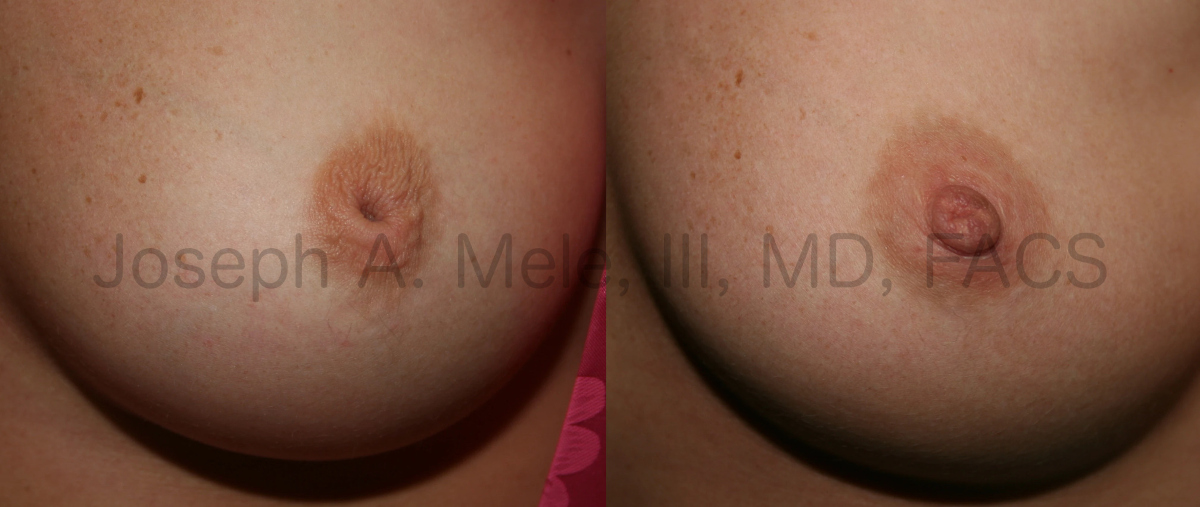
One of the most common nipple asymmetries is caused by inversion (retraction) of the nipples. Inverted nipples can occur on one or both sides. Inverted nipples and even bifid (split or duplicated) nipples can be treated with minor surgery.
Before correction the nipple and part of the areola are hidden.
Inverted nipples are caused by short mammary ducts that pull the nipple inside the breast tissue. In the most pronounced forms even the areola maybe hidden. The scar for inverted nipple correction is normally hidden in the fold beneath the nipple. Since correction involves releasing the tight ducts, correction may interfere with the ability to breast feed, and this should be discussed with your plastic surgeon prior to surgery.
After correction the relatively large nipple can now be seen.
The size and shape of the nipple can also be adjusted.
Close-up of breast showing appearance of nipple enlargement after pregnancy.
Overly large nipples can be reduced in length and girth. In general, it is easier to reduce a large nipple than to enlarge a small one. Nipple reconstruction is performed after a mastectomy when the nipple is absent. With nipple reconstruction, especially when the breast has received radiation, the most difficult aspect is creating and maintaining nipple projection.
Close-up of breast showing appearance of nipple after nipple reduction.
There are times when the nipples are normally formed, but their location on the breast is asymmetric or they are just too low. Modest changes in nipple location can be improved with a periareolar approach. Several centimeters of motion can be safely accomplished with this method. The same periareolar technique can also be used for areolar reduction or to correct the overly full areola, as seen with a tubular breast deformity.
Larger asymmetries may require surgery similar to a breast lift. Formal breast lifts allow the larger movement of the nipples, and reshaping of the entire breast mound. See the previous San Francisco Plastic Surgery Blog posting by clicking here Breast Mound Asymmetry San Francisco: Breast Mound, Breast Implants. There are many types of lifts, and each has its own pros and cons. The art of Plastic Surgery is choosing the best approach for each individual San Francisco breast asymmetry patient. This will be the topic of a future posting.