February 16th, 2011 Dr. Mele
Tubular breast deformity is a common, congenital breast abnormality found in both women and men. In men, the treatment is straight forward (see the bottom of this article). In women, however, additional aesthetic norms come into play, making the repair more complex.
Tubular Breast Deformity in Women
Tubular breast deformity is known by many names:
- Tubular breast deformity
- Tuberous breast deformity
- Snoopy Nose or Snoopy’s Nose deformity
- Constricted breast deformity
Women with mild constriction often come to see me to simply increase the size of their breast, not aware of the diagnosis. Women with more severe deformity, however, are often reluctant to show their breasts to others, and want to improve the size and the shape of their breasts. Correcting these types of problems is more challenging, but at the same time, quite rewarding.

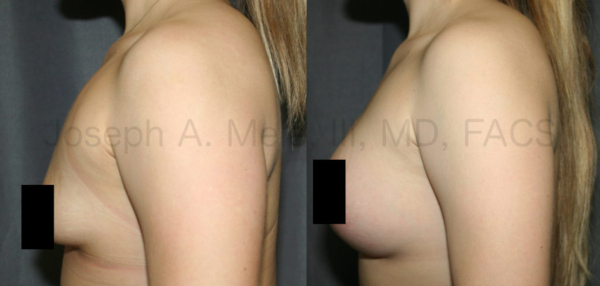
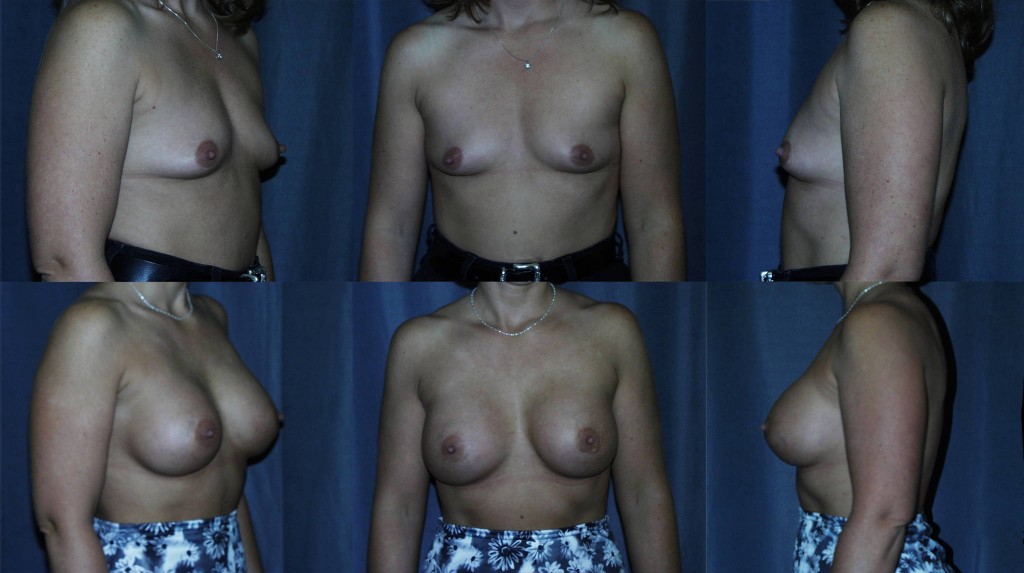
Mild tubular breast deformity with constricted base was corrected with sub-pectoral breast augmentation (behind the muscle) and internal release (no lift needed)
Tubular Breast Abnormality is a Congenital Breast Deformity
While present at birth, the full extent of the tubular breast deformity is often not appreciated until puberty. This is when the breasts normally develop, and the full extend of abnormalities are revealed. While women with tubular breasts have smaller than average sized breasts, not all small breasts are tubular breasts. While the extent to which the deformities manifest can vary widely, several specific abnormalities are present.
Signs and Presentation of Tubular Breast Abnormality
Besides smaller size, the main components of the tubular breast are a constricted base and a tubular shape to the breast. This can be exacerbated by herniation of the breast tissue into the areola, causing “puffy nipples”. Technically, the nipple is not affected, but the areola, the colored skin around the nipple, may project out from the breast mound. The overall effect is an elongated or tubular shape to the breast. The true tubular shape is most noticeable in more severe cases.
The colloquial name for tuberous breasts is the Snoopy Nose or Snoopy’s Nose deformity. Snoopy is Charlie Brown’s white beagle of Peanuts fame. Picture the front of Snoopy’s muzzle. If you are not familiar with Snoopy click the link above. His white face represents the breast mound, his black nose sits like a ball on the end, and represents the herniated breast tissue filling the areola.
Treatment of the Tuberous Breasts
As mentioned above, tubular breasts tend to not fully develop. Often patients with tubular breasts desire breast augmentation to increase the size of their breasts. For mild tubular breast deformity, a breast implant may be sufficient treatment. When the breasts are more tubular, additional maneuvers are necessary to provide an enhanced result.
If the areola is overly full, a periareolar lift can reduce the puffy nipples, and prevent the breast tissue from herniating. Unlike for men, the breast tissue is not usually removed, just pushed back into its normal anatomical position. The constricted base seen with tuberous breasts also tends to shorten the distance between the areola and the base of the breast. The lift has the additional benefit of moving the areola higher on the breast, helping to center the nipple on the breast mound.

Moderate tubular breast deformity with constricted base, elongated breast and mild areolar breast tissue herniation, best seen in right breast (your left). Both size and shape were corrected with breast augmentation and peri-areolar lifts.
Traditionally, tubular breast were treated with breast implants placed in front of the muscle. With a periareolar lift, it usually possible to place the implant behind the muscle. This gives a more natural appearing breast mound, and makes it easier to perform mammography in the future. While silicone and saline breast implants can both give good looking results, for smaller breast, a silicone gel implant may give a better feeling result. It is important to discuss the pro’s and con’s of each option with your Board Certified Plastic Surgeon.
Tubular Breast Deformity in Men
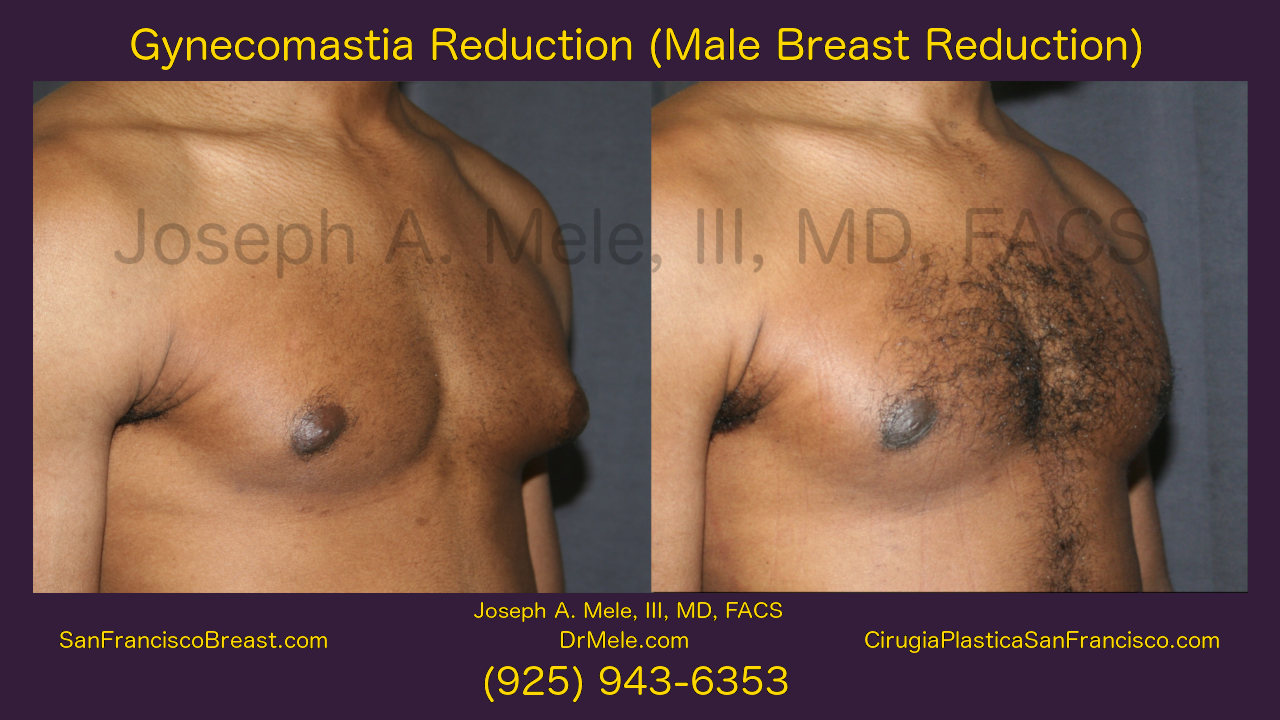
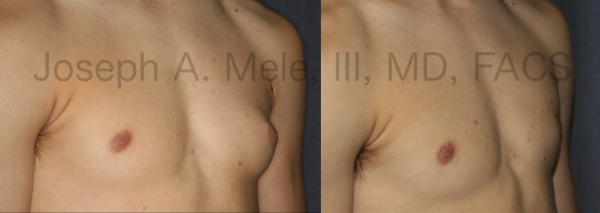
In men, tubular breast deformity presents as an overly full areola or “puffy nipples”. Since men like flat chests, tuberous breasts are easily treated in with resection of the excess tissue. The procedure is similar to that used for Gynecomastia. A small “smiley-face” incision is made from 4 to 8 o’clock around the lower edge of the areola, and the excess glandular tissue is removed. The procedure provides a smoother contour, and a quick recovery.
Information on Tubular Breasts
More information on tubular breasts is available on the breast abnormalities page of my specialty breast site under Congenital Abnormalities – Tuberous or Tubular Breasts, and the Snoopy Nose Deformity. Tubular Breast Augmentation Before and After Pictures are also available in my main web site. The best information, however, is only available in person. If you would like to schedule a consultation appointment in my Walnut Creek Cosmetic Surgery office, please give me a call at (925) 943-6353, or use the contact form in the column to the left.
Posted in Areolar Reduction, Breast Asymmetry, Breast Augmentation, Breast Lift (Mastopexy), Tubular Breasts | No Comments »
November 25th, 2010 Dr. Mele
San Francisco plastic surgery patients have an extensive new local resource encompassing all aspects of cosmetic breast enhancement surgery. I have consolidated my years of experience, and the common questions that my patients ask, to create a site that is both informative and understandable. If you are considering cosmetic breast surgery, SanFranciscoBreast.com is a comprehensive collection of consumer information.
The web site is illustrated with videos and before and after pictures. The list of topics covered is long and includes:
-
Breast Augmentation
-
Breast Augmentation Lift
-
Breast Augmentation Revision
-
Breast Lift
-
Breast Reduction
-
Gynecomastia Reduction – Breast Reduction for Men
-
Specialty Breast Procedures – Correction of Other Breast Abnormalities
SanFranciscoBreast.com is a specialty site dedicated to all aspects cosmetic breast surgery. Since the site is focused only on the breast, it gives me the opportunity to describe each procedure in detail, and to provide you with specific information to help you make an informed decision.
Posted in About Dr. Mele, Breast Asymmetry, Breast Augmentation, Breast Implant Options, Breast Implant Revision Surgery, Breast Lift (Mastopexy), Breast Reduction, Breast Reduction (Men), Breast Reduction (Women), Capsular Contracture, Inverted Nipples, Nipple Reduction, Tubular Breasts | No Comments »
February 21st, 2010 Dr. Mele

Radiant Life – RLM Success Files features breast augmentation by Dr. Joseph A. Mele.
As seen in Radiant Life Magazine.
(Click to enlarge.)
Radiant Life® Magazine is The Aesthetic Wellness Magazine, and is dedicated to innovations in cosmetic plastic surgery. The current issue of Radiant Life® features an article by Lindsay Haakenson on the latest innovations in Breast Augmentation entitled Breast Surgery 2.0.
Radiant Life Magazine approached me with a short deadline and the need for an example of modern breast augmentation. My staff contacted a few of our many satisfied patients. Jennifer was the first to respond, and she immediately agreed to both an interview with Radiant Life Magazine and the use of her pictures, and for that she gets my sincere thanks. This is a true testimonial* to how worthwhile breast augmentation surgery has been for her. Thanks goes out to my other happy patients who also graciously responded, and to Lindsay Haakenson for including me.
Jennifer first came into the office for a consultation after noticing her breast volume had decreased after pregnancy. She was interested in restoring what mother nature had both given and then taken away. She expressed a desire to maintain proportions with her body, and wanted a natural look that would be attractive, without being distracting.
The excerpt to the right is from the Breast Surgery 2.0. At the top are her breast augmentation before and after pictures. Before submuscular (subpectoral) breast augmentation, her breasts where asymmetrical, small, had a relatively low set nipple and a constricted base. The distance between the nipple and the inframammary fold was short, and the remaining breast tissue was firm. She had a mild form of what is sometimes referred to as a tubular breast.
The simplest way to correct a tubular breast is with a subglandular breast augmentation. Often a periareolar mastopexy is performed to lift and reshape a protruding nipple/areolar complex at the same time. Okay, that may not sound so simple, and in Jennifer’s case, the easiest way was not necessarily the best way.
Every patient requires careful thought and consideration. In Jennifer’s case, the tubular deformity was mild, and a periareolar breast lift was not needed. The lack of breast tissue higher on the chest meant that the upper pole of the implant was more likely to be seen. A saline implant was placed behind the muscle to help soften the upper pole of the implant, and to give a more teardrop shape. A periareolar incision was used, and this, as is usual, healed very well.
For a more pronounced tubular breast deformity, this approach may not work. Unlike the approach using a periareolar lift, it will not correct a bulging areola that is often seen in concert with the narrow constricted breast base. If you are considering breast augmentation, it is important to seek a qualified and experienced, board certified plastic surgeon, so that the safest and most predictable plan can be constructed.
I want to thank Jennifer for volunteering to share her results with you. The best part of my job is helping my patients. I am thrilled that Jennifer is happy with the results of her breast augmentation.
* As per the latest American Society of Plastic Surgeons Code of Ethics this is a true testimonial. I have not reimbursed my patient in any way for her kind words, and I have not paid Radiant Life Magazine to be included in this article. To read the entire Radiant Life Magazine article, click here. You need to be able to view pdf files in order to display the contents properly. To download the latest version of Adobe Reader for free click here.
Posted in Breast Asymmetry, Breast Augmentation, Home, Tubular Breasts | 2 Comments »
September 11th, 2009 Dr. Mele
Walnut Creek Plastic Surgeon (San Francisco Bay Area, East Bay) Joseph A. Mele, III, MD, FACS, will be appearing on KRON channel 4′s, Body Beautiful this Monday, September 14, 2009, at 11:00 AM.
KRON4′s Body Beautiful, is a weekly news show hosted by News Anchor Vivki Liviakis. It originates right here in San Francisco and is know through out the Bay Area for its coverage of the lastest trends in cosmetic plastic surgery.
This week’s topic will be breast augmentation, specifically breast implant revision surgery. Information about breast augmentation and the most common reasons for breast implant revision will be presented. Topics will include, choosing the best breast implant size, breast implant deflation, capsular contracture, dealing with breast asymmetry, and how to decrease your risk of needing breast augmentation revision surgery.
If you have questions that you would like me to answer on air, please send them via the contact form on this page. Please do mention that you would like me to answer your question on Body Beautiful, otherwise all inquiries are kept confidential. Alternatively, you can send your questions directly to KRON4 via the Body Beautiful web page. You can also phone into the studio while we are on the air, and get your questions answered live.
Previous shows discussing breast augmentation, tummy tucks, liposuction, eyelids surgery and many other cosmetic plastic surgery procedures can be found on my website in the DrMele.com Video Gallery
A unique aspect of Body Beautiful is it live broadcast live. Broadcasting live allows for more a more dynamic and interactive presentation. A segment of the show will be dedicated to viewer questions. So be sure to call in.
Posted in Breast Asymmetry, Breast Augmentation, Breast Implant Revision Surgery, Breast Lift (Mastopexy), Capsular Contracture, Home, Tubular Breasts | No Comments »
August 24th, 2009 Dr. Mele
Breast asymmetry is more the rule than the exception, and there are many ways in which breasts can be uneven. Size, shape and location all come into play. Asymmetry may effect the entire breast mound (see previous post) or just the nipples. Normally, the differences are small; however, as the magnitude of breast asymmetry increases, so does the desire for correction.
In my San Francisco Bay Area (Walnut Creek) cosmetic plastic surgery practice, I measure the differences between the breasts both subjectively and objectively every day. Small differences frequently go unnoticed. Often, asymmetry is first noted in the consultation for breast augmentation. When the difference is obvious, however, breast asymmetry can be the driving force toward seeking consultation with a Board Certified Plastic Surgeon.
This post is focussed primarily on areola asymmetry (the darker skin around the nipple) and nipple asymmetry (the raised part in the middle). Look for a post on breast asymmetry (the breast mound itself), including breast implant asymmetry, in the very near future.
One of the most common nipple asymmetries is caused by inversion (retraction) of the nipples. Inverted nipples can occur on one or both sides. Inverted nipples and even bifid (split or duplicated) nipples can be treated with minor surgery.

Before correction the nipple and part of the areola are hidden.
Inverted nipples are caused by short mammary ducts that pull the nipple inside the breast tissue. In the most pronounced forms even the areola maybe hidden. The scar for inverted nipple correction is normally hidden in the fold beneath the nipple. Since correction involves releasing the tight ducts, correction may interfere with the ability to breast feed, and this should be discussed with your plastic surgeon prior to surgery.

After correction the relatively large nipple can now be seen.
The size and shape of the nipple can also be adjusted.

Close-up of breast showing appearance of nipple enlargement after pregnancy.
Overly large nipples can be reduced in length and girth. In general, it is easier to reduce a large nipple than to enlarge a small one. Nipple reconstruction is performed after a mastectomy when the nipple is absent. With nipple reconstruction, especially when the breast has received radiation, the most difficult aspect is creating and maintaining nipple projection.

Close-up of breast showing appearance of nipple after nipple reduction.
There are times when the nipples are normally formed, but their location on the breast is asymmetric or they are just too low. Modest changes in nipple location can be improved with a periareolar approach. Several centimeters of motion can be safely accomplished with this method. The same periareolar technique can also be used for areolar reduction or to correct the overly full areola, as seen with a tubular breast deformity.
Larger asymmetries may require surgery similar to a breast lift. Formal breast lifts allow the larger movement of the nipples, and reshaping of the entire breast mound. See the previous San Francisco Plastic Surgery Blog posting by clicking here Breast Mound Asymmetry San Francisco: Breast Mound, Breast Implants. There are many types of lifts, and each has its own pros and cons. The art of Plastic Surgery is choosing the best approach for each individual San Francisco breast asymmetry patient. This will be the topic of a future posting.
Posted in Areolar Reduction, Breast Asymmetry, Breast Augmentation, Breast Implant Revision Surgery, Breast Lift (Mastopexy), Home, Inverted Nipples, Nipple Reduction, Tubular Breasts | No Comments »
August 16th, 2009 Dr. Mele
There are many ways in which breasts can be uneven. Size, shape and location are the most common. There can be asymmetry of the nipples as discussed in Breast Asymmetry San Francisco: Inverted Nipples and Asymmetry, or asymmetry of the breast mounds themselves discussed here. If the differences are small, everything appears normal; however, as the magnitude of asymmetry increases, so does the desire for correction.
There are times when the nipples are normally formed, but their location on the breast is asymmetric or low. This post will discuss breast mound asymmetry, including breast implant asymmetry and nipple location.
Modest changes in nipple location can be improved with a periareolar approach. In these cases an incision is made around the areola and differing amounts of skin are removed to move the nipple and areola in the desired direction. Several centimeters of motion can be safely accomplished with this method.
The same periareolar technique can also be used for areolar reduction. When the areola is too large, it be reduced to better match the proportions of the breast. The periareolar technique can also correct the overly full areola, as seen with a tubular breast deformity.
Larger asymmetries, require greater movement of nipple areola, and are accomplished with surgery similar to a breast lift.

Before breast augmentation and formal breast lift. Note the asymmetries. On left side (patient's right) both the breast mound and the nipple areola complex are larger and lower.
Formal breast lifts are also know as inferior pedicle breast lifts, inverted-T breast breast lifts or anchor scar breast lifts. This is the most versatile of the breast lift and allows for the largest movement of the areola and nipples, as well as reshaping of the entire breast mound. Larger corrections are possible with preservation nipple sensation and circulation.

After breast augmentation and an "inverted-T" breast lift. The periareolar and vertical components of the scar can be seen. The horizontal scar is hidden in the inframammary fold.
In this case a breast augmentation was used to adjust the breast volume; at other times a breast reduction is more appropriate. As previously dicussed, breast implant revision surgery may also be indicated for breast implant asymmetry from capsular contracture.
There are many types of breast lifts and each has its pro’s and con’s. The art of Plastic Surgery is choosing the best approach for each individual San Francisco breast asymmetry patient. I call this, using the smallest hammer necessary to get the job done. While bigger lifts leave a longer scar, choosing too small a lift still leaves a scar but it does not correct the original problem.
Posted in Areolar Reduction, Breast Asymmetry, Breast Augmentation, Breast Implant Revision Surgery, Breast Lift (Mastopexy), Home, Tubular Breasts | No Comments »