As summer winds down, seasonal cosmetic concerns shift from body to face, so today, we will review the Facelift. You will have answers to the Top Ten Frequently Asked Questions about Facelifts. I’ll let you know what the procedure fixes, expected results and recovery time.
Top Ten Facelift Questions and Answers
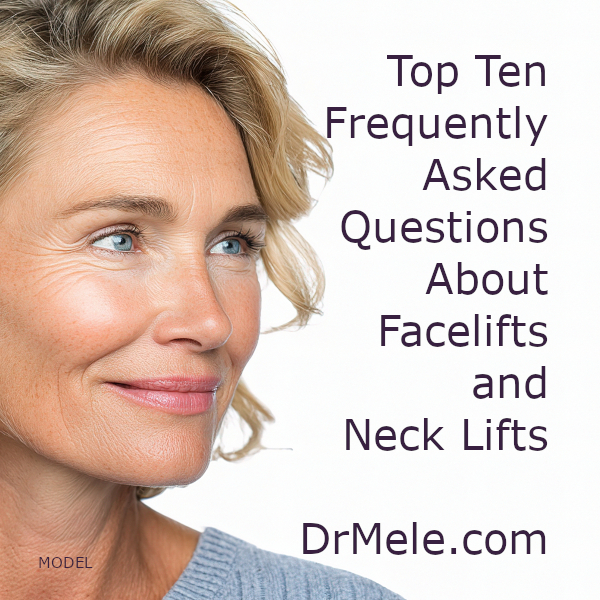
Top 10 FAQs for Facelifts and Neck Lifts.
1 – What Does a Facelift/Neck Lift Fix?
Also known as a Rhytidectomy, the Facelift provides correction for sagging lower facial skin, prominent jowls and loose soft tissue of the neck. Although Rhytidectomy literally means wrinkle removal, a Facelift does not treat fine lines or surface wrinkles, often found around the mouth. These superficial lines may respond better to surface treatments, like chemical peels, laser treatments or dermabrasion.
2 – How Long Will My Facelift Last?
Rhytidectomy results typically last 10 to 15 years, though natural aging and gravity continue over time. Good health, habits and genetics will prolong the results. Non-smokers, who have been good about avoiding prolonged sun exposure in good health make good candidates. If you do smoke, a minimum of four weeks without smoking before and after surgery, reduces your risks of complications by a factor of six.
3 – What is a Rhytidectomy and Mini-Rhytidectomy?
A Rhytidectomy is another word for Facelift/Neck Lift. It includes lifting the cheeks and jowls, tightening the jawline and lifting the skin of the neck. Separate procedures can be added to balance the forehead’s appearance and improve the eyelids if indicated, to maintain facial harmony.
A Mini Rhytidectomy is a Mini Facelift. It focuses on minor lower facial sagging with shorter scars. It provides benefit to the jawline and jowls, but is not as effective in improving neck skin laxity. A Mini Rhytidectomy is more superficial, while a Full Facelift also addresses deeper structures across the lower face and neck.
4 – Will I Look Unnatural or “Pulled” After my Facelift?
Modern Facelift Techniques focus on lifting deeper muscle layers rather solely than pulling the skin. This helps prevent a tight or fake appearance that can occur when the skin, exclusively, is used to provide all the tightening.
The first few weeks, you may appear over-tightened, due to normal postoperative swelling. As the swelling decreases, the tension on the skin relaxes and the natural contours return.
5 – What is the Recovery Time for a Neck Lift?
Initial swelling and bruising subside within two to four weeks after a Rhytidectomy. This is when most people feel ready to return to normal social activities. Individual results will vary. Giving yourself adequate time for recovery reduces stress and makes the experience more enjoyable.
Avoiding medications that promote bleeding, like aspirin, ibuprofen and many herbal preparations can reduce bruising and promote early healing. Smoking cessation also speeds recovery, and if you can quit for your facelift, you can quit forever. Your face will thank you.
6 – Where are the Facelift Scars Located?
Facelift Incisions are hidden within the hairline, around the natural contours of the ears and when needed under the chin. Initially, the scars are more visible, but normally fade with time. Sun avoidance, scar creams and good hydration all help the scars to fade quickly.
7 – Am I a Good Candidate for a Rhytidectomy?
Good candidates for Facelifts are non-smokers in general good health with realistic expectations about their outcome. Smokers have six times the risk of wound healing problems, so stopping around the time of surgery is a must.
If you have other medical problems, they must be under good control prior to surgery. Be certain to bring a list of your current medications, vitamins, herbs and supplements with you to your initial consultation appointment. Patients over 50 are expected to provide a recent EKG, to screen for heart problems.
8 – What is the Best Age for a Facelift?
Most patients undergo the procedure between ages 40 and 70 when skin laxity begins, and elasticity remains. The right age for you will vary with your goals and individual anatomy.
9 – Can a Rhytidectomy be Combined with Other Surgeries?
Yes, patients frequently combine Facelifts with Eyelid Surgery, Brow Lifts, or Facial Fat Grafting for balanced rejuvenation. Maintaining the natural balance of the face is an important part of a great result.
10 – What are the Risks of Facelift Surgery?
The Rhytidectomy is a safe and effective surgical procedure, but risks exist. Potential risks include bleeding, infection, visible scarring and temporary numbness. The discussion of surgical risks is an important part of your initial evaluation with a qualified Board Certified Plastic Surgeon.
Facelift Consultations
If you are considering Facial Plastic Surgery, and would you like to know more about how the procedure could work for you, call (925) 943-6353 today. My office will help you schedule a private consultation appointment at your convenience.
We are located in the San Francisco East Bay Area town of Walnut Creek, CA, serving our local Northern California community and beyond.
Previous Post Next Post