• Home
  • Meet Dr. Mele
  • Contact Us
  • Social Media Links

Patient Safety – AB 583 – A Great Bill for You

September 5th, 2010 Dr. Mele

California State Capitol

Every now and then, a State Bill comes along that just makes sense. AB 583 is such a bill. It has no hidden agenda, it is easy for health care practitioners to comply with and it provides meaningful objective information for patients.

AB 583 (Hayashi) requires health care practitioners to disclose their name, license type (RN, MD, DO, etc), highest level of academic degree received and for physicians, their board certification. This information must be placed on the health care practitioner’s website, and is also required to be given to the patient in writing at the initial patient encounter or must be prominently displayed in their office.

As simple as this sounds, it has taken over three years of work by many members of the California Medical Association and the California Society of Plastic Surgeons to get this bill on Governor Arnold Schwarzenegger‘s desk.

AB 583 is not yet a law. There is some debate, mostly from practitioners who are not Board Certified, to withhold any type of disclosure requirement. As a Board Certified Plastic Surgeon, I fully support this disclosure. As a Walnut Creek Plastic Surgeon, I have many well educated patients. I have had to care for patients who have seen less qualified practitioners, and who have received questionable treatment and results. Often they are surprised and embarrassed to find out the “Plastic Surgeon” they had entrusted with their health, was not a Board Certified Plastic Surgeon, and in some cases, was not even a doctor.

Critics will say that even the best Board Certified Plastic Surgeons can have poor results. While this is true, when the correct approach is instituted from the start, the chances of a poor result are significantly decreased, and the chances of recovery from a poor result are significantly enhanced.

The more you know as a patient, the safer you can be. In California, anyone with a Physicians and Surgeons License can perform plastic surgery. Non-MD oral surgeons are allowed to do facial plastic surgery. AB 583 helps patients by requiring your health care provider to inform you about the type and duration of training they have received. This will not protect you from the truly unscrupulous, but it will help you to know the type of training any ethical health care practitioner has received.

I encourage you to support passage of AB 583. Letters can be sent to the Governor here:

The Honorable Arnold Schwarzenegger
Governor of California
State Capitol Building
Sacramento, CA 95814

or you may fax your letter to 916 558-3160.

Your opinion is important. Please act before September 17th (the earlier the better) to let your viewpoint be heard.

Posted in Patient Safety | No Comments »

Brachioplasty (Arm Lift) San Francisco

August 27th, 2010 Dr. Mele

Brachioplasty is the plastic surgery term for an arm lift. For large excesses of upper arm skin, there is no better treatment. While liposuction can address excess fat in the upper arm, it cannot reduce loose skin.

For women and men who have lost a significant amount of weight, the upper arm is an area that can be problematic. With weight gain, the skin expands to cover the increased size. This happens any place on the body that fat is stored, not just the upper arms. The arms, abdomen, breasts, thighs, face and back are frequently lifted and tucked after massive weight loss and post-bariatric surgery. The tailoring of excess skin is an important component of cosmetic plastic surgery, and can dramatically improve appearance. If you have lost a large amount of weight, removing the excess skin completes the transition.

Before and After Brachioplasty (Arm Lift)


Right Arm after weight loss and before Arm Lift (Brachioplasty)

Right Arm after weight loss and before Arm Lift (Brachioplasty)

Right Arm after weight loss and after Arm Lift (Brachioplasty)

Right Arm after weight loss and after Arm Lift (Brachioplasty)

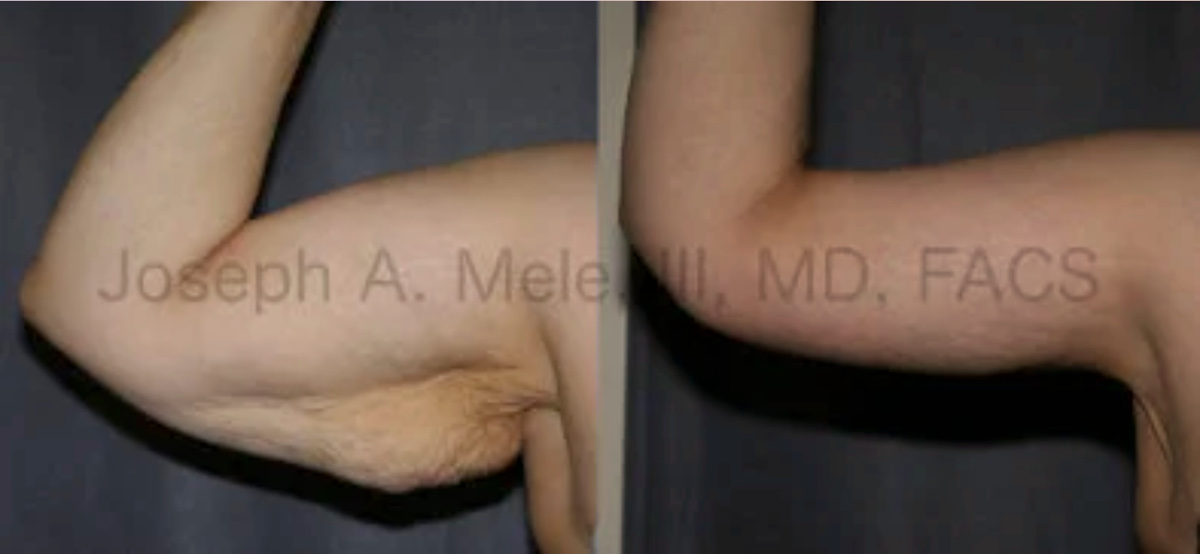
Above is a woman who has lost about half her weight. She was left with a large amount of skin on her upper arms, sometimes referred to as “bat wings”. Brachioplasty (arm lift) before and after pictures are shown. The picture on the left shows the amount of excess skin present before her arm lift. The picture on the right reveals her appearance after brachioplasty. The incision is placed along the inferior border of the arm to keep it out of sight.

After Weight Loss, When is it Time to Consider a Lift?

If you have recently lost weight, or have had bariatric surgery, it is worth giving your body a year to adjust. This gives your skin a chance to contract, and your body’s digestive system a chance to absorb the nutrients you need to heal. If it has been a year, and there is still too much skin, cosmetic plastic surgery can help.

Posted in Arm Lift (Brachioplasty), Home, Post-Bariatric Surgery (After Weight Loss) | No Comments »

One Board Certified Plastic Surgeon

August 20th, 2010 Dr. Mele

A Board Certified Plastic Surgeon

Dr. Joseph Mele, guest author for ABoardCertifiedPlasticSurgeonResource.com

I was recently asked to contribute to A Board Certified Plastic Surgeon Resource, an online resource helping patients find Board Certified Plastic Surgeons. My article stresses the importance of Board Certification, and explains how to recognize a true Medical Board.

Most Medical Boards are self regulating. The long standing, traditional medical boards are also under the regulation of the American Board of Medical Specialties (ABMS). Under the ABMS the only Board specifically dedicated to Plastic Surgery is the American Board of Plastic Surgery. Other sound-alike boards, for example The American Board of Facial Plastic Surgery and the American Board of Cosmetic Surgery, have not been accepted as ABMS Boards, and thus fall outside the regulation of the ABMS.

Information about the American Board of Plastic Surgery can be found right here on the San Francisco Plastic Surgery Blog: Board Certified by the American Board of Plastic Surgery.

For the full version of the article, click the picture below.

Click here for the full version of Dr. Mele's article on Board Certification.

Dr. Mele's article on Board Certification

Posted in About Dr. Mele, Patient Safety | No Comments »

International Society for Aesthetic Plastic Surgery (ISAPS) in San Francisco

August 16th, 2010 Dr. Mele

The International Society for Aesthetic Plastic Surgery (ISAPS) started its 40th anniversary meeting this weekend in San Francisco. While the majority of the meeting will be spent discussing the finer points of plastic surgery technique, Saturday was spent discussing patient safety on a global scale.

The ISAPS is leading the way in global guidelines for plastic surgery patient safety. Topics included:

  • Uniform global plastic surgeon certification requirements
  • Uniform global facility accreditation requirements
  • Medical Procedures Abroad ™ i.e. Medical tourism
  • Guidlines for patient safety
  • Medical device guidelines and usage

Sunday was spent discussing Blepharoplasty (eyelid surgery) and Rhytidectomy (face lift surgery). Today was dedicated to Rhinoplasty (nasal surgery) and Mammoplasty (breast surgery: breast augmentation, breast implants, breast enhancement, breast reduction, beast reconstruction, congenital breast deformities and breast lift surgery).

Tomorrow Maria Siemionow, MD, the team leader of the first U.S. face transplantation surgery, will be making a special presentation. Tuesday will focus on aesthetic reconstructive surgery, as well as Abdominoplasty (tummy tuck) and Body Contouring (liposuction and body lifts).

The final day of the conference, Wednesday, will be spent on Cosmetic Medicine and finally Patient Safety and Complications. It’s been great so far. If you would like more information on any of these procedures, please click on any of the Categories to the left, or visit my main website: DrMele.com.

Posted in Patient Safety, Plastic Surgery Societies | No Comments »

Breast Augmentation and Nipple Piercing

August 11th, 2010 Dr. Mele

Body Art

Body art traditionally refers to tattoos and piercings, but some would say cosmetic plastic surgery is a form of body art. It is not scalpelling, but a scalpel is used. As body art becomes more main stream, questions regarding breast augmentation before and after nipple piercing come up more often than you might think.


Breast Augmentation with Nipple Piercing Before

Preexisting Body and Nipple Piercing - Before Breast Augmentation

Breast Augmentation with Nipple Piercing After

After Breast Augmentation - Body and Nipple Piercings Survived.

Pre-Existing Nipple Piercing

If you have pierced nipples, and are considering breast implants, breast augmentation can be safely performed in the presence of pierced nipples. A few precautions need to be taken to maximize the safety and predictability of you surgery:

  • The piercings need to be clean and without irritation. Irritated piercings are a set up for infection, and this could lead to an infection around the breast implants.
  • The jewelry should be removed from the piercing immediately before surgery. Electrocautery is used routinely during surgery to prevent bleeding. An electric shock to your piercings would cause a burn.
  • The jewelry should be replaced immediately after surgery. At the end of the breast augmentation I normally replace the jewelry to prevent the piercing from closing.
  • If the piercing should become irritated or infected after surgery, it should be addressed immediately. Sometimes this means removing the jewelry from the piercing.

Nipple Piercing After Breast Augmentation

If you already have breast implants, and are considering getting your nipples pierced, I don’t recommend it. If you are still determined to get a nipple piercing, you need to be especially vigilant. Choose a reputable establishment, which uses sterile technique. Infections can occur with any piercing, and every infection has the potential to spread.

Nipple piercings can be especially problematic as the breast gland itself can become infected. This can put the both the breast tissue and the breast implants at risk, especially if your breast implants are in front of the pectoralis muscle. If there is any redness, swelling, discharge or increasing pain at the piercing site, call you plastic surgeon, and seek immediate treatment. The jewelry may need to be removed, but it is better to lose a piercing than to lose a breast implant.

Posted in Breast Augmentation, Patient Safety | No Comments »

Plastic Surgery Blogs

August 1st, 2010 Dr. Mele

Dr. Joseph Mele's San Francisco Plastic Surgery Blog

Dr. Joseph Mele's San Francisco Plastic Surgery Blog

Thank you for reading my Plastic Surgery Blog. The previous posting, Dr. Mele Receives the 2009 Patients’ Choice Award, pushes the number of posts on the San Francisco Plastic Surgery Blog to over 100. Not bad for a little over a year of existence.

Thanks to readers like you, the San Francisco Plastic Surgery Blog consistently ranks high on Google. Of the millions of listings found under “plastic surgery blog,” today the San Francisco Plastic Surgery Blog is once again ranked number one. While Google is constantly adjusting its rankings, the San Francisco Plastic Surgery Blog consistently ranks among the select few found on page one.

If you are new to the San Francisco Plastic Surgery Blog, I hope you find these articles useful and informative. The goal is to provide information about a wide range of plastic surgery topics in an interesting and entertaining fashion. If you are interested in a specific procedure, the ever increasing number of articles are organized by topic. You can find these topics listed to the left under Categories.

Most of the articles were inspired by the questions I receive every day in my Walnut Creek Plastic Surgery practice. I am open to requests, so if you cannot find an article addressing your area of interest in plastic surgery, let me know, and I will try to help.

Posted in About Dr. Mele, Home | No Comments »

Dr. Mele Receives the 2009 Patients’ Choice Award

July 28th, 2010 Dr. Mele

Dr. Mele 2009 Patients Choice Award

Dr. Mele 2009 Patients Choice Award Recipient

Thanks to you and other happy patients, I have again received the Patients’ Choice Award. More than 800,000 patient reviews and ratings were gathered for the 2009 Patients’ Choice Award, and this top rating has only been given to a select few of the nation’s doctors.

Ratings are compared in the following areas:

  • Bedside manner
  • Amount of time spent with patients
  • Courtesy of my staff
  • Appropriate follow-up
  • Overall opinion of me as a physician

The award is selected on merit by American Registry, in partnership with LexisNexis, Vitals and Castle Connolly Medical’s America’s Top Doctors.

Thank you to my patients. There is nothing better than being appreciated. I am very happy that I was able to make a positive contribution to your lives. Thank you for choosing me as your San Francisco, East Bay Area Board Certified Plastic Surgeon in Walnut Creek.

Posted in About Dr. Mele, Home | No Comments »

Rhytidectomy (Facelift) San Francisco – Part 4 of 4

July 24th, 2010 Dr. Mele

In the last few decades, plastic surgery has moved from a secretive, back door affair, to main street, and the Facelift (Rhytidectomy) is no exception. Mini-facelifts and “weekend facelifts” like the Lifestyle Lift®, QuickLift™ are household words, and nothing says mainstream more than a brand name, late night informercial, but has it gone too far?

I had never heard of astroturfing until the LifeStyle Lift came along. It illustrates the hazards of purchasing a procedure from a corporation with a large marketing budget, rather than from a Board Certified Plastic Surgeon. More importantly, is the one-size-fits-all facelift a good idea?

The One-Size-Fits-All Facelift

To my eye, facelifts are individualized procedures. Each face is different and every face ages differently. When I evaluate a new patient for a facelift, I evaluate many specific areas. I can tailor my approach to maximize the benefit to the areas that need it the most. The advantage of knowing how to do more than one type of facelift is that I can choose the method that is most likely to help your specific needs.

Sometimes a mini-facelift is enough. Sometimes the traditional full facelift is necessary. Sometimes a deeper plane also needs to be addressed. Should the facelift be en-block or bidirectional? Differences between the mini and full facelifts are explained in my post: Facelift (Rhytidectomy) v. Mini Facelift (Mini Rhytidectomy). Mini and full facelift before and after pictures are also included. Which approach to use is a decision I make after I see you. With mass marketed mini-facelifts, one-size-fits-all, the treatment is largely determined before the evaluation. It’s akin to selecting a tool, before knowing what you are supposed to do with it.

The Buck Stops Here

When I see you in my office for any procedure, I want all the information I can get before selecting a plan. I want to know:

  • Where are the problems?
  • What needs to be addressed?
  • Is it fixable?
  • Are the goals realistically achievable?

How best to proceed is determined after defining the goals, reviewing the options and building trust. My goal is to provide you with sufficient information so that there are no surprises. A good result takes communication and teamwork throughout the process. A good result takes careful planning and keeping all the options open until the best method is defined.

A facelift is not a one-size-fits-all commodity. Honest discussion beforehand, yields better results and higher satisfaction. If there was one, singular best way to do a facelift, every plastic surgeon would do the same procedure every time. The variety in approaches to the facelift, reflects the variety seen in the face.

Body Beautiful

The 800 number in the video below was only used for viewer questions during the live broadcast. If you have questions, or would like to schedule a consultation appointment for a facelift, please call my Walnut Creek Plastic Surgery office at (925) 943-6353.

Information in this video is provided for general informational purposes only. Specific recommendations can only be made after a careful history and physical examination are performed. Some of the topics covered include:

  • Brand name mini-facelifts (Lifestyle Lift®, QuickLift™, …)?
  • The importance of investigating your doctor before scheduling an appointment
  • Who will take care of you if there is a problem?
  • How to find a Board Certified Plastic Surgeon
  • Viewer questions are answered about Blepharoplasty (Eye Lid Surgery)

The other segments of this broadcast can be found here:

  • Rhytidectomy (Facelift) San Francisco – Part 1 of 4
  • Rhytidectomy (Facelift) San Francisco – Part 2 of 4
  • Rhytidectomy (Facelift) San Francisco – Part 3 of 4
  • Rhytidectomy (Facelift) San Francisco – Part 4 of 4 (You are here)

Check if your doctor is Board Certified by the American Board of Plastic Surgery.
Check if your doctor is Board Certified by another American Board of Medical Specialties board. You will need to register to use this site, but it is safe, free and fast.
Check if your doctor has an unrestricted California Medical License. Read the disclaimer and click “Continue to Search” at the bottom. If you are not in California, Google your local medical board for a link.

Posted in Facelift (Rhytidectomy), Home, Mini Facelift (Mini Rhytidectomy) | No Comments »

Rhytidectomy (Facelift) San Francisco – Part 3 of 4

July 20th, 2010 Dr. Mele

The two most important aspects of any surgical procedure are predictability and safety. The facelift (rhytidectomy) is no exception. If you are considering a facelift, you want to know:

  • What will a facelift can do for my face?
  • How can I have a facelift in the safest possible manner?

The video segment from KRON4′s Body Beautiful answers these questions, and explains:

  • The goals of facelift surgery
  • How to make it safe

The facelift addresses three main areas:

The Cheeks – Nasolabial Folds and Marionette Lines

Sometimes called the “parentheses,” because they bracket the mouth, the nasolabial folds are the wrinkles that run from the base of the nose to the corners of the mouth. The creases that continue from the corners of the mouth down to the chin are called marionette lines.

These areas are frequently treated with Hyaluronic Acid (HA) fillers like Restylane®, Perlane® and Juvederm®. Now that all the HA fillers come with a local anesthetic (Lidocaine) added, it is a more comfortable procedure. Facelifts reduce nasolabial folds and marionette lines in an entirely different way. By elevating the cheeks, and reducing the amount of skin that folds over them, the depth and shadowing of these aging folds are reduced. For deeper lines, a combination of filler and lift may be necessary. Your own cells can be used to fill the area too. When performing a facelift, I will often use a dermal graft to further reduce the facial folds in the nasolabial and marionette areas.

The Neck

The facelift includes the cheeks, jawline and neck. If you only have loose skin on the neck, then a necklift may suffice, but most of the time, both areas age in parallel. If you have loose neck skin, or bands on the front of the neck from the platysma muscle, a facelift can attenuate them.

The Jawline and The Jowls

The jawline is the boundary between the face and the neck. As we age, this boundary becomes blurred. The jowls begin to break up the youthful smooth contours, and the definition between the face and neck becomes less distinct. Since the face and neck are both treated, the jawline between them is also addressed with a facelift. San Francisco Bay Area patients have come to expect the best in facelift surgery. Rejuvenation without distortion is the key. A clean jawline goes a long way toward a youthful face.

Facelift Safety

The safety of a facelift is enhanced by a thorough preoperative workup. This includes everything done leading up to the surgery. If you have high blood pressure, being certain that is it well controlled before surgery is imperative. If you smoke, stopping four weeks before surgery reduces the risk of healing problems by a factor of six.

Doing the facelift procedure safely is also important. The proper facility and equipment help ensure that you are properly monitored the day of surgery.

Last, and certainly not least, the training of you Plastic Surgeon is important. A well trained surgeon is a safe surgeon. By selecting a Board Certified Plastic Surgeon, you can be certain they have the most specialized and thorough training available. Members of the American Society for Aesthetic Plastic Surgery (ASAPS) are uniquely qualified in the realm a Cosmetic Plastic Surgery. As a condition of membership, I have to be a Board Certified Plastic Surgeon and specialize in the Cosmetic aspects of Plastic Surgery.

On With the Show

The 800 number in the video below was only used for viewer questions during the live broadcast. If you have questions, or would like to schedule a consultation appointment for a facelift, please call my Walnut Creek Plastic Surgery office at (925) 943-6353.

This video is provided for general informational purposes only. Specific recommendations can only be made after a careful history and physical examination are performed. Some of the topics covered include:

  • The changing acceptance of the Facelift
  • The increasing popularity of Facelifts (about 100000 facelifts are performed a year)
  • The goals of the Rhytidectomy
  • The hazards of overcorrection
  • The differences between male and female Facelifts
  • Facelift do’s and don’t's
  • How to assess preexisting medical conditions – preoperative optimization
  • Should you see your primary medical doctor before having surgery?
  • Smoking and Facelifts
  • The importance of a Board Certified Plastic Surgeon
  • The importance of an Accredited Surgery Center
  • Can other facial rejuvenation procedures be safely combined with a facelift?

The other segments of this broadcast can be found here:

  • Rhytidectomy (Facelift) San Francisco – Part 1 of 4
  • Rhytidectomy (Facelift) San Francisco – Part 2 of 4
  • Rhytidectomy (Facelift) San Francisco – Part 3 of 4 (You are here)
  • Rhytidectomy (Facelift) San Francisco – Part 4 of 4 (Coming soon)

Posted in Facelift (Rhytidectomy), Home | No Comments »

Rhytidectomy (Facelift) San Francisco – Part 2 of 4

July 16th, 2010 Dr. Mele

Almost 100,000 facelifts were performed by Board Certified Plastic Surgeons in the United States last year. It is one of the most frequently requested cosmetic plastic surgery procedures I perform. While rhytidectomy means wrinkle removal, the goal is to achieve a youthful, rested appearance that maintains expression.

This video segment, taken from my appearance on KRON4′s Body Beautiful, discusses the changes that occur with a facelift. Facelift before and after pictures are included. The specific areas of treatment are compared for the rhytidectomy and mini-rhytidectomy. The pro’s and con’s of the facelift are contrasted with the mini-facelift. San Francisco Bay Area residents had their questions about facelifts and necklifts answered live.

The 800 number in the video below was used for the live broadcast. If you have questions, or would like to schedule a consultation appointment, please call my Walnut Creek Plastic Surgery office at (925) 943-6353. Questions can also be asked using the contact form on the lower left aspect of this page.

This video is provided for general informational purposes only. Specific recommendations can only be made after a careful history and physical examination are performed. Some of the topics covered include:

  • How popular is the Facelift procedure?
  • Before and after pictures of Facelifts
  • Before and after pictures of Mini-Facelifts
  • Description of the Facelift
  • What is a Mini-Facelift?
  • What areas of the face and neck are addressed with a Facelift?
  • How is a Necklift different from a Facelift?
  • Can Liposuction take the place of a Facelift?
  • How is the definition of the neck restored?

The other segments of this broadcast can be found here:

  • Rhytidectomy (Facelift) San Francisco – Part 1 of 4
  • Rhytidectomy (Facelift) San Francisco – Part 2 of 4 (You are here)
  • Rhytidectomy (Facelift) San Francisco – Part 3 of 4
  • Rhytidectomy (Facelift) San Francisco – Part 4 of 4 (Coming soon)

Posted in Facelift (Rhytidectomy), Home | No Comments »

« Previous Entries

  • Follow Dr. Joseph Mele on Facebook Get tweets from Dr. Joseph Mele on Twitter View Dr Joseph Mele's Videos on YouTube
    Subscribe to our RSS Feed.
    Join us on Facebook.
    Receive our Tweets on Twitter.
    Watch the DrMele channel on YouTube.


  • Useful Links

    • Visit Dr. Mele's Main Website
    • Visite el Sitio Principal del Dr. Mele
  • Recent Posts

    • Patient Safety – AB 583 – A Great Bill for You
    • Brachioplasty (Arm Lift) San Francisco
    • One Board Certified Plastic Surgeon
    • International Society for Aesthetic Plastic Surgery (ISAPS) in San Francisco
    • Breast Augmentation and Nipple Piercing
    • Juvederm XC and Vivite Give Away
    • Plastic Surgery Blogs
    • Dr. Mele Receives the 2009 Patients’ Choice Award
    • Rhytidectomy (Facelift) San Francisco – Part 4 of 4
    • Rhytidectomy (Facelift) San Francisco – Part 3 of 4
  • Categories

    • About Dr. Mele (14)
      • Plastic Surgery Societies (13)
    • Areolar Reduction (2)
    • Arm Lift (Brachioplasty) (2)
    • Breast Asymmetry (8)
    • Breast Augmentation (27)
      • Breast Implant Options (3)
    • Breast Implant Revision Surgery (19)
    • Breast Lift (Mastopexy) (4)
    • Breast Reduction (4)
      • Breast Reduction (Men) (4)
      • Breast Reduction (Women) (2)
    • Capsular Contracture (10)
    • Eyelashes (1)
    • Eyelid Lift (Blepharoplasty) (8)
    • Facelift (Rhytidectomy) (6)
    • Home (102)
    • Inverted Nipples (1)
    • Liposuction (21)
    • Mini Facelift (Mini Rhytidectomy) (2)
    • Mini Tummy Tuck (Mini Abdominoplasty) (8)
    • Mommy Makeover (7)
    • Nipple Reduction (2)
    • Patient Safety (15)
    • Post-Bariatric Surgery (After Weight Loss) (6)
    • Rhinoplasty (Nasal Surgery) (3)
    • Scar Revision (Keloids) (6)
    • Tubular Breasts (4)
    • Tummy Tuck (Abdominoplasty) (13)
    • Uncategorized (4)
    • Wrinkle Reduction (Non-surgical) (17)
    • Chin Implants/Augmentation (2)
    • Lip Enhancement/Augmentation (6)
  • Archives

    • September 2010
    • August 2010
    • July 2010
    • June 2010
    • May 2010
    • April 2010
    • March 2010
    • February 2010
    • January 2010
    • December 2009
    • November 2009
    • October 2009
    • September 2009
    • August 2009
    • July 2009
    • June 2009
  • Fill out the form to receive more info.

    * indicates a required field


    Please send me regular updates from the doctor
  • Abdominoplasty Arm Lift (Brachioplasty) Augmentation Blepharoplasty Botox/Dysport Botulinum Toxin Breast Breast Asymmetry Breast Augmentation Breast Implant Complications Breast Implant Revision Breast Implants Breast Lift Breast Reduction Capsular Contracture Chin Augmentation Cosmetic Surgery Eyelid Surgery Eye Lift Facelift Fillers Gel Gummy Gynecomastia Hyaluronic Acid Implants Lip Augmentation Lip Enhancement Liposuction Lips Mini Abdominoplasty Mini Tummy Tuck (Mini Abdominoplasty) Mommy Makeover Nipple Asymmetry Nipple Reduction Patient Safety Plastic Surgery Post-Bariatric Surgery Rhinoplasty Rhytidectomy Saline Scar Revision (Keloids) Silicone Tummy Tuck Wrinkle Treatments

    WP Cumulus Flash tag cloud by Roy Tanck and Luke Morton requires Flash Player 9 or better.


Joseph A. Mele. M.D., F.A.C.S
130 La Casa Via Walnut Creek, CA 94598 | 925-943-6353
Copyright © 2010 www.sanfranciscoplasticsurgeryblog.com | Terms of Use