• Home
  • Meet Dr. Mele
  • Contact Us
  • Social Media Links

Breast Augmentation and Nipple Piercing

August 11th, 2010 Dr. Mele

Body Art

Body art traditionally refers to tattoos and piercings, but some would say cosmetic plastic surgery is a form of body art. It is not scalpelling, but a scalpel is used. As body art becomes more main stream, questions regarding breast augmentation before and after nipple piercing come up more often than you might think.


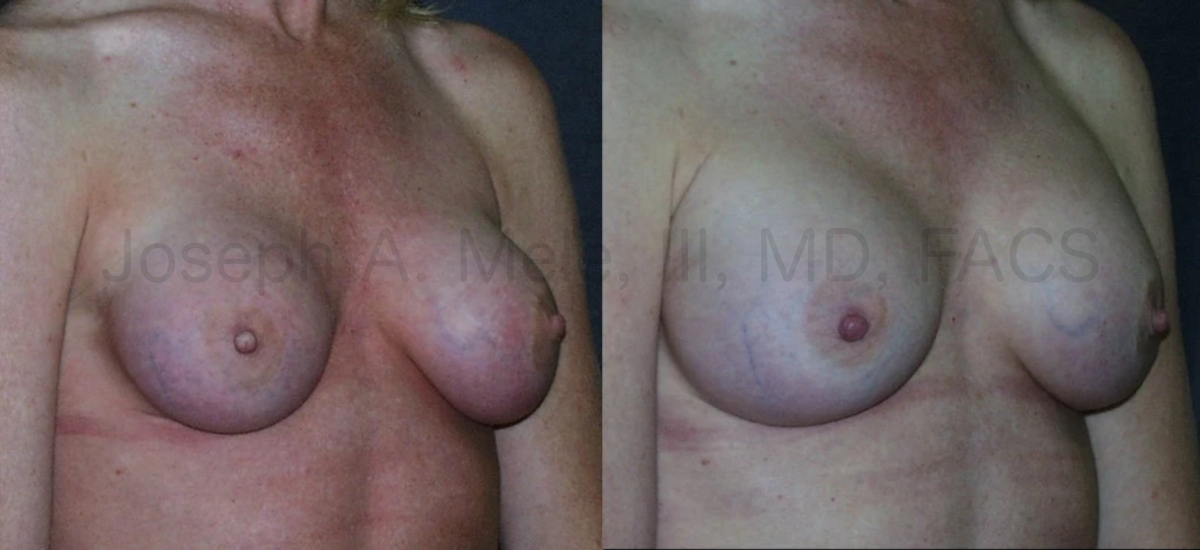
Breast Augmentation with Nipple Piercing Before

Preexisting Body and Nipple Piercing - Before Breast Augmentation

Breast Augmentation with Nipple Piercing After

After Breast Augmentation - Body and Nipple Piercings Survived.

Pre-Existing Nipple Piercing

If you have pierced nipples, and are considering breast implants, breast augmentation can be safely performed in the presence of pierced nipples. A few precautions need to be taken to maximize the safety and predictability of you surgery:

  • The piercings need to be clean and without irritation. Irritated piercings are a set up for infection, and this could lead to an infection around the breast implants.
  • The jewelry should be removed from the piercing immediately before surgery. Electrocautery is used routinely during surgery to prevent bleeding. An electric shock to your piercings would cause a burn.
  • The jewelry should be replaced immediately after surgery. At the end of the breast augmentation I normally replace the jewelry to prevent the piercing from closing.
  • If the piercing should become irritated or infected after surgery, it should be addressed immediately. Sometimes this means removing the jewelry from the piercing.

Nipple Piercing After Breast Augmentation

If you already have breast implants, and are considering getting your nipples pierced, I don’t recommend it. If you are still determined to get a nipple piercing, you need to be especially vigilant. Choose a reputable establishment, which uses sterile technique. Infections can occur with any piercing, and every infection has the potential to spread.

Nipple piercings can be especially problematic as the breast gland itself can become infected. This can put the both the breast tissue and the breast implants at risk, especially if your breast implants are in front of the pectoralis muscle. If there is any redness, swelling, discharge or increasing pain at the piercing site, call you plastic surgeon, and seek immediate treatment. The jewelry may need to be removed, but it is better to lose a piercing than to lose a breast implant.

Posted in Breast Augmentation, Patient Safety | No Comments »

Breast Augmentation – Size Matters

May 29th, 2010 Dr. Mele

Dove took some criticism for its Curves ad campaign.

Perhaps the most difficult decision in breast augmentation surgery is the size. When Dove tried responding to criticism that the women seen in ads are not representative of real women, they found themselves being criticized again for selecting a broader, but still restricted, subset. It is really hard to represent all women in a single print ad or even a 60 second commercial. Women come in all shapes and sizes, and for this reason, so do breast implants.

Selecting the best breast implant is an important part of obtaining the optimal breast enhancement. And when it comes to breast implant volume, there is more to it than choosing a number. Size matters, and in more ways than you might think. The size of the existing breast, the size of the desired breast and the size of the woman, are all important. Here is one example.

Not Your Average Breast Augmentation

A young mother came to me with a desire to repair some of the damage caused by pregnancy. A big part of her concern was the almost complete loss of breast volume. She was not trying to “make a statement” with her breasts. She just wanted them back. Her clothing no longer fit, and she missed the more feminine curves she once possessed.

Trying to figure out your desired breast implant volume can be very confusing. For breast size, we tend to think more along the lines of cup size rather than cc’s, and cup sizes are confusing enough. The most common breast augmentation requested is a C-cup, but C-cup volumes vary by the manufacturer and even by the style of the bra.

Internet resources claim anywhere from 100 to 250 cc’s will give an increase of one cup size. The highest volume in the range is more than double the lowest volume, yet the range is about right. Cup size depends on band size — the distance around the rib cage below the breasts. To state this in the most obvious terms, bigger girls need bigger volumes, to get similar results.


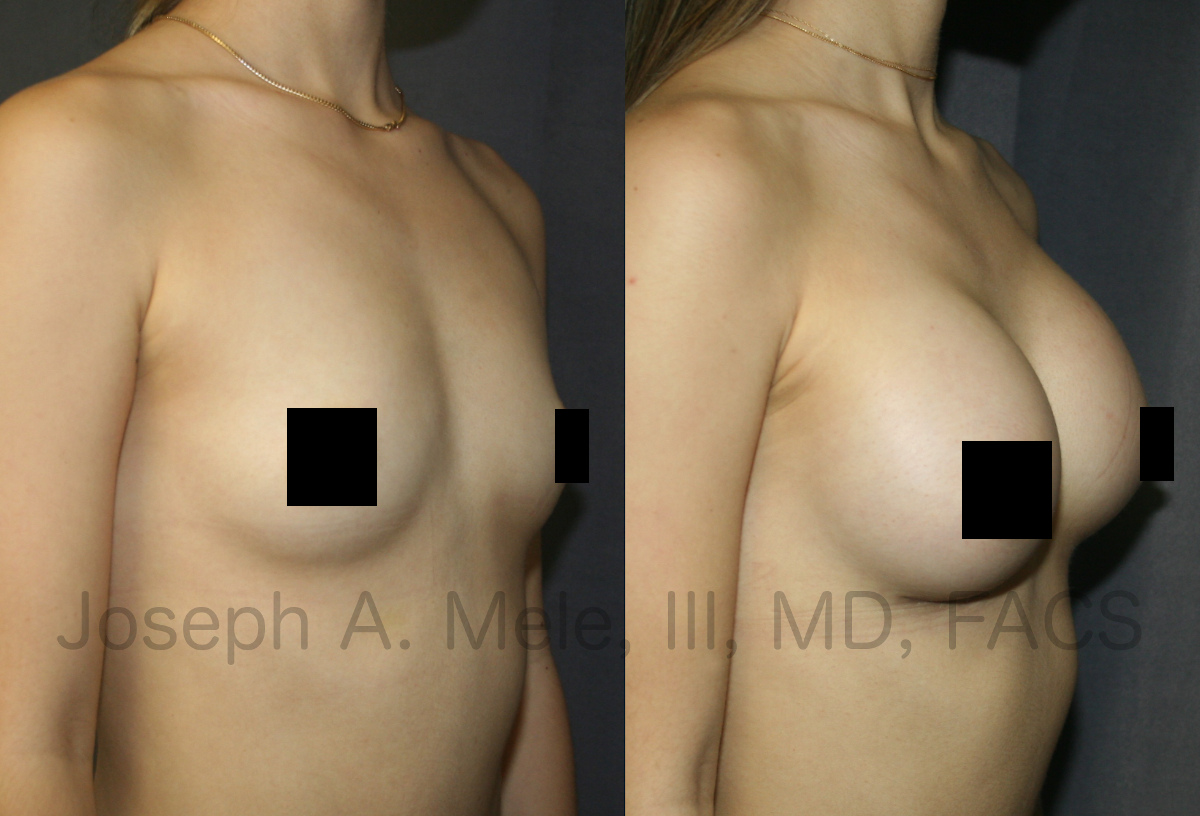
Before breast augmentation.

After breast augmentation.

The average implant size used varies by region. The average volume used in the United States is in the 300-350 cc range. My patient desired a breast size proportional to her body. She wanted to be able to find clothing that would fit without being too baggy or feeling too tight. Being of average height and desiring an average size, you might think she would require the average implant volume. If only it were that simple.

The breast augmentation pictured above was accomplished with saline breast implants placed under the muscle via a periareolar incision. A moderate profile implant was selected so that the diameter of the implant matched the diameter of the breast. Matching the breast diameter is critical with saline implants. The correct breast implant diameter, especially for saline implants, is often more important than the implant’s volume.

The volume selected was above average at 420 cc’s. A larger breast implant was necessary because there was smaller amount of native breast volume present before surgery. Additionally, the larger volume was needed so that the implant’s diameter would match the chest. While 420 cc’s may seem large, in this case, the result is just what the patient wanted.

The result is a beautiful breast that is well shaped and well proportioned. Despite using a round implant, the shape is natural. Placing the implant behind the muscle, for a woman with little breast tissue to disguise it, can give a round implant a pleasing teardrop shape.

Too Small, Too Big, Just Right

Most patients want breast enhancement that is big enough, but not too big. They want enough change so that they know breast augmentation was done, but not so much that is becomes a new source of embarrassment. After breast augmentation, you want to feel comfortable, and you want clothing to fit well.

The most common reason for breast augmentation revision surgery is to increase the size of the implants. As a breast augmentation patient, the most helpful thing you can provide your surgeon is a good idea of how much breast enlargement is enough. I have tried to offer useful suggestions in: How to Choose the Correct Breast Implants: Size.

Breast Implant Profiles – Shape Matters Too

The profile of the implant can influence the final shape and location of the breast. For implants of the same volume, the wider diameter found in lower profile implants, adds more “side boob”. On the other hand, the narrower diameter of a high profile implant, will increase the space between the breasts.

For implants of the same diameter, the lower volume in a low profile implant will result in a breast with less forward projection. The opposite effect is obtained with a high profile breast implant. A high profile implant will result in a breast with more projection, and a larger cup size. Here is some additional information about Breast Diameter and Breast Implants in Breast Augmentation.

The Advantage of a Board Certified Plastic Surgeon

In determining the correct volume for my patient, the advantage I have, besides being a Board Certified Plastic Surgeon, is that I was able to do a physical examination, take measurements, determine skin elasticity and compare what I saw with the size, shape and volumes available for breast implants. There is no better way to determine what needs to be done for a cosmetic procedure than with a focused medical history and physical examination. My patient’s goals, combined with her measurements, determined that a larger than average volume implant was necessary in this case.

When it comes to breast size, there is no secret formula and there is no right answer, there is only the right size for you. It varies with each individual, and it is often the most difficult variable to pin down. This is the advantage of seeing a Board Certified Plastic Surgeon with experience in breast augmentation who cares about how you are going to look and feel afterwards.

Posted in Breast Augmentation, Home | No Comments »

Spring Breast Augmentation San Francisco Bay Area

May 25th, 2010 Dr. Mele

Whether it is spring fashion or spring fever, the demand for breast augmentation is on the rise. If you are considering breast augmentation, you are looking in the right place.

Get Informed

Heidi Montag prior to her recent breast augmentation.

Many options are available for gathering the breast augmentation information you need. The Internet offers a wealth of information — some good; some not so much. While not all the information you read will apply to you, visiting reputable web sites can give you an idea of what your options are.

Friends and family members can be important allies. If you are fortunate enough to have friends or family members who have had breast augmentation, they can provide you with unique and personal insight into the procedure. It is important to note, however, that everyone’s experience (and body) is unique.

The best breast augmentation advice is found during your consultation appointment. As a diplomate of the American Board of Plastic Surgery, I put the focus on your goals, so that I can formulate a plan that addresses your unique needs.

Here are a few resources I have created to help you with some of the most common questions:

My main web site has a page dedicated to breast augmentation, including many frequently asked questions. It reviews options for incisions, implant placement, types of implants and size selection . Click here to visit the breast augmentation page on DrMele.com.

On this blog there are many posts and videos discussing breast augmentation. Clicking on “Breast Augmentation” to the left under Categories will give you pages of all the pertinent breast augmentation articles. The subheading “Breast Implant Options” list articles discussing how to pick the best implants for you.

Top Three Breast Augmentation Questions

  • Size – How to Choose the Correct Breast Implants: Size
  • Silicone vs. Saline – How to Choose the Correct Breast Implants: Silicone vs. Saline
  • Breast Implant Profile/Diameter – Breast Diameter and Breast Implants in Breast Augmentation

Breast Augmentation Videos

Many of my television appearances discussing breast augmentation can also be viewed via YouTube. Clicking the YouTube button at the top of the left column will take you to my YouTube channel. For breast augmentation, I have also created two YouTube playlists:

  • Breast Augmentation San Francisco
  • Breast Augmentation (Breast Implant) Revision San Francisco

The Next Step

Whether you are considering breast augmentation, or you want breast augmentation revision, when you are ready, the next step is to schedule a consultation appointment with a Board Certified Plastic Surgeon. You can check my (or any doctor’s) certification on the American Board of Plastic Surgery website.

A consultation with a Board Certified Plastic Surgeon will allow you to express your goals, explore your options and ask your questions. If you are ready to take the next step, call (925) 943-6353 for your personal consultation appointment.

Posted in Breast Augmentation, Breast Implant Revision Surgery, Home | No Comments »

Radiant Life – RLM Success Files – Breast Augmentation

February 21st, 2010 Dr. Mele

Radiant Life – RLM Success Files features breast augmentation by Dr. Joseph A. Mele.

As seen in Radiant Life Magazine.
(Click to enlarge.)

Radiant Life® Magazine is The Aesthetic Wellness Magazine, and is dedicated to innovations in cosmetic plastic surgery. The current issue of Radiant Life® features an article by Lindsay Haakenson on the latest innovations in Breast Augmentation entitled Breast Surgery 2.0.

Radiant Life Magazine approached me with a short deadline and the need for an example of modern breast augmentation. My staff contacted a few of our many satisfied patients. Jennifer was the first to respond, and she immediately agreed to both an interview with Radiant Life Magazine and the use of her pictures, and for that she gets my sincere thanks. This is a true testimonial* to how worthwhile breast augmentation surgery has been for her. Thanks goes out to my other happy patients who also graciously responded, and to Lindsay Haakenson for including me.

Jennifer first came into the office for a consultation after noticing her breast volume had decreased after pregnancy. She was interested in restoring what mother nature had both given and then taken away. She expressed a desire to maintain proportions with her body, and wanted a natural look that would be attractive, without being distracting.

The excerpt to the right is from the Breast Surgery 2.0. At the top are her breast augmentation before and after pictures. Before submuscular (subpectoral) breast augmentation, her breasts where asymmetrical, small, had a relatively low set nipple and a constricted base. The distance between the nipple and the inframammary fold was short, and the remaining breast tissue was firm. She had a mild form of what is sometimes referred to as a tubular breast.

The simplest way to correct a tubular breast is with a subglandular breast augmentation. Often a periareolar mastopexy is performed to lift and reshape a protruding nipple/areolar complex at the same time. Okay, that may not sound so simple, and in Jennifer’s case, the easiest way was not necessarily the best way.

Every patient requires careful thought and consideration. In Jennifer’s case, the tubular deformity was mild, and a periareolar breast lift was not needed. The lack of breast tissue higher on the chest meant that the upper pole of the implant was more likely to be seen. A saline implant was placed behind the muscle to help soften the upper pole of the implant, and to give a more teardrop shape. A periareolar incision was used, and this, as is usual, healed very well.

For a more pronounced tubular breast deformity, this approach may not work. Unlike the approach using a periareolar lift, it will not correct a bulging areola that is often seen in concert with the narrow constricted breast base. If you are considering breast augmentation, it is important to seek a qualified and experienced, board certified plastic surgeon, so that the safest and most predictable plan can be constructed.

I want to thank Jennifer for volunteering to share her results with you. The best part of my job is helping my patients. I am thrilled that Jennifer is happy with the results of her breast augmentation.

* As per the latest American Society of Plastic Surgeons Code of Ethics this is a true testimonial. I have not reimbursed my patient in any way for her kind words, and I have not paid Radiant Life Magazine to be included in this article. To read the entire Radiant Life Magazine article, click here. You need to be able to view pdf files in order to display the contents properly. To download the latest version of Adobe Reader for free click here.

Posted in Breast Asymmetry, Breast Augmentation, Home, Tubular Breasts | 1 Comment »

Breast Augmentation (Breast Implant) Revision Surgery San Francisco – Part 4

January 29th, 2010 Dr. Mele

Breast Augmentation Revision Surgery, has become an important area of specialization in my Walnut Creek plastic surgery practice. As many as 25% of women undergoing breast augmentation, will require a second surgery in the ten years after surgery.

Breast augmentation revision surgery may be elective, and may be performed to increase or decrease the size of your breast implants. Increasing breast implant size is one of the most common, and simplest forms of breast implant revision.

Breast implant revision surgery may be needed to replace a deflated implant or to revise the scar around the implant (capsular contracture). The major US breast implant manufacturers offer lifetime replacement of their breast implants if a breast implant deflation occurs. They also provide financial support if the breast implant leaks occur within ten years of the primary breast augmentation.

You will find videos on breast augmentation and breast augmentation revision surgery posted on the San Francisco Plastic Surgery Blog. They can be viewed here or on my YouTube channel. Please remember, the 800 number appearing on the video was only for the live show, to contact my office for additional information or to schedule a private consultation appointment, call (925) 943-6353.

This video comes from a segment of KRON’s Body Beautiful. You can hear:

  • What is Breast Augmentation Revision surgery?
  • Who needs Breast Implant Revision surgery?
  • Do your silicone breast implants or saline breast implants come with a warranty?
  • Is there an expiration date on my breast implants?
  • Before and after pictures of Breast Implant Deflation Replacement Surgery?
  • Can breast implant asymmetry be improved?
  • How does Capsular Contracture present?
  • Can breast surgery be performed for a diabetic (a person with diabetes)?

If you are considering Breast Implant Revision Surgery in the San Francisco Bay Area, a Board Certified Plastic Surgeon can help. This first step is a consultation appointment so that existing problems can be defined and achievable goals can be set.

Breast Implant Revision Links

Breast Implant Revision – Part 1

Breast Implant Revision – Part 2

Breast Implant Revision – Part 3

Breast Implant Revision – Part 4: (You are here.)

Thanks for visiting the San Francisco Plastic Surgery Blog.

Posted in Breast Augmentation, Breast Implant Revision Surgery, Capsular Contracture, Home | No Comments »

Breast Augmentation (Breast Implant) Revision Surgery San Francisco – Part 3

January 25th, 2010 Dr. Mele

Breast Augmentation Revision Surgery, has become a specialty unto itself. While most women will never require breast augmentation revision, a large minority will. The exact number is difficult to pin down; however, studies have indicated that in the ten years after breast augmentation, as many as 25%, will undergo a second breast augmentation related surgery.

Many times there is no complication, and the primary motivation for breast augmentation revision surgery is to change the size of the implants. Perhaps the most common breast implant revision surgery is to replace breast implants with a larger pair. This is the reason I place so much emphasis on defining the goal size for breast augmentation before surgery. Even so, minds and goals can change with time.

Other times breast implant revision surgery is less volitional, and may be due to gravity (requiring a breast lift), breast implant failure (breast implant deflation or breast implant rupture) or capsular contracture (tightening of the nature scar that surrounds the implant causing movement or firmness of the breast implants).

Other videos on this subject have been posted on the San Francisco Plastic Surgery Blog and they can be viewed here (see bottom of article for links) or on my YouTube channel. When you are watching this video, please note, the 800 number on the video was for the live show, to contact my office for additional information or to schedule a private consultation appointment, call (925) 943-6353.

On this episode of KRON’s Body Beautiful you can learn:

  • What are the main reasons for Breast Augmentation Revision surgery
  • Do breast implants wear out?
  • What is the capsule around the breast implants?
  • What is Capsular Contracture?
  • How long is the Breast Implant Warranty?
  • How many Breast Augmentations are performed each year?
  • How is Breast Implant Revision Surgery performed?
  • What is the recovery like after Breast Augmentation Revision?

Breast Augmentation Revision Surgery requires a careful analysis of the existing problem, a thoughtful discussion about the good (and bad) aspects of all available treatments, the ability to adapt the plan to any new findings found during surgery, and a careful recovery, to speed you return to daily life. The first step is a private consultation with a Board Certified Plastic Surgeon.

Promised Links

Breast Implant Revision – Part 1

Breast Implant Revision – Part 2

Breast Implant Revision – Part 3 (You are here.)

Breast Implant Revision – Part 4

Thanks for visiting the San Francisco Plastic Surgery Blog.

Posted in Breast Augmentation, Breast Implant Revision Surgery, Capsular Contracture, Home | No Comments »

Breast Implant Revision (Part 2)

October 6th, 2009 Dr. Mele

Whether you are considering breast enhancement, or already have breast implants, this video discusses the most frequent reasons why corrective surgery is needed and includes before and after pictures and live viewer questions.

This is part two of two from an episode of KRON 4′s Body Beautiful with Vicki Liviakis that aired last month. This video discusses breast augmentation revision surgery, including before and after pictures and viewer questions.

Specific examples are shown. The first patient (shown below) had breast augmentation in her twenties. Years later, she had children and was not happy with the changes in her breast resulting from pregnancy and breast feeding. Before and after breast augmentation revision surgery pictures are shown. In her case a breast implant exchange and breast lift and were performed to adjust for lost volume and improve the shape of the sagging breasts.

A different patient had breast implant bottoming out. In her case the implants had fallen below the inframammary fold leaving the nipples high and flattening out the normal curve beneath the breast. Corrective beast augmentation surgery included breast implant implant exchange to adjust the volume, and the inframammary fold was reconstructed internally to raise the implant and form a distinct curve beneath the breast.

The caller in this video had a question about ruptured silicone gel implants that were placed in the 1970′s. If any breast implant has ruptured, it needs to be removed. Most frequently, a ruptured breast implant is replaced at the same operation. Silicone gel implants in particular should be removed sooner than later. A ruptured silicone gel implant, over time, can cause increased scarring and hardening of the breasts, as the body tries to wall off the free gel. If not treated promptly, this type of scarring can lead to further problems than may not be correctable.

Silicone gel filled implants placed before 1985 seem to have a higher deflation rate than the new silicone breast implants. In fact, the outer shell of silicone breast implants has changed twice since the 70′s. The first change, in the mid 80′s, was to decrease the rupture rate. The second change, in the mid 90′s, was to reduce gel bleed (the ability of the silicone gel to leak through outer shell without a rupture). Both US FDA approved breast implant manufactures, Allergan and Mentor, offer lifetime replacement of their implants should they fail, and often provide financial support should this occur within ten years of your breast augmentation procedure. For details of the Mentor and Allergan (Natrelle) Breast Implant Warranties click on the manufactures names. It is best to get the information direct from the manufacturer; however, the Mentor site has been going through some changes, perhaps with the merger with Johnson & Johnson, so if you can’t link there, JustBreastImplants.com also has information on breast implant warranties.

Additional Breast Augmentation Revision Videos

Breast Implant Revision – Part 1

Breast Implant Revision – Part 2 (You are here.)

Breast Implant Revision – Part 3

Breast Implant Revision – Part 4

Thanks for visiting the San Francisco Plastic Surgery Blog.

Posted in Breast Asymmetry, Breast Augmentation, Breast Implant Revision Surgery, Breast Lift (Mastopexy), Capsular Contracture, Home, Mommy Makeover | No Comments »

Breast Implant Revision (Part 1)

October 2nd, 2009 Dr. Mele

Breast Augmentation is currently the most frequently performed cosmetic plastic surgery procedure. Whether you are considering breast enhancement, or already have breast implants, this video discusses the most frequent reasons why corrective surgery is needed.

Breast augmentation revision surgery is sometimes necessary even in the best of hands. Revision surgery can range from simple, like changing breast implants after deflation or changing sizes, to more complicated, like when treating breast ptosis (sagging) or capsular contracture. The best way to reduce your risk of needing breast revision surgery is to choose a qualified Board Certified Plastic Surgeon.

If you need breast revision surgery, choosing a well trained Board Certified Plastic Surgeon with a broad experience in breast enhancement surgery is the best way to get a satisfying result. By choosing a Board Certified Plastic Surgeon who specializes on cosmetic surgery, you get a doctor who is well trained and well rehearsed in a wide range of treatment options.

Breast implant revision in San Francisco is no different than in other areas of the United States. Sometimes the results of the breast augmentation where just not what was expected. Other times, the result were great and either the breasts change, the implants change or the desires change. When these situations arise, breast augmentation revision surgery could be your best option to get back into the shape you want.

This is part one of two from an episode of KRON 4′s Body Beautiful with Vicki Liviakis that aired last month. This video discusses breast augmentation revision surgery. Part two will include more discussion, before and after pictures and viewer questions.

The best way to be certain your plastic surgeon is appropriately trained to perform breast augmentation surgery is to make sure that he or she is a Board Certified Plastic Surgeon. By choosing a Plastic Surgeon who is a member of the American Society of Plastic Surgeons (ASPS), you can be certain that their credentials have been verified. ASPS members are held to higher standards in ethical care of patients and continuing medical education requirements. ASPS standards are above and beyond those required by State licensing boards and hospital credentialing committees.

A small percentage of ASPS members are also members of the American Society for Aesthetic Plastic Surgery (ASAPS). ASAPS members are ASPS members who specialize in the cosmetic side of Plastic Surgery. ASAPS members must meet the standards of ASPS, apply independently for membership to ASAPS and demonstrate a commitment to cosmetic plastic surgery both in education and in patient care.

ASPS is the largest plastic surgery specialty organization in the world. Founded in 1931, the society is composed of board-certified plastic surgeons who perform cosmetic and reconstructive surgery. ASAPS is the leading organization of board-certified plastic surgeons specializing in cosmetic surgery of the face and body, and I am proud to be an active member of both.

Next time I will talk more about the reasons for breast augmentation revision surgery and how a qualified Plastic Surgeon can help.

Additional Breast Augmentation Revision Videos

Breast Implant Revision – Part 1 (You are here.)

Breast Implant Revision – Part 2

Breast Implant Revision – Part 3

Breast Implant Revision – Part 4

Thanks for visiting the San Francisco Plastic Surgery Blog.

Posted in Breast Asymmetry, Breast Augmentation, Breast Implant Revision Surgery, Capsular Contracture, Home, Mommy Makeover | No Comments »

Mommy Makeover: Breast Augmentation San Francisco

September 25th, 2009 Dr. Mele

Dr. Mele appears on NBC Bay Area's Living Well

Yesterday I was on NBC Bay Area, KNTV, Living Well with host Peggy Pico. We discussed the Mommy Makeover San Francisco, focussing on breast augmentation, tummy tuck, mini tummy tuck and liposuction. I will be posting several excerpts of the show on the San Francisco Plastic Surgery Blog. This video discusses breast enhancement and the future postings will discuss the belly enhancement, tummy tucks and liposuction. The full episode is also available on line. To view the entire segment, just click on the NBC Bay Area logo above.

Breast augmentation is one component of the Mommy Makeover. It has become the most frequently performed cosmetic plastic surgery procedure in the United States with 400,000 breast enlargement surgeries performed last year. That’s 800,000 breast implants.

This segment discusses the types of breast implants available: saline breast implants, silicone breast implants and even the soon to be available gummy bear solid gel implants. Comparisons area made between smooth round breast implants and textured shaped breast implants. The importance of body proportions is stressed, and before and after pictures are reviewed.

I will add additional video from the show about tummy tucks, mini tummy tucks and liposuction in the near future so stay tuned. If you would like more information on Breast Augmentation San Francisco, click here to visit the Breast Augmentation page on DrMele.com.

Posted in Breast Augmentation, Breast Implant Revision Surgery, Home, Mommy Makeover | No Comments »

Breast Augmentation Revision Surgery

September 7th, 2009 Dr. Mele

Breast augmentation has become the most frequently performed cosmetic plastic surgery procedure. As a result, breast augmentation revision has also increased. This topic has been discussed previously under breast asymmetry and capuslar contracture. There are many reasons for breast implant revision surgery San Francisco; they can be divided into three main groups.

  • Breast implant size – Perhaps the most common reason for breast implant revision surgery. The breast implant and pocket may both be fine, but there is a desire to change the size of the breast augmentation. By far, the most common change is to place larger breast implants, but reducing breast implant size and correcting asymmetry for size also are included in this category.
  • Breast implant leak – Failure of the implant, and loss of the filling volume is another common reason for breast implant revision. Saline filled breast implants rapidly lose volume and it is clear that there is a problem. Silicone gel filled breast implants may require an MRI to determine if there is a leak. Regardless of the type of implant, if there is a leak, it needs to be replaced.
  • Pocket problems – The pocket around the implant is normally lined with a thin soft scar. When the scar becomes too thick or too tight this is called capsular contracture. In its advanced stages, capsular contracture can lead to a firm, tight, immobile breast, which in severe cases becomes painful. On the other hand, if the scar is too soft and loose, the implants can move too much. This can lead to implants that are bottoming out (too low) or the implants may fall to the side when laying down (like natural large breast do).

Here is another example of breast augmentation revision surgery bay area. This patient presented to my Walnut Creek plastic surgery office. Overall, she was happy that she had breast implants, but she had several aspects that she wanted improved.

  • Her bra would ride up onto the lower pole of her breast with exercise.
  • Her implants had bottomed out.
  • Her breast implants were asymmetric (more bottoming on the right).
  • Her implants were a little small still.
  • Her nipples were too prominent, noticed more after her primary breast augmentation.
  • Her nipples were asymmetric.

The following procedures were discussed:

  • Capsulorrhaphy – literally means capsule tightening. The lower pole of the capsule is closed to lift the implant higher on the chest. Capsulorrhaphy is also performed to move implants out of the armpits. Larger implants and weaker soft tissues increase the risk of implant malposition, and recurrence of the problem.
  • Creation of an New Inframammary Fold (IMF) – This is a difficult procedure to get right, and it is worth finding a Board Certified Plastic Surgeon who has experience with this type of correction. The IMF is purposefully formed slightly higher than the desired result as there is almost always some stretching again after surgery. This procedure and capsulorrhaphy can both improve asymmetry. A defined IMF is important to keep the bra in the correct position and to allow the bra to support the breast properly.
  • Breast Implant Exchange – Whenever breast augmentation revision is performed, it is worth considering whether to replace the implants. Implant volumes are most commonly increased during breast revision surgery. Sometimes the volumes are reduced and sometimes the volumes are adjusted to help compensate for asymmetry. The implants can also be exchanged between saline and silicone gel. As is often the case, a slightly larger implant was desired. Larger implants can increase the risk of bottoming out. Smaller implants will increase the reliability of the capsulorrhaphy and IMF repairs. Smaller implants are lighter, and less weight means a better chance for long term correction.
  • Nipple Reduction – Generous nipples can be reduced in size. The scar lies in the crease at the base of the nipple and is very difficult to see.
  • Periareaolar Breast Lift – The periareolar scar can be used to move the nipple/areaolar complex (nipple and the dark skin around it) in any direction. As with a breast lift, the scar goes around the areola. In this case, the right nipple is significantly higher than the left; however, since the patient was not really bothered by her nipple position, it was not fixed.

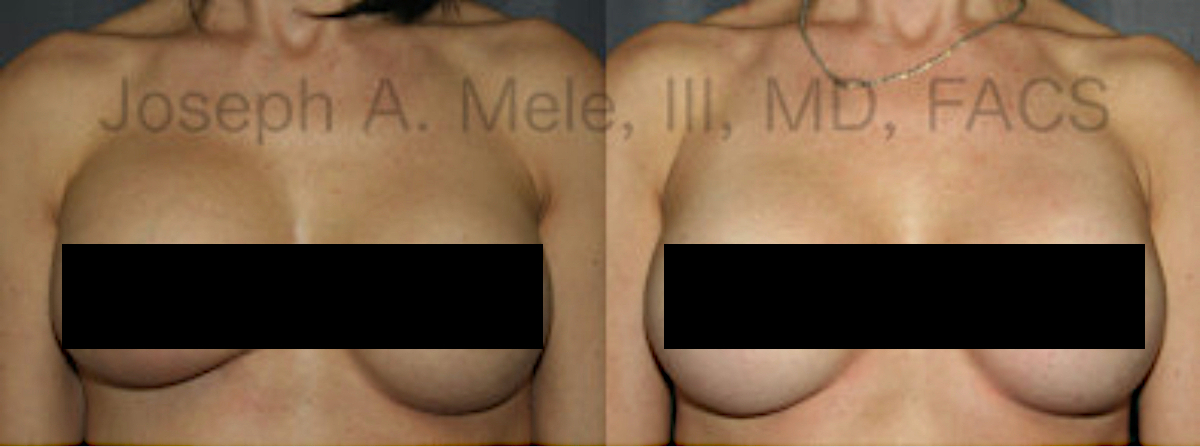
Breast Augmentation Revision with Nipple Reduction - Before (left) and After (right)

Breast Augmentation Revision with Nipple Reduction - Before (left) and After (right)

The previous implants were removed, a capsulorraphy was performed, additional work was done internally to form a new IMF, and new implants where placed via a periareolar scar (from 4 to 8 o’clock). The volume was increased from 300 to 350 cc’s using saline filled implants. In addition, the nipples were reduced with an incision that runs around its base. The nipple is still high on the right, and could be improved by further raising the breast implants. However, for the sake of the left breast, it is better to keep the implants in their current position. While this leaves the right nipple high, it avoids creating a low (sagging looking) nipple on the left.

Notice the improvement of the angle at the bottom of the breasts. It is no surprise that the bra was ridding up onto the breasts before surgery. After recreation of the IMF, it is higher, smooth and well defined.

Posted in Breast Asymmetry, Breast Augmentation, Breast Implant Revision Surgery, Capsular Contracture, Home, Nipple Reduction | No Comments »

« Previous Entries

  • Follow Dr. Joseph Mele on Facebook Get tweets from Dr. Joseph Mele on Twitter View Dr Joseph Mele's Videos on YouTube
    Subscribe to our RSS Feed.
    Join us on Facebook.
    Receive our Tweets on Twitter.
    Watch the DrMele channel on YouTube.


  • Useful Links

    • Visit Dr. Mele's Main Website
    • Visite el Sitio Principal del Dr. Mele
  • Recent Posts

    • Patient Safety – AB 583 – A Great Bill for You
    • Brachioplasty (Arm Lift) San Francisco
    • One Board Certified Plastic Surgeon
    • International Society for Aesthetic Plastic Surgery (ISAPS) in San Francisco
    • Breast Augmentation and Nipple Piercing
    • Juvederm XC and Vivite Give Away
    • Plastic Surgery Blogs
    • Dr. Mele Receives the 2009 Patients’ Choice Award
    • Rhytidectomy (Facelift) San Francisco – Part 4 of 4
    • Rhytidectomy (Facelift) San Francisco – Part 3 of 4
  • Categories

    • About Dr. Mele (14)
      • Plastic Surgery Societies (13)
    • Areolar Reduction (2)
    • Arm Lift (Brachioplasty) (2)
    • Breast Asymmetry (8)
    • Breast Augmentation (27)
      • Breast Implant Options (3)
    • Breast Implant Revision Surgery (19)
    • Breast Lift (Mastopexy) (4)
    • Breast Reduction (4)
      • Breast Reduction (Men) (4)
      • Breast Reduction (Women) (2)
    • Capsular Contracture (10)
    • Eyelashes (1)
    • Eyelid Lift (Blepharoplasty) (8)
    • Facelift (Rhytidectomy) (6)
    • Home (102)
    • Inverted Nipples (1)
    • Liposuction (21)
    • Mini Facelift (Mini Rhytidectomy) (2)
    • Mini Tummy Tuck (Mini Abdominoplasty) (8)
    • Mommy Makeover (7)
    • Nipple Reduction (2)
    • Patient Safety (15)
    • Post-Bariatric Surgery (After Weight Loss) (6)
    • Rhinoplasty (Nasal Surgery) (3)
    • Scar Revision (Keloids) (6)
    • Tubular Breasts (4)
    • Tummy Tuck (Abdominoplasty) (13)
    • Uncategorized (4)
    • Wrinkle Reduction (Non-surgical) (17)
    • Chin Implants/Augmentation (2)
    • Lip Enhancement/Augmentation (6)
  • Archives

    • September 2010
    • August 2010
    • July 2010
    • June 2010
    • May 2010
    • April 2010
    • March 2010
    • February 2010
    • January 2010
    • December 2009
    • November 2009
    • October 2009
    • September 2009
    • August 2009
    • July 2009
    • June 2009
  • Fill out the form to receive more info.

    * indicates a required field


    Please send me regular updates from the doctor
  • Abdominoplasty Arm Lift (Brachioplasty) Augmentation Blepharoplasty Botox/Dysport Botulinum Toxin Breast Breast Asymmetry Breast Augmentation Breast Implant Complications Breast Implant Revision Breast Implants Breast Lift Breast Reduction Capsular Contracture Chin Augmentation Cosmetic Surgery Eyelid Surgery Eye Lift Facelift Fillers Gel Gummy Gynecomastia Hyaluronic Acid Implants Lip Augmentation Lip Enhancement Liposuction Lips Mini Abdominoplasty Mini Tummy Tuck (Mini Abdominoplasty) Mommy Makeover Nipple Asymmetry Nipple Reduction Patient Safety Plastic Surgery Post-Bariatric Surgery Rhinoplasty Rhytidectomy Saline Scar Revision (Keloids) Silicone Tummy Tuck Wrinkle Treatments

    WP Cumulus Flash tag cloud by Roy Tanck and Luke Morton requires Flash Player 9 or better.


Joseph A. Mele. M.D., F.A.C.S
130 La Casa Via Walnut Creek, CA 94598 | 925-943-6353
Copyright © 2010 www.sanfranciscoplasticsurgeryblog.com | Terms of Use