• Home
  • Meet Dr. Mele
  • Contact Us
  • Social Media Links

Rhytidectomy (Facelift) San Francisco – Part 4 of 4

July 24th, 2010 Dr. Mele

In the last few decades, plastic surgery has moved from a secretive, back door affair, to main street, and the Facelift (Rhytidectomy) is no exception. Mini-facelifts and “weekend facelifts” like the Lifestyle Lift®, QuickLift™ are household words, and nothing says mainstream more than a brand name, late night informercial, but has it gone too far?

I had never heard of astroturfing until the LifeStyle Lift came along. It illustrates the hazards of purchasing a procedure from a corporation with a large marketing budget, rather than from a Board Certified Plastic Surgeon. More importantly, is the one-size-fits-all facelift a good idea?

The One-Size-Fits-All Facelift

To my eye, facelifts are individualized procedures. Each face is different and every face ages differently. When I evaluate a new patient for a facelift, I evaluate many specific areas. I can tailor my approach to maximize the benefit to the areas that need it the most. The advantage of knowing how to do more than one type of facelift is that I can choose the method that is most likely to help your specific needs.

Sometimes a mini-facelift is enough. Sometimes the traditional full facelift is necessary. Sometimes a deeper plane also needs to be addressed. Should the facelift be en-block or bidirectional? Differences between the mini and full facelifts are explained in my post: Facelift (Rhytidectomy) v. Mini Facelift (Mini Rhytidectomy). Mini and full facelift before and after pictures are also included. Which approach to use is a decision I make after I see you. With mass marketed mini-facelifts, one-size-fits-all, the treatment is largely determined before the evaluation. It’s akin to selecting a tool, before knowing what you are supposed to do with it.

The Buck Stops Here

When I see you in my office for any procedure, I want all the information I can get before selecting a plan. I want to know:

  • Where are the problems?
  • What needs to be addressed?
  • Is it fixable?
  • Are the goals realistically achievable?

How best to proceed is determined after defining the goals, reviewing the options and building trust. My goal is to provide you with sufficient information so that there are no surprises. A good result takes communication and teamwork throughout the process. A good result takes careful planning and keeping all the options open until the best method is defined.

A facelift is not a one-size-fits-all commodity. Honest discussion beforehand, yields better results and higher satisfaction. If there was one, singular best way to do a facelift, every plastic surgeon would do the same procedure every time. The variety in approaches to the facelift, reflects the variety seen in the face.

Body Beautiful

The 800 number in the video below was only used for viewer questions during the live broadcast. If you have questions, or would like to schedule a consultation appointment for a facelift, please call my Walnut Creek Plastic Surgery office at (925) 943-6353.

Information in this video is provided for general informational purposes only. Specific recommendations can only be made after a careful history and physical examination are performed. Some of the topics covered include:

  • Brand name mini-facelifts (Lifestyle Lift®, QuickLift™, …)?
  • The importance of investigating your doctor before scheduling an appointment
  • Who will take care of you if there is a problem?
  • How to find a Board Certified Plastic Surgeon
  • Viewer questions are answered about Blepharoplasty (Eye Lid Surgery)

The other segments of this broadcast can be found here:

  • Rhytidectomy (Facelift) San Francisco – Part 1 of 4
  • Rhytidectomy (Facelift) San Francisco – Part 2 of 4
  • Rhytidectomy (Facelift) San Francisco – Part 3 of 4
  • Rhytidectomy (Facelift) San Francisco – Part 4 of 4 (You are here)

Check if your doctor is Board Certified by the American Board of Plastic Surgery.
Check if your doctor is Board Certified by another American Board of Medical Specialties board. You will need to register to use this site, but it is safe, free and fast.
Check if your doctor has an unrestricted California Medical License. Read the disclaimer and click “Continue to Search” at the bottom. If you are not in California, Google your local medical board for a link.

Posted in Facelift (Rhytidectomy), Home, Mini Facelift (Mini Rhytidectomy) | No Comments »

Rhytidectomy (Facelift) San Francisco – Part 3 of 4

July 20th, 2010 Dr. Mele

The two most important aspects of any surgical procedure are predictability and safety. The facelift (rhytidectomy) is no exception. If you are considering a facelift, you want to know:

  • What will a facelift can do for my face?
  • How can I have a facelift in the safest possible manner?

The video segment from KRON4′s Body Beautiful answers these questions, and explains:

  • The goals of facelift surgery
  • How to make it safe

The facelift addresses three main areas:

The Cheeks – Nasolabial Folds and Marionette Lines

Sometimes called the “parentheses,” because they bracket the mouth, the nasolabial folds are the wrinkles that run from the base of the nose to the corners of the mouth. The creases that continue from the corners of the mouth down to the chin are called marionette lines.

These areas are frequently treated with Hyaluronic Acid (HA) fillers like Restylane®, Perlane® and Juvederm®. Now that all the HA fillers come with a local anesthetic (Lidocaine) added, it is a more comfortable procedure. Facelifts reduce nasolabial folds and marionette lines in an entirely different way. By elevating the cheeks, and reducing the amount of skin that folds over them, the depth and shadowing of these aging folds are reduced. For deeper lines, a combination of filler and lift may be necessary. Your own cells can be used to fill the area too. When performing a facelift, I will often use a dermal graft to further reduce the facial folds in the nasolabial and marionette areas.

The Neck

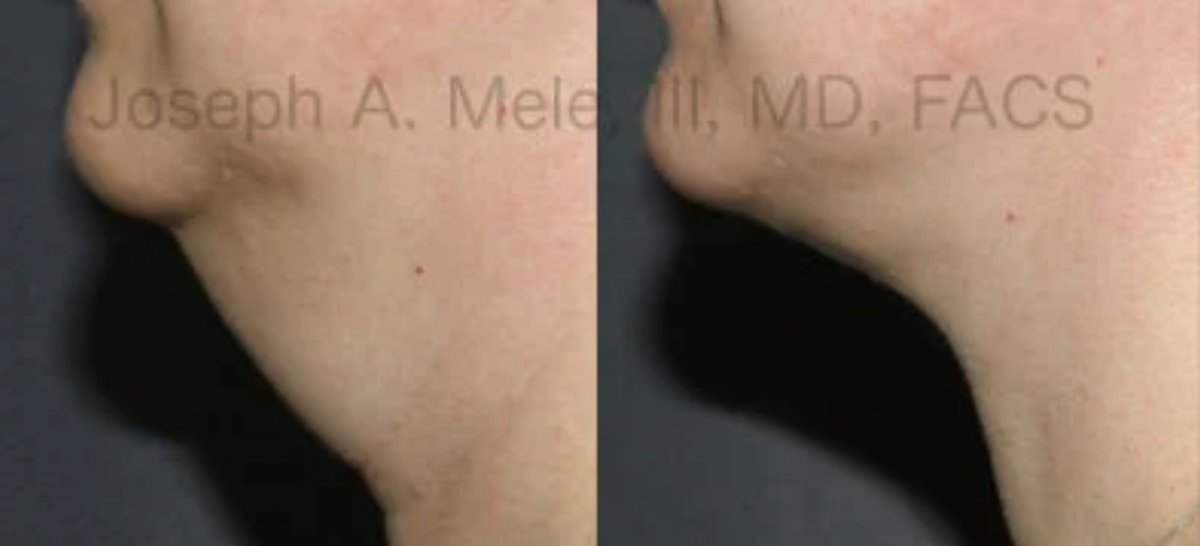
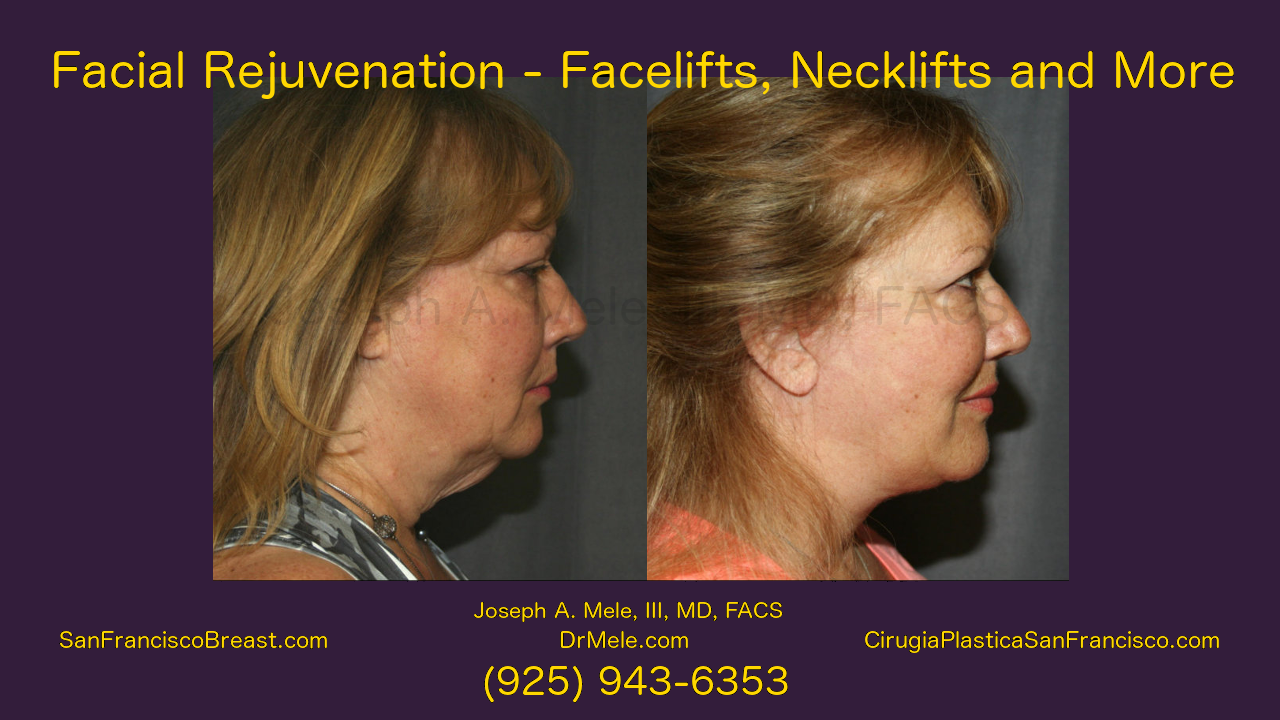
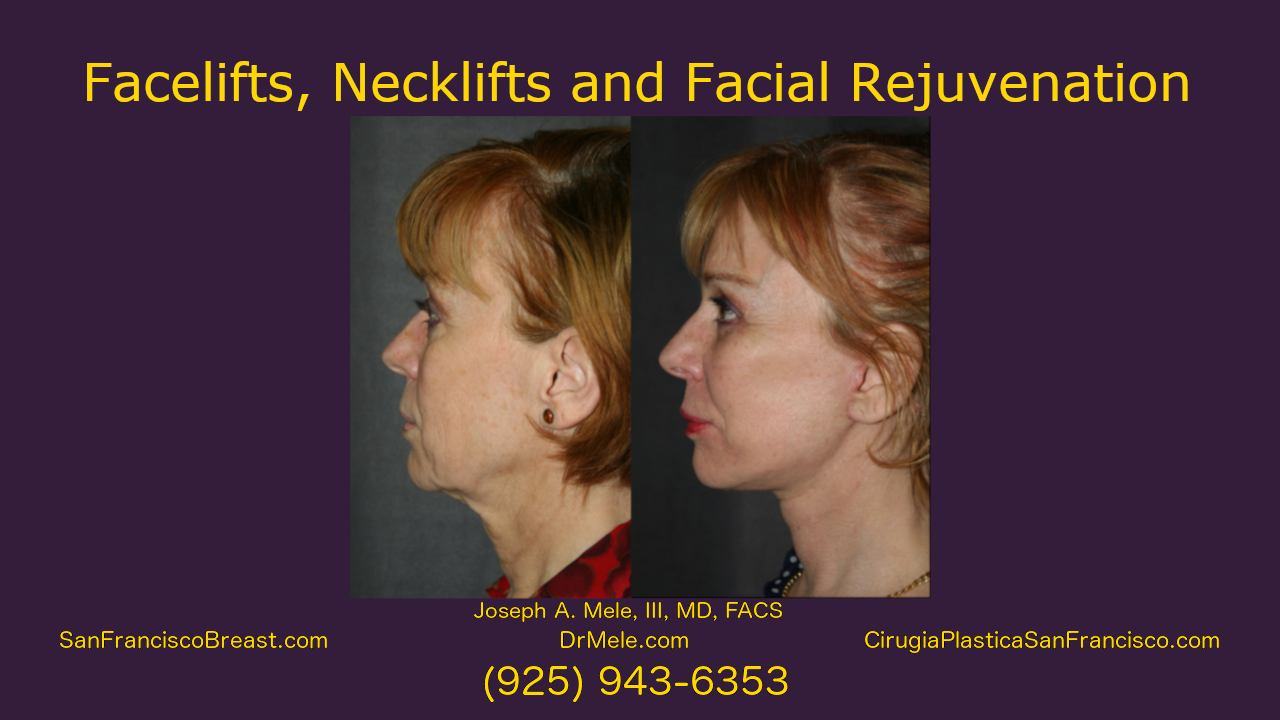
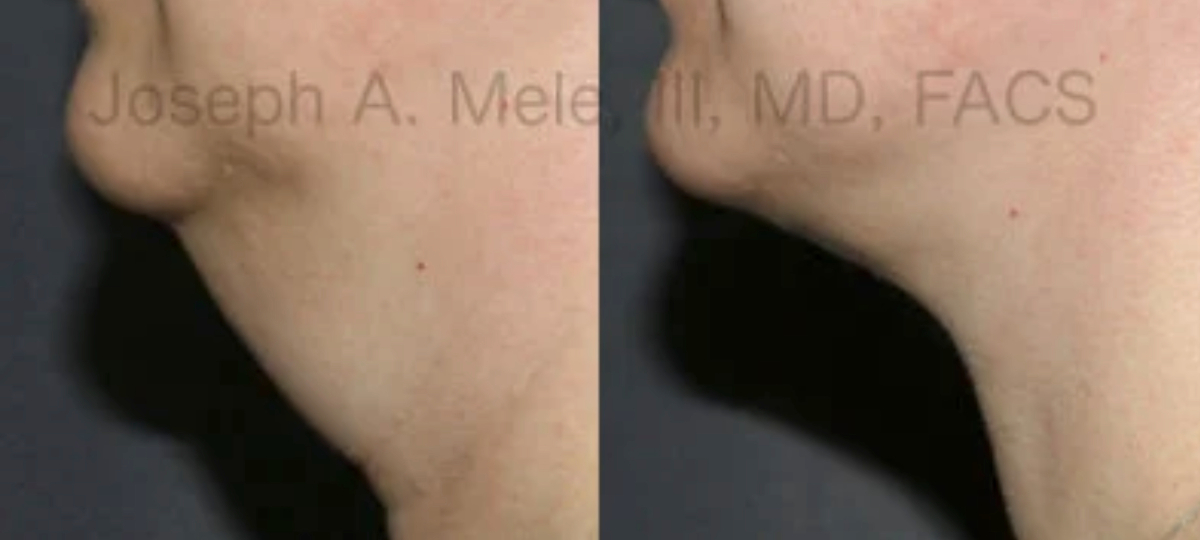
The facelift includes the cheeks, jawline and neck. If you only have loose skin on the neck, then a necklift may suffice, but most of the time, both areas age in parallel. If you have loose neck skin, or bands on the front of the neck from the platysma muscle, a facelift can attenuate them.

The Jawline and The Jowls

The jawline is the boundary between the face and the neck. As we age, this boundary becomes blurred. The jowls begin to break up the youthful smooth contours, and the definition between the face and neck becomes less distinct. Since the face and neck are both treated, the jawline between them is also addressed with a facelift. San Francisco Bay Area patients have come to expect the best in facelift surgery. Rejuvenation without distortion is the key. A clean jawline goes a long way toward a youthful face.

Facelift Safety

The safety of a facelift is enhanced by a thorough preoperative workup. This includes everything done leading up to the surgery. If you have high blood pressure, being certain that is it well controlled before surgery is imperative. If you smoke, stopping four weeks before surgery reduces the risk of healing problems by a factor of six.

Doing the facelift procedure safely is also important. The proper facility and equipment help ensure that you are properly monitored the day of surgery.

Last, and certainly not least, the training of you Plastic Surgeon is important. A well trained surgeon is a safe surgeon. By selecting a Board Certified Plastic Surgeon, you can be certain they have the most specialized and thorough training available. Members of the American Society for Aesthetic Plastic Surgery (ASAPS) are uniquely qualified in the realm a Cosmetic Plastic Surgery. As a condition of membership, I have to be a Board Certified Plastic Surgeon and specialize in the Cosmetic aspects of Plastic Surgery.

On With the Show

The 800 number in the video below was only used for viewer questions during the live broadcast. If you have questions, or would like to schedule a consultation appointment for a facelift, please call my Walnut Creek Plastic Surgery office at (925) 943-6353.

This video is provided for general informational purposes only. Specific recommendations can only be made after a careful history and physical examination are performed. Some of the topics covered include:

  • The changing acceptance of the Facelift
  • The increasing popularity of Facelifts (about 100000 facelifts are performed a year)
  • The goals of the Rhytidectomy
  • The hazards of overcorrection
  • The differences between male and female Facelifts
  • Facelift do’s and don’t's
  • How to assess preexisting medical conditions – preoperative optimization
  • Should you see your primary medical doctor before having surgery?
  • Smoking and Facelifts
  • The importance of a Board Certified Plastic Surgeon
  • The importance of an Accredited Surgery Center
  • Can other facial rejuvenation procedures be safely combined with a facelift?

The other segments of this broadcast can be found here:

  • Rhytidectomy (Facelift) San Francisco – Part 1 of 4
  • Rhytidectomy (Facelift) San Francisco – Part 2 of 4
  • Rhytidectomy (Facelift) San Francisco – Part 3 of 4 (You are here)
  • Rhytidectomy (Facelift) San Francisco – Part 4 of 4 (Coming soon)

Posted in Facelift (Rhytidectomy), Home | No Comments »

Rhytidectomy (Facelift) San Francisco – Part 2 of 4

July 16th, 2010 Dr. Mele

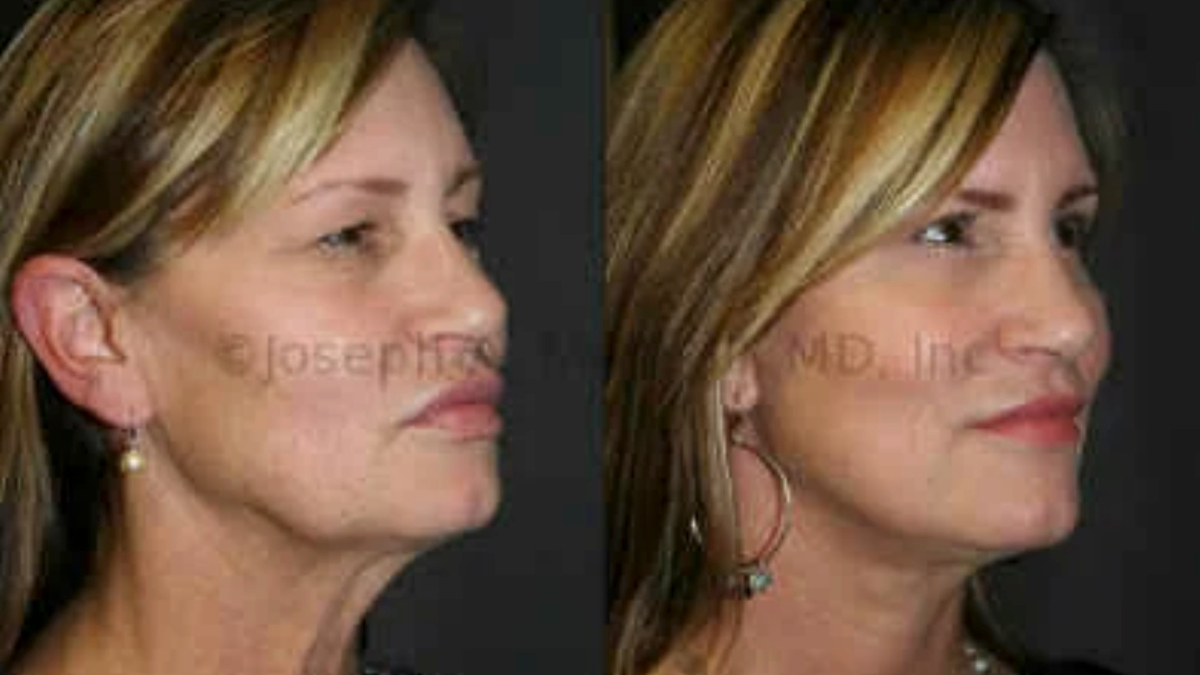
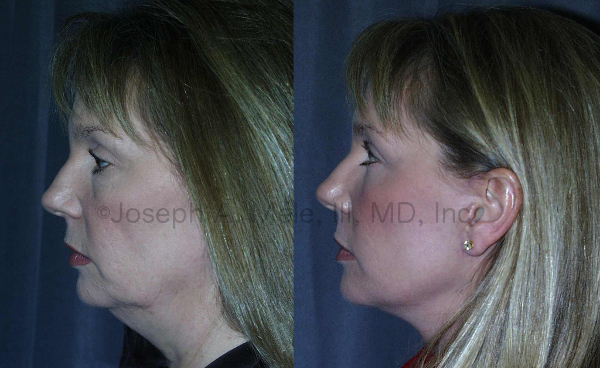
Almost 100,000 facelifts were performed by Board Certified Plastic Surgeons in the United States last year. It is one of the most frequently requested cosmetic plastic surgery procedures I perform. While rhytidectomy means wrinkle removal, the goal is to achieve a youthful, rested appearance that maintains expression.

This video segment, taken from my appearance on KRON4′s Body Beautiful, discusses the changes that occur with a facelift. Facelift before and after pictures are included. The specific areas of treatment are compared for the rhytidectomy and mini-rhytidectomy. The pro’s and con’s of the facelift are contrasted with the mini-facelift. San Francisco Bay Area residents had their questions about facelifts and necklifts answered live.

The 800 number in the video below was used for the live broadcast. If you have questions, or would like to schedule a consultation appointment, please call my Walnut Creek Plastic Surgery office at (925) 943-6353. Questions can also be asked using the contact form on the lower left aspect of this page.

This video is provided for general informational purposes only. Specific recommendations can only be made after a careful history and physical examination are performed. Some of the topics covered include:

  • How popular is the Facelift procedure?
  • Before and after pictures of Facelifts
  • Before and after pictures of Mini-Facelifts
  • Description of the Facelift
  • What is a Mini-Facelift?
  • What areas of the face and neck are addressed with a Facelift?
  • How is a Necklift different from a Facelift?
  • Can Liposuction take the place of a Facelift?
  • How is the definition of the neck restored?

The other segments of this broadcast can be found here:

  • Rhytidectomy (Facelift) San Francisco – Part 1 of 4
  • Rhytidectomy (Facelift) San Francisco – Part 2 of 4 (You are here)
  • Rhytidectomy (Facelift) San Francisco – Part 3 of 4
  • Rhytidectomy (Facelift) San Francisco – Part 4 of 4 (Coming soon)

Posted in Facelift (Rhytidectomy), Home | No Comments »

Rhytidectomy (Facelift) San Francisco – Part 1 of 4

July 12th, 2010 Dr. Mele

The name for the facelift procedure, or rhytidectomy, comes from the Latin word rhytid meaning wrinkle. Rhytidectomy literally means wrinkle removal. While Board Certified Plastic Surgeons remove wrinkles from all over the body, in Cosmetic Plastic Surgery, the term rhytidectomy is used almost exclusively to describe the surgical procedure that removes wrinkles from the face.

While the facelift is the gold standard for facial rejuvenation, there are many options to consider. This video segment, taken from my appearance on KRON4′s Body Beautiful, discusses the changes that occur in the face as we age. It reviews treatments like botulinum toxin (BOTOX Cosmetic, Dysport) and fillers (Restylane, Perlane, Juvederm), mini-facelifts and the facelift. San Francisco Bay Area residents were able to call in with their questions and have them answered live on the air.

The 800 number in the video below was only used for viewer questions during the live broadcast. If you have questions, or would like to schedule a consultation appointment, please call my Walnut Creek Plastic Surgery office at (925) 943-6353.

This video is provided for general informational purposes only. Specific recommendations can only be made after a careful history and physical examination is performed. Some of the topics covered include:

  • Loss of facial volume as we age
  • The effects of gravity
  • Restoration of volume with fillers
  • Reducing facial animation lines with Botox/Dysport
  • What is a facelift?
  • What areas of the face are addressed with a facelift?
  • Is the neck included in a facelift?
  • How is facial volume replacement addressed?
  • Is it supposed to look tight?

The other segments of this broadcast can be found here:

  • Rhytidectomy (Facelift) San Francisco – Part 1 of 4 (You are here)
  • Rhytidectomy (Facelift) San Francisco – Part 2 of 4
  • Rhytidectomy (Facelift) San Francisco – Part 3 of 4
  • Rhytidectomy (Facelift) San Francisco – Part 4 of 4 (Coming soon)

Posted in Facelift (Rhytidectomy), Wrinkle Reduction (Non-surgical) | No Comments »

New Plastic Surgery Products – Hydrelle®

August 1st, 2009 Dr. Mele

UPDATE: I can no longer recommend this product. I would suggest using Restylane®, Perlane® or Juvederm®. All three are now available with Lidocaine, all three seem to have fewer adverse reactions and superior customer service. Details here.

Hydrelle the first FDA approved wrinkle filler with a numbing agent added.

Hydrelle: first FDA approved wrinkle filler with numbing added.

Sometimes called the liquid facelift, injectable fillers have made there mark in cosmetic plastic surgery. While they cannot do what a facelift does in terms of removing loose skin, they can fill the deeper lines around the nose lips and mouth. These lines are one of the three main areas corrected by a surgical facelift. For my patients with only these lines, a filler is a quicker and less expensive option. For my patients with these lines plus jowls and loose neck skin, correcting the lines can often postpone the need for a facelift.

Additional information and educational movies about injectable fillers and facelifts can be found on my Walnut Creek Plastic Surgery Website. Here are the links: Injectable Dermal Fillers Walnut Creek and Facelift Walnut Creek. Below is a brief review of the injectable dermal fillers that are currently available.

Dermal fillers are some of the most commonly used cosmetic products in facial plastic surgery. They can be used to reduce wrinkles and add volume. Dermal fillers are also used to augment lips, cheeks and chins. And now a new dermal filler is coming soon to San Francisco Plastic Surgery offices.

The King is Dead; Long Live the King!

Collagen® is no longer manufactured by Allergan. It was the king of facial wrinkle injections and plumped lips for decades. Now there is a new king. The generic term for these is Hyaluronic Acid (HA).

Hyaluronic Acid has replaced Collagen® because HA is softer and longer lasting. You may know them by their brand names: Restylane®, Perlane®, Juvederm® and the soon to be available Hydrelle®. Hydrelle is the first HA preparation made with lidocaine (a numbing agent) mixed in.

While Radiese® is also an injectable dermal filler it is not a HA and it is not as versatile. Its use is limited to deeper wrinkles and to augmenting the cheeks and chin. It is not recommended for fine lines or lips. It is bright white and firm to touch as opposed to HA fillers which are a clear gel.

So What is Hyaluronic Acid

Hyaluronic acid (HA), like collagen, is naturally found in our skin and joints. It used in many commercially available moisturizers, and several manufactures purify it for the treatment of wrinkles. While HA is a good moisturizer when applied to the surface of the skin, the real benefit of HA is wrinkle reduction by direct injection.

HA is supplied in pre-filled sterile single-use syringes. It is a clear gel that can be injected directly into the dermis (deep skin) to provide immediate improvement in the appearance of wrinkles. It can also be used to enhance facial features, the most popular being the lips. Unlike Collagen®, which was quite firm, HA’s are soft, and softness is a big benefit for lips.

The biggest downside to current wrinkle reductions with HA’s is that it needs to be injected. Injections can cause discomfort and sometimes bruises. There is some mild swelling and redness associated with the treatments, but this resolves quickly. To help reduce the discomfort associated with the injections, all major HA manufactures/suppliers (Medicis and Allergan in the US) have added Lidocaine to their HA product. While Hydrelle®, was the first FDA approved combination of HA and numbing agent, Perlane®, Restylane® and Juvederm® are now also available with Lidocaine.

San Francisco Bay Area Plastic Surgery

So what can you expect from HA injections? Currently in my San Francisco Bay Area Plastic Surgery practice I prepare for HA injections by carefully cleaning the skin and then blocking the area with a Lidocaine injection. With the area now numb, I can concentrate on wrinkle correction, and you can feel comfortable.

What will be different with Hydrelle®? Hydrelle® numbs as it’s injected. The lidocaine in the Hydrelle® will not help with the first pass. Unless the area is blocked as above, the first pass will be felt. However, with deeper wrinkles, multiple passes over the same area are common. For these repeat injections, the site would be numb from the first pass, and any discomfort minimized. The advantage is that only the treated area is numb.

Collagen® also had lidocaine added and it worked pretty well. Being a Board Certified Plastic Surgeon who practiced through the transition from Collagen® to the first HA Restylane®, I can tell you many of my Collagen® patients made the transition to HA’s and preferred the block over the lidocaine in the injectable. This is especially true in the upper lip. For some, anesthetizing the area with a local block will still be better, but it is nice to have options.

Posted in Facelift (Rhytidectomy), Home, Wrinkle Reduction (Non-surgical) | No Comments »


  • Follow Dr. Joseph Mele on Facebook Get tweets from Dr. Joseph Mele on Twitter View Dr Joseph Mele's Videos on YouTube
    Subscribe to our RSS Feed.
    Join us on Facebook.
    Receive our Tweets on Twitter.
    Watch the DrMele channel on YouTube.


  • Useful Links

    • Visit Dr. Mele's Main Website
    • Visite el Sitio Principal del Dr. Mele
  • Recent Posts

    • Patient Safety – AB 583 – A Great Bill for You
    • Brachioplasty (Arm Lift) San Francisco
    • One Board Certified Plastic Surgeon
    • International Society for Aesthetic Plastic Surgery (ISAPS) in San Francisco
    • Breast Augmentation and Nipple Piercing
    • Juvederm XC and Vivite Give Away
    • Plastic Surgery Blogs
    • Dr. Mele Receives the 2009 Patients’ Choice Award
    • Rhytidectomy (Facelift) San Francisco – Part 4 of 4
    • Rhytidectomy (Facelift) San Francisco – Part 3 of 4
  • Categories

    • About Dr. Mele (14)
      • Plastic Surgery Societies (13)
    • Areolar Reduction (2)
    • Arm Lift (Brachioplasty) (2)
    • Breast Asymmetry (8)
    • Breast Augmentation (27)
      • Breast Implant Options (3)
    • Breast Implant Revision Surgery (19)
    • Breast Lift (Mastopexy) (4)
    • Breast Reduction (4)
      • Breast Reduction (Men) (4)
      • Breast Reduction (Women) (2)
    • Capsular Contracture (10)
    • Eyelashes (1)
    • Eyelid Lift (Blepharoplasty) (8)
    • Facelift (Rhytidectomy) (6)
    • Home (102)
    • Inverted Nipples (1)
    • Liposuction (21)
    • Mini Facelift (Mini Rhytidectomy) (2)
    • Mini Tummy Tuck (Mini Abdominoplasty) (8)
    • Mommy Makeover (7)
    • Nipple Reduction (2)
    • Patient Safety (15)
    • Post-Bariatric Surgery (After Weight Loss) (6)
    • Rhinoplasty (Nasal Surgery) (3)
    • Scar Revision (Keloids) (6)
    • Tubular Breasts (4)
    • Tummy Tuck (Abdominoplasty) (13)
    • Uncategorized (4)
    • Wrinkle Reduction (Non-surgical) (17)
    • Chin Implants/Augmentation (2)
    • Lip Enhancement/Augmentation (6)
  • Archives

    • September 2010
    • August 2010
    • July 2010
    • June 2010
    • May 2010
    • April 2010
    • March 2010
    • February 2010
    • January 2010
    • December 2009
    • November 2009
    • October 2009
    • September 2009
    • August 2009
    • July 2009
    • June 2009
  • Fill out the form to receive more info.

    * indicates a required field


    Please send me regular updates from the doctor
  • Abdominoplasty Arm Lift (Brachioplasty) Augmentation Blepharoplasty Botox/Dysport Botulinum Toxin Breast Breast Asymmetry Breast Augmentation Breast Implant Complications Breast Implant Revision Breast Implants Breast Lift Breast Reduction Capsular Contracture Chin Augmentation Cosmetic Surgery Eyelid Surgery Eye Lift Facelift Fillers Gel Gummy Gynecomastia Hyaluronic Acid Implants Lip Augmentation Lip Enhancement Liposuction Lips Mini Abdominoplasty Mini Tummy Tuck (Mini Abdominoplasty) Mommy Makeover Nipple Asymmetry Nipple Reduction Patient Safety Plastic Surgery Post-Bariatric Surgery Rhinoplasty Rhytidectomy Saline Scar Revision (Keloids) Silicone Tummy Tuck Wrinkle Treatments

    WP Cumulus Flash tag cloud by Roy Tanck and Luke Morton requires Flash Player 9 or better.


Joseph A. Mele. M.D., F.A.C.S
130 La Casa Via Walnut Creek, CA 94598 | 925-943-6353
Copyright © 2010 www.sanfranciscoplasticsurgeryblog.com | Terms of Use