Dr. Joseph Mele appears on KRON4′s Body Beautiful.
On Monday, Walnut Creek Plastic Surgeon, Dr. Joseph Mele, MD, FACS, appears on the San Francisco Bay Area’s News Station, KRON Channel 4, with the latest in breast enhancement options. As a guest of Body Beautiful with Janelle Marie, Dr. Mele will discuss Breast Augmentation, Breast Lift, Breast Reduction and even Breast Revision Surgery.
Answers to Your Breast Enhancement Questions
The television show is broadcast live, so you can call in and ask your questions on the air, and get your Breast Enhancement Questions answered during the show. Tune in to channel 4 at 11 AM on Monday (December 10, 2012) for the number to call. Also, feel free to call the office at (925) 943-6353 any weekday, 9 AM to 5 PM.
San Francisco Breast Enhancements
In conjunction with Monday’s topic, the San Francisco Breast website has had a mini lift. New pages have been added to expand the popular Breast Augmentation and Breast Implant Revision pages. More details and the latest information is available about your Breast Augmentation, Breast Implants and Breast Augmentation Revision options.
Click on the banners below to visit the site. Menus for the new pages are available at the top of these pages.
Click above to visit SanFranciscoBreast.com’s New Breast Augmentation Page
Click above to visit San Francisco Breast's New Breast Implant Revision Page
More Information
The goal is to provide you the best information available about Cosmetic Breast Surgery. If you need more information, use the contact form on the left to send our Walnut Creek Plastic Surgery office a question. Information here, and on my web sites, provides good general knowledge; however, it cannot substitute for an in-person consultation with a Board Certified Plastic Surgeon. If you are looking for specific details, or a personalized treatment plan, schedule your private consultation appointment today (925) 943-6353.
In trying to answer some of the most frequently asked questions about Breast Augmentation Revision, I have provided information here and on my main web sites. Information on the Internet, however, cannot replace a consultation with a Board Certified Plastic Surgeon. If you are having problems with your Breast Implants, seek the advice of a qualified professional, preferably a member of the American Society for Aesthetic Plastic Surgery.
What Are the Most Common Reasons for Breast Augmentation Revision?
The most common reasons for Breast Augmentation Revision include:
The desire to Change Size
Breast Implant Deflation
Capsular Contracture
Breast Implant Malposition (often caused by capsular contracture)
Changing Breast Implant Size
One of the most common reasons for Breast Augmentation Revision is to change the size of the Breast Implants. The overwhelming majority of the time, the goal is to increase the size of the Breast Implants. The procedure is usually simpler, and has a much easier recovery, than the initial Breast Augmentation. The pocket is opened, the old implants removed, the pocket is enlarged (capsulotomy or capsulectomy), and new implants are placed. When the goal is to decrease the size of the Breast Implants, the procedure is the same except the pocket is not enlarged, and sometimes it needs to me tightened (capsulorrhaphy). Breast Implants can also be changed from Saline to Silicone Gel, and less frequently from Silicone Gel to Saline.
Breast Implant Deflation
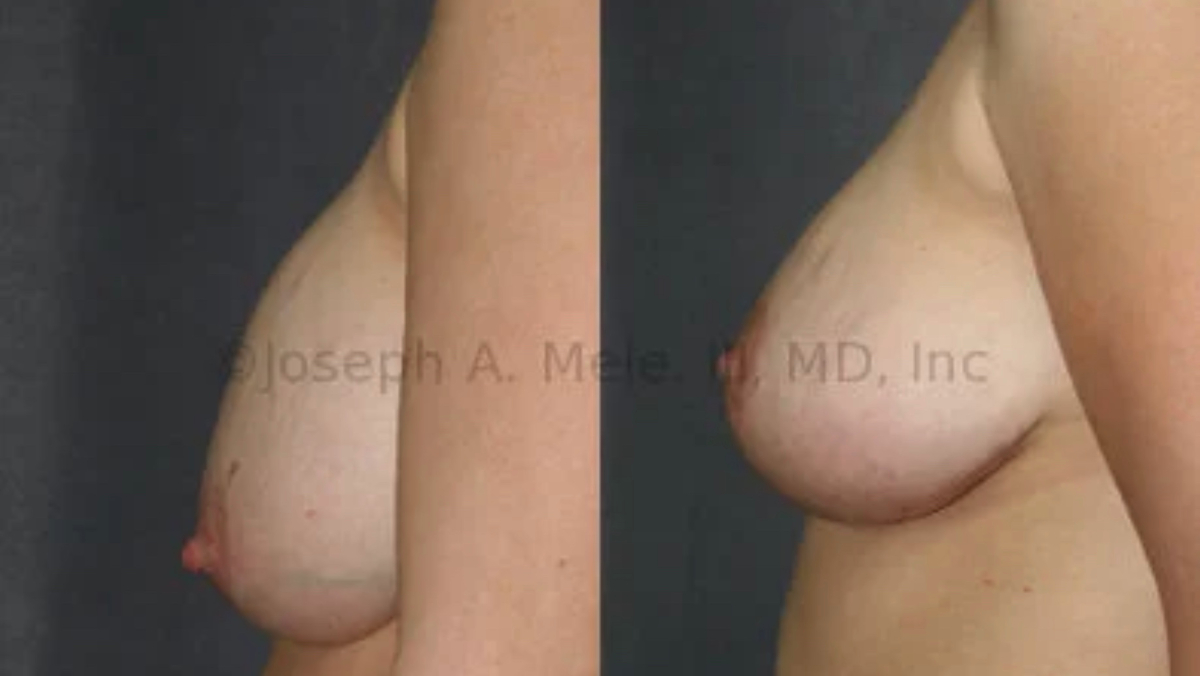
Breast Implant Deflation and Replacement: Problem – Patient’s left saline breast implant has deflated. Solution – Patient desired larger breast implants so both sides were replaced with larger breast implants.
With the advent of improved manufacturing and materials, the risk of breast implant deflation is reduced. What happens when a breast implant deflates depends on what is it filled with. Saline Breast Implants go flat, and the solution is safely absorbed by the body. Silicone Breast Implants have a firm center, and initially there may be no sign of a leak. Over time, the gel can leak out of the capsule, and you may feel a lump. Any lump in the breast should be promptly investigated. The sooner a broken implant is replaced, the simpler the procedure will be. The big three US breast implant manufacturers all have warranties: Allergan, Mentor and Sientra.
Capsular Contracture
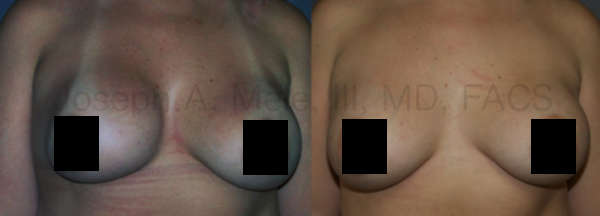
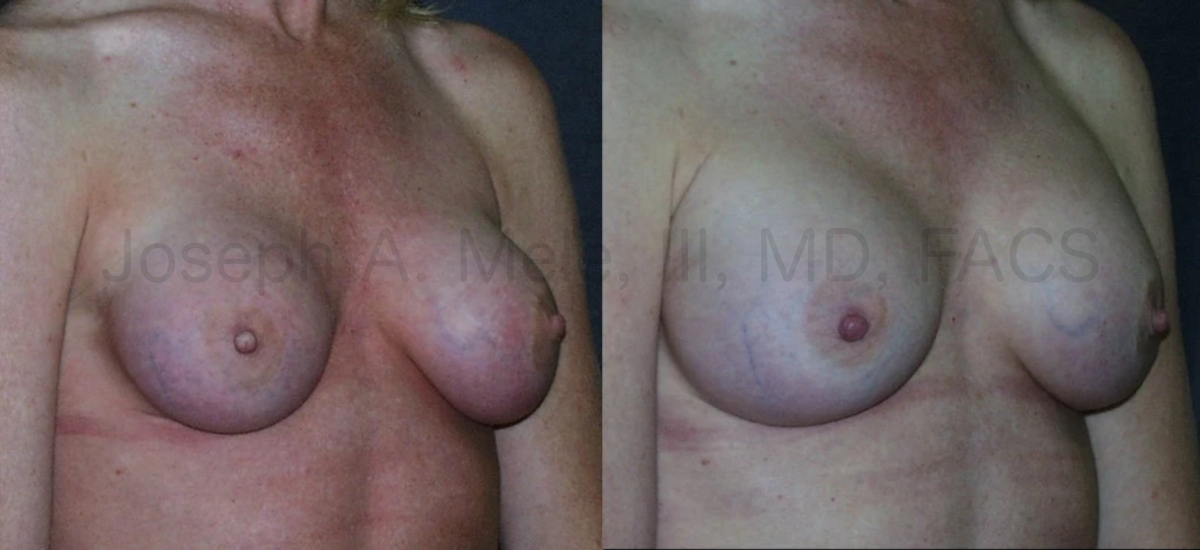
Capsular Contracture Before and After Capsulectomy: Problem – Capsular Contracture leads to firmer, smaller and more centralized breast implants. Solution – Capsulectomy removes the tight scar, softening and expanding the implants.
Capsular Contracture is the term for hardening of the Breast Implants. The breast implants themselves do not get hard, but the scar capsule that lines the pocket in which the Breast Implant sits tightens. The scar squeezes the Breast Implants and can change the firmness, shape and position of the Breast Augmentation. In the before picture above the redness of the breasts is caused by congestion of the circulation. It the most severe cases of Capsular Contracture (Grade IV) not only is the shape of the breast changed, but the breast also become painful.
Treatment of Capsular Contracture includes one, or a combination of:
Capsulectomy (removing the scar)
Capsulotomy (opening the scar)
Breast Implant Replacement
Breast Implant Malposition
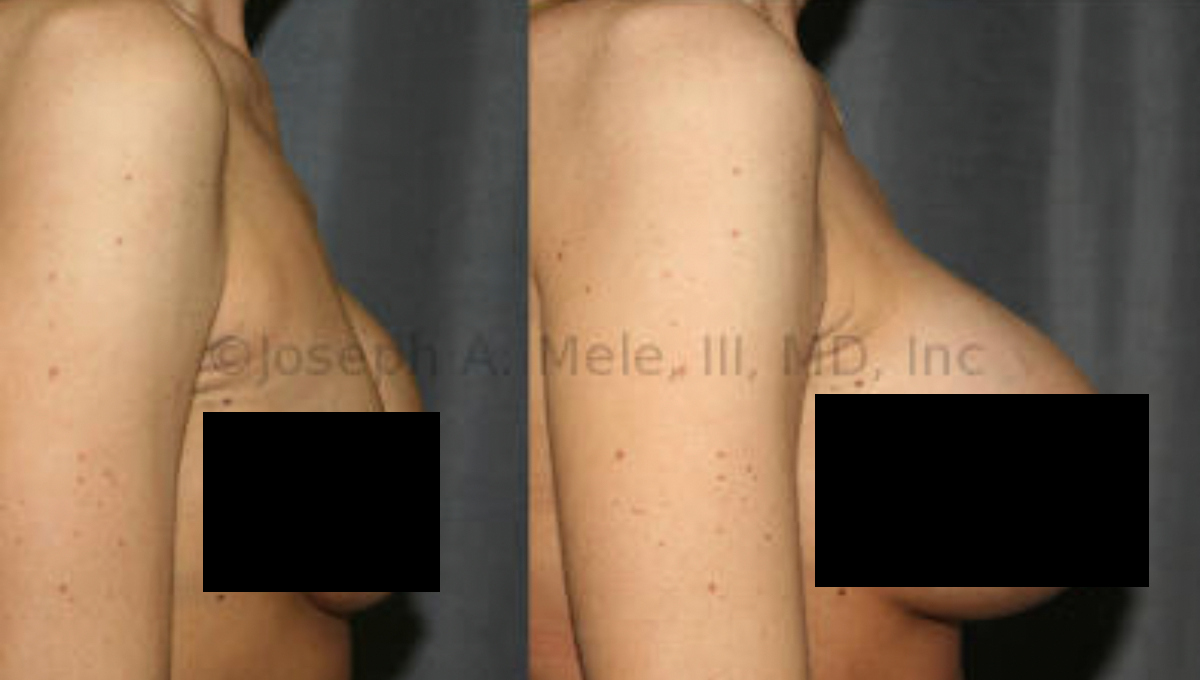
Breast Implant Malposition is a large topic by itself. When Breast Implant Malposition is caused by Capsular Contracture, the treatment is similar to that described above. When caused by Breast Implants that are too large for a woman’s frame, reducing the size of the Breast Implants may be an important part of the treatment. When implants are too low, the inframammary fold may need to be repaired, or completely reconstructed as is often the case in Breast Reconstruction after a mastectomy. Symmastia is also a form of Breast Implant Malposition that is seen when the breast implants migrate towards each other, breadloafing and forming a uniboob.
Problems With Breast Augmentation
If you have problems with your breast augmentation, seek the assistance of a Board Certified Plastic Surgeon, who has experience with the correction of Breast Augmentation. Although many of the skills required for Breast Augmentation are necessary for Breast Augmentation Revision, Breast Augmentation Revision Specialists have developed specific skills, and can help guide you to achieve safer and more predictable results.
The FDA (U.S. Food and Drug Administration) makes distinctions for approval depending on what is being approved. Since the FDA reviews everything from tongue depressors to artificial hearts, it makes sense that different levels of review exist. It also means that “FDA Approved” means something different for different medical devices, pharmaceuticals and medical equipment.
It may surprise you to know that breast implants are one of the most investigated medical devices in the history of the FDA. Since their introduction half a century ago, the FDA has mandated several large studies, involving tens of thousands of women. These studies have proven the efficacy and more importantly the safety of the current and the next generation breast implants, and the work is ongoing. Large scale investigations of both saline and silicone breast implants continue today. We are over half way through ten-year studies on the currently available breast implants. I am a primary investigator in these studies, and many of my patients have volunteered to participate in order to provide up-to-date safety data for the next generation of breast augmentation patients.
FDA Approved Breast Implants
Breast implants are classified as a medical device. When FDA review is needed prior to marketing a medical device there are two levels of approval:
FDA Clearance - The FDA will “clear” the device after reviewing a premarket notification, otherwise known as a 510(k) (a section in the Food, Drug, and Cosmetic Act), that has been filed with the FDA. To acquire clearance to market a device using the 510(k) pathway, the submitter of the 510(k) must show that the medical device is “substantially equivalent” to a device that is already legally marketed for the same use.
FDA Approval - The FDA will “approve” the device after reviewing a premarket approval (PMA) application that has been submitted. To acquire approval of a device through a PMA application, the PMA applicant must provide reasonable assurance of the device’s safety and effectiveness.
When it comes to breast implants, FDA approval means a lot. For the three companies currently FDA approved to sell breast implants in the US (Allergan, Mentor and now Sientra), the process was long, involving years of research and thousands of women. The process allowed the FDA to identify several quality control issues with the French manufacturer PIP, before their breast implants were allowed to be marketed in the U.S. PIP did not receive FDA approval, and sale of these adultered breast implants was blocked. The FDA single-handedly protected U.S. women from the problems PIP breast implants are causing around the world. Providing, the women did not go outside the U.S. for their surgery.
FDA Approved Radiation-Emitting Electronic Products – Huh?
I consulted the FDA web-site for the definition. A radiation-emitting electronic product is any product that uses electricity to power an electronic circuit that gives off any kind of radiation. Radiation means energy traveling across space. X-rays, microwaves, radiofrequency (RF) waves, laser, visible light, sound, ultrasound, and ultraviolet light are a few examples of the many types of radiation that may be produced by an electronic product. These devices include many of the latest fads in non-invasive, non-surgical cosmetic rejuvenation. But “FDA Approved” does mean the same thing for these devices, despite what is implied by the glossy adds featuring women too young to need the procedures.
The emphasis for all device approval is safety. The main goal of the FDA is to be certain that the device, when properly used by a trained professional, is not likely to cause injury. Even a low energy laser pointer can cause you serious injury, if pointed at your eye. Like with implantable medical devices, the FDA does a good job in ascertaining device safety.
The efficacy side of FDA approval, for external medical devices like lasers, ultrasound and R-F devices, is much less strenuous. While thousands of women were enrolled in breast implant studies, most radiation-emitting electronic products’ studies have low numbers of enrollees (10 – 40 is not unusual). As long as no one is hurt, and one patient shows some improvement, the device is “FDA Approved.” So it’s still buyer beware, especially if you are promised something that sounds too good to be true.
The Tool vs. the Professional
FDA approval is very important for medical devices. As a Board Certified Plastic Surgeon, I appreciate everything the FDA does to provide me with the best tools of the trade. While the proper tools are important, the person holding the tool is even more important. If you are seeking cosmetic surgery, be certain to find a Board Certified Plastic Surgeon to be your guide. We are very fortunate in the San Francisco Bay Area to have some of the best training programs and professionals in the world. With the right tools, in the proper hands, great things are possible.
PIP founder, Jean-Claude Mas, arrested after French breast implant manufacturing scandal.
The arrest of Poly Implant Prothese (PIP) founder, Jean-Claude Mas, in January, brought 2 years of investigations to its logical, albeit protracted, conclusion. However, the story goes back much farther, and there is much more work to do.
Poly Implant Prothese – PIP
PIP was founded in 1991 as a manufacturer of silicone breast implants covered with a polyurethane foam. When the US FDA restricted the use of silicone gel breast implants in 1992, the silicone breast implant market shrank. In 1995, France too placed restrictions on silicone filled breast implants. PIP expanded its market through innovation, and began offering pre-filled saline breast implants in 1996. It was with these pre-filled saline implants that PIP moved into the US market. 1996 was the first time I heard the name PIP.
PIP’s Short Lived Stay in the US – Thank You FDA
After a few years of use, it became clear to US plastic surgeons that PIP breast implants where not the same quality that US Board Certified Plastic Surgeons were used to with Inamed (formerly McGahn and now Natrelle under Allergan) and Mentor (now Johnson & Johnson). In general, breast implant failure rates are low in the first year and are more likely to leak the older they get, but the PIP saline implants seemed to leak much sooner and more often. Moreover, all PIP pre-filled saline implants experienced volume loss, even without obvious holes. A study published much later, in 2006, confirmed this. PIP’s popularity wained.
The FDA Goes to France
In May 2000, a decade before the current PIP silicone filled breast implant crisis, the US FDA performed an inspection of the PIP factory in La Seyne-sur-Mer (Southern France). The finding led to the immediate halt of all US PIP breast implant sales. The FDA issued a warning letter to PIP owner, Jean-Claude Mas, declaring its saline implants “adulterated.” The report sited 11 questionable manufacturing practices that were outside industry recognized best-practices. Whether the French Health Authority (AFSSAPS) was informed about the results of the FDA’s inspection or not, is unclear. If only the AFSSAPS had taken action then…
Silicone Gel Breast Implants are Back
By 2001, France removed its restrictions on silicone filled breast implants. PIP was still in business in Europe, and was expanding into South America, so again PIP innovated. In 2002, PIP launched an asymmetrical silicone filled breast implant. Fortunately, for all US women, the FDA had already given PIP the boot.
The Center of the Problem
On paper, these new breast implants were filled with NuSil, manufactured in California by NuSil Inc., a company founded by McGhan breast implant founder, Donald McGhan. In reality, PIP was not using NuSil to fill its breast implants. Instead, Monsieur Mas had his own recipe for a silicone filler, which I will call PIP gel. PIP more often used PIP’s non-approved silicone gel to fill PIP breast implants. The main reason, price. It cost about $23 to fill an implant with NuSil, but only $3 if PIP’s gel was substituted. This saved PIP about two million dollars in 2009. But the cheaper implants were also inferior in quality. The real cost was to come to the women receiving PIP breast implants, because PIP gel is made with industrial grade silicone, rather than the required medical grade silicone. Moreover, the failure rate of the PIP silicone filled breast implants, like the saline filled breast implants, seemed to come sooner and more frequently.
Knowing When to Duck
Although PIP was a French company, it was certified by TUV Rheinland in Germany. The approval came in 1997, and yearly inspections where performed in accordance to regulations. Unfortunately, guidelines also required TUV Rheinland to give PIP 10 days advance notice of their arrival. PIP used this time to hide all evidence of PIP gel. The paperwork was filed to look legit, and the regulators where none the wiser.
The European system had no requirements for unannounced inspection of the manufacturing facilities or even the breast implants. Once approved, the silicone filling of PIP implants was never retested.
More Acronyms – AFSSAPS
The AFSSAPS (Agence Francaise de Securite Sanitaire des Produits de Sante), does not certify medical products, but it can remove defective or dangerous products from the French market. In 2001, when silicone breast implants were reintroduced to France. The AFSSAPS tested the contents of PIP implants prior to approval. After that, private companies LEMI and LNE, to over. While strength and toxicity test were performed, no results are available about whether NuSil or PIP gel was used. The first random test was not performed until 2010, after PIP was under police investigation. The finding in the 2010 AFSSAPS report reads, “this one does not reach the degree of quality of a silicone gel intended for breast implants.”
European Regulators Blissfully Unaware
The FDA’s warning never reached Europe. Although the AFSSAPS watches the FDA site, it missed the PIP posting warning of problems in PIP’s breast implant manufacturing. There was, and still is, no system in place for sharing the information. Perhaps, this will now change, and countries can share information proactively. For a global economy, it makes sense.
It wasn’t until March of 2010, that two French health inspectors, acting on a tip, discovered six discarded plastic containers of Silopren along the outside wall of the PIP breast implant production facility. Silopren is a line of liquid silicone used mostly for industrial use, there are some medical uses for some of the Silopren product line, but externally for scar modification, and not as a filler for breast implants. PIP was not supposed to be using Silopren. Pip was supposed to be using NuSil. A week later, the factory was raided. It took another 8 months to track down Mas. The picture above is from the Interpol website.
European Regulators Under Scrutiny
French and European safety regulators now find themselves in an untenable position. European and South American governments are offering to pay for the removal of the estimated 300,000 defective PIP implants, before further harm is done. It is estimated that 10% of these implants have already leaked.
There is much to be learned from the PIP problems. Regulating medical devices is hard. It is a balance between allowing innovation and protecting from harm. In the elective surgery arena, the balance is tipped toward protection. However, in the case of PIP, there were many warning signs. Poor manufacturing, poor quality control, poor oversight and ignorance of the warnings from the FDA led to 10 years of inaction.
Low Price and Low Quality Often Go Together
Since in the US, PIP breast implants never achieved FDA approval, I never used them. I have not use the saline filled PIP breast implants either. I have, however, had to remove them. There were cheaper, but when it comes to enhancing one’s body cheaper is not better. Reputable, experienced and dedicated count, and this comes with a price. When it comes to plastic surgery, the lowest price is rarely the right answer.
What to do With PIP Breast Implants
If you had Breast Augmentation surgery in the US, with a reputable plastic surgeon, you do not have to worry about PIP silicone gel filled implants. However, if you had breast augmentation outside the US, you should check which implants were used. All PIP silicone breast implants should be replaced with new, FDA approved, breast implants, or at a minimum removed before they cause problems. If they have leaked, the sooner they are removed the better. If they haven’t leaked, it is recommended that you replace or remove them before they do. Either way, if you have PIP breast implants, find a Board Certified Plastic Surgeon today.
Live on KRON channel 4 next Monday, March 12, 2012, at 11:00 AM, I will be discussing the top 5 (or 6) cosmetic plastic surgery procedures. The show is live, so you can call in with any questions you might have.
The American Society of Plastic Surgeons 2011 Cosmetic Plastic Procedure Statistics are Released.
Every year the American Society of Plastic Surgeons (ASPS) and the American Society for Aesthetic Plastic Surgery (ASAPS) publish their Cosmetic Plastic Surgery Statistics. The 2011 statistics show a gradual increase in the number of cosmetic plastic surgery procedures.
Cosmetic Procedures on the Rise
Overall Americans had 13.8 million cosmetic procedures in 2011. The majority of these were minimally invasive procedures with the neuromodulators (Botox, Dysport) and dermal fillers (Restylane, Juvederm, Perlane and Radiesse) accounting for the majority of treatments.
The Top 5 Minimally Invasive Procedure
Top 5 Minimaly Invasive Cosmetic Procedures
12.2 million minimally invasive procedures were performed in 2011. Here is how the top 5 minimally invasive procedures rank:
1.6 million cosmetic surgery procedures were performed in 2011. Breast Augmentation remains the number one choice, while the Facelift and Tummy Tuck are essentially tied for fifth place. Here are the numbers:
To schedule a consultation appointment, please call my office at (925) 943-6353. You can click on names of any of cosmetic plastic surgery procedures listed above to visit the main website, or use may use the contact form in the side bar to send your questions to me. Thanks for visiting the San Francisco Plastic Surgery Blog.
Earlier this year, the San Francisco Plastic Surgery Blog reported an extremely unusual, but possible association between breast implants and a rare form of Non-Hodgkin’s Lymphoma named Anaplastic Large Cell Lymphoma or ALCL. The tumor is extremely rare. Of the 5-10 million women with breast implants, fewer than 100 cases have been identified. Literature reviews have identified 34 unique cases, and as many as 75 cases may have been identified worldwide. Because of the rare nature of the tumor, it is not clear what the association between ALCL and breast implant is.
Anaplastic Large Cell Lymphoma
Demographics of all Known Reported Cases
Demographics of the cases are as follows:
Age: Median 51 years old, Range 28-87 years old
Implant Type: Silicone 24, Saline 7, Not specified 3
Time from implant to ALCL diagnosis: Median 8 years, Range 1-23 years
Reason for Breast Implant: Reconstruction 11, Cosmetic 19, Not Specified 4
The American Society of Plastic Surgery (ASPS) and the American Society for Aesthetic Plastic Surgery (ASAPS) have partnered with other international plastic surgery societies like the International Society for Aesthetic Plastic Surgery (ISAPS), to provide an organized way to report, and characterize the diagnosis and treatment of ALCL since its discovery.
ALCL is Not Breast Cancer
Breast cancer dwarfs ALCL in both numbers of cases and lethality. Breast cancer has an incidence of 1 in 9 women. This means for a group of nine randomly selected women, one woman would be expected to develop breast cancer in her lifetime. The actual breast cancer rate is a little higher, and this is why routine mammograms after age 40 are so important for early detection. The risk of getting breast cancer is about 700 times higher than the risk of getting struck by lightning.
No Increased Rate of Breast Cancer for Women with Breast Implants
While the association between ALCL and breast implants is still being worked out, there is no increased risk of breast cancer in women with breast implants. In fact, the results of more than seven long-term follow-up studies show that women with implants have a lower rate of breast cancer than is expected in the general population, and higher survival rates, perhaps due to enhanced breast awareness and early detection.
Looks Like ALCL, but Doesn’t Act Like ALCL
ALCL associated with breast implants is not as aggressive as other types of ALCL. It acts more like cutaneous lymphomas than the more systemic form of ALCL. ALCL associated with breast implants has been characterized as a rarely occurring, low-grade lymphoma, that seems to grow slowly and locally. While the risk of breast cancer is 1 in 9, the risk of ALCL is less than 1 in 300,000, and most resources quote ranges of 1 in 500,000 to 1 in a million. The risk of getting ALCL associated with breast implants is 50 to 150 times lower than the risk of getting stuck by lightning.
Last week, news of the first reported death from ALCL associated with breast implants hit the French news. The details are not known at this time, and unfortunately, the case is further complicated by the use of fraudulent breast implants that were filled with industrial grade silicone instead of the required medical grade silicone. The implants were manufactured by Poly Implant Prothèses (PIP) at La Seybe-sur-Mer in the Var. The company was forced to close in March of 2010, after it was determined that the implants were filled with non-medical grade silicone gel. These implants have more gel bleed, and are ten times more likely to break. Even though the company was forced to withdraw its products from the market when the discovery was made, thousands of French women are known to still have the defective implants. These implants have never been FDA approved in the US. Only Allergan’s Natrelle and Mentor’s Memory Gel breast implants are currently FDA approved.
The Latest ALCL News
The best information currently available on the topic is a review of opinions by a panel of experts from RAND Health, UCLA’s department of medicine’s division of hematology-oncology, the University of Michigan Health System’s department of surgery’s division of plastic surgery and others. The article has been accepted by ASPS’s Plastic and Reconstructive Surgery Journal, but has not yet been published. The results are based on the small number of cases known to exist, represent the opinions of the seven panel members and are not based on prospective randomized evidence. A copy of the article can be found here. The article’s disclaimer reads: Support for this study was provided by the Plastic Surgery Educational Foundation (PSEF) and the Aesthetic Surgery Education and Research Foundation (ASERF) through unrestricted grants from Allergan, L.L.C.; Mentor Worldwide, L.L.C.; and Sientra, Inc. Neither the study sponsors nor the listed companies had roles in the design and conduct of the study; collection, management, analysis, and interpretation of the data; and preparation, review, or approval of the manuscript.
As more information becomes available, I will post more updates. It is important to remember that this is an extremely rare problem. It is a sensational story though, so it is sure to hit the mainstream media soon. The ASPS, ASAPS and ISAPS are actively seeking all known cases of ALCL found around breast implants to determine what, if any association exists, if there is a causal relationship and how best to treat the disease when discovered. If you have, or know someone who has, ALCL associated with breast implants, please contact one of these plastic surgery societies and the FDA.
More Information About ALCL
A current summery of ALCL cases appeared in the June issue of Plastic and Reconstructive Surgery. The abstract can be read here.
The FDA has an ALCL and breast implants FAQ page here. Moreover, all confirmed cases of ALCL in women with breast implants should be reported to Medwatch, the FDA’s safety information and adverse event reporting program. Report online here or by calling 1-800-332-1088.
How to Detect ALCL Associated with Breast Implants
The chances of getting breast implant associated ALCL are extremely remote. I have thousands of patients with breast implants, and chances are that I will go my entire career without seeing one case. This, however, will not keep me from looking for it.
Most cases of ALCL in patients with breast implants have presented with a seroma (fluid collection) around the breast implant more than six months after the initial surgery. To try and detect ALCL as soon as possible, experts are recommending aspirating (draining) seromas around breast implants when they occur later than six months after breast augmentation or breast augmentation revision surgery, and also sending the fluid for cytologic analysis to check for abnormal cells. If you feel you have a problem with your breast implants, do not delay; seek the advice of a Board Certified Plastic Surgeon in your area.
On April 12, 1961, Soviet cosmonaut, Yuri Gagarin, used a space capsule like this to become the first human in orbit. That same year, the first breast implant was developed by American plastic surgeons Thomas Cronin and Frank Gerow.
Breast implant capsules have a bad reputation. Normally, they are only discussed when they are causing problems like capsular contracture or breast implant malposition. However, like a space capsule, the breast implant capsule provides protection, and without breast implant capsules, there would be no breast augmentation.
What is a breast implant capsule?
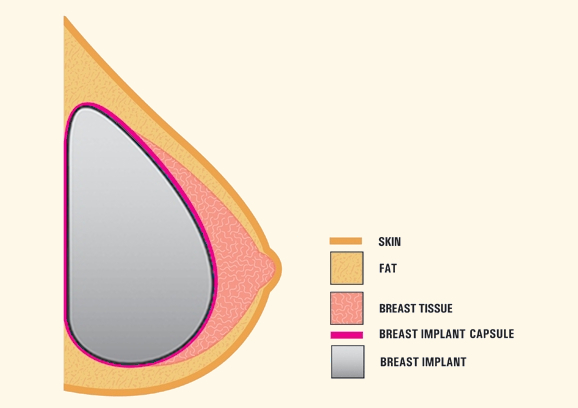
Whenever a breast implant is used for breast augmentation, your body makes an encapsulating sheet of scar that lines the breast implant’s pocket. This normally thin, soft scar is called the “capsule”, and it is incredibly important in maintaining your breasts’ enhancement.
Have you ever wondered how breast implants stay in place?
The capsule is responsible for keeping the breast implants in the proper position beneath the breasts. It forms in just a few weeks after breast augmentation surgery and keeps the breast implants from freely sliding around. Optimal breast implant position is a combination of careful placement during surgery and a proper capsule. The capsule will quickly line the surgical pocket and provide a smooth, strong interface between the breast implant and the soft tissues of the chest. By reinforcing the pocket, the capsule helps to maintain optimal breast implant placement.
The capsule protects the breast implant.
Not only does the capsule help keep the breast implant in position, it also protects the implant. The interior of the capsule is smooth and allows for nearly frictionless movement within its boundaries. The outer layers of the capsule provide enhanced vascular circulation and helps protect the breast implant from infection.
When good capsules go bad.
So what can go wrong with breast implant capsules? The perfect capsule is firm enough to maintain proper breast implant positioning, but soft enough to not be felt. Problems occur at the extremes, so like Goldilocks the capsule needs to be just right, not too hard and not too soft.
Too soft
When the Breast Implant Capsule is too soft, it does not provide enough support for the implant. Gravity pulls the implants down when standing or to the side when laying down. The larger the breast implants, the greater the force. Stomach sleeping also pushes the implants apart. A healthy capsule can resist the tendency toward Breast Implant Malposition, but a good bra helps too.
Treatment for implant malposition can include a capsulorrhaphy, to tighten the capsule, and close off the areas where the implant should not be going. If an overly large breast implant in compounding the problem, a smaller implant can help reduce recurrence. The use of an acellular dermal matrix (ADM) has also become more popular as a way to line, reinforce and thicken the capsule.
Too hard
When the Breast Implant Capsule is too hard, it can compress the implants, and cause Capsular Contracture. Capsular contracture can also result in breast implant malposition. If the capsule is tight only on one side, it will push the breast implant toward the soft side. If the capsule is tight all the way around, it can make the implant feel hard.
Treatment for capsular contracture includes capsulectomy, removing the thickened capsule, and capsulotomy, incising the capsule to allow it to expand. Both these techniques are performed in the operating room. An older, non-operative technique called closed capsulotomy was a way to split the capsule without surgery by forcefully compressing the implant. This has been largely abandoned as it has less predictable results, may lead to uncontrolled bleeding or implant rupture, and violates most breast implant warranties.
Just Right
The most common types of capsules are grade I followed by grade II. Grade I capsules are soft on not detectable from the outside, Grade II capsules feel firmer, but are not tight enough to cause visual changes. Both usually provide adequate support to allow the breast to age naturally, securely on the chest. If you are considering breast augmentation, or you have breast implants and are considering breast implant revision surgery, give me a call at (925) 943-6353 or contact my Walnut Creek Plastic Surgery Office using the contact form in the left column.
Breast Implant Revision Surgery is performed to improve the results of Breast Augmentation. While Breast Augmentation is both safe and effective, our bodies continue to change as we age. Breasts naturally change size and shape over time. This occurs with or without breast augmentation. While most changes are gradual, changes can happen relatively quickly with pregnancy and changes in weight.
Breast Implant Replacement
Breast implants can wear out too, requiring a new implant to be placed. The major US breast implant companies, Allegan and Mentor, do provide Breast Implant Warranties.
What Are the Common Reasons for Breast Augmentation Revision Surgery?
The most common reasons for Breast Implant Revision Surgery are a desire for a change in size, deflation of the breast implant, capsular contracture and breast implant malposition. It is important to clearly identify what problem(s) are bothersome, and to seek a consultation with a Board Certified Plastic Surgeon.
Below is number four of four of my latest Breast Implant Revision Videos. They appeared on KRON4′s Body Beautiful. The series covers Breast Augmentation, Breast Implants and Breast Augmentation Maintenance. The television show was broadcast live, so viewers could call in during the broadcast to have their questions answered. The (415) number shown in the video was only for the show; however, if you have Breast Augmentation or Breast Implant Revision questions, please call our San Francisco Bay Area Plastic Surgery Office directly at (925) 943-6353. If you prefer, you may also use the contact form on the left.
San Francisco Bay Area Breast Implant & Breast Augmentation Revision Video
San Francisco Bay Area Breast Implant Revision Questions
This Breast Augmentation and Breast Implant Revision Surgery video includes:
The type of trauma most likely to cause breast implant deflation
Common reasons for breast implant revision surgery
Changing breast implant size
Breast implant leaks
Capsular Contracture
Breast Implant Malposition
Breast Augmentation and Breast Implants Revision Resources
You are viewing number three of four Breast Implants Revision Video segments from Dr. Mele’s recent Body Beautiful television appearance. Here are links to the other segments:
Breast Augmentation remains one of the procedures that I perform most frequently. Whether you’ve always had small breast and want them larger, or you had larger breast and want them back, Breast Augmentation can help you achieve your goals.
Breast Implant Revision Surgery is performed to improve the results of Breast Augmentation. While Breast Augmentation is both safe and effective, our bodies change as we age. Breasts naturally change size and shape over time, and this happens even after breast augmentation. Changes can certainly be exacerbate by pregnancy and changes in weight, but most of the time the changes are gradual and sneak-up on us.
What’s New in Breast Implants and Breast Augmentation?
If you are considering Breast Augmentation or Breast Implant Revision surgery, you should know that new breast implants are available and more are on the horizon. New techniques are also being developed to help make your Breast Enhancement simpler, safer, more predictable and easier overall. Be certain to seek a Board Certified Plastic Surgeon for all your Cosmetic Breast Surgery needs.
Below is part three of four of my Breast Implant Revision Video that appeared on KRON4′s Body Beautiful. Options in Breast Augmentation, Breast Implants and Breast Augmentation Maintenance are reviewed. The television show was broadcast live, so viewers could call in during the broadcast to have their questions answered. The (415) number shown in the video was only for the show; however, if you have Breast Augmentation or Breast Implant Revision questions, please call our San Francisco Bay Area Plastic Surgery Office directly at (925) 943-6353. If you prefer, you may also use the contact form on the left.
San Francisco Bay Area Breast Implant & Breast Augmentation Revision Video
San Francisco Bay Area Breast Implant Revision Questions
This Breast Augmentation, Breast Implant Revision Surgery video includes:
The Breast Implants currently available
Saline Breast Implants – Natrelle (Allergan) and Mentor (J&J)
Silicone Gel Breast Implants (Natrelle and Memory-Gel)
Soft-Solid Silicone Breast Implants (GummiBear Implants)
Natrelle 410′s*
Mentor Contour Profile Gel (CPG)*
*The 3 yr and 5 yr data for the 410′s and CPG breast implants surpasses that of the breast implants that are already approved in this country. Why are they not approved? Only your FDA knows for sure.
Breast implant deflation
What are the signs and symptoms associated with a leaking breast implant?
How to check for a breast implant leak
How long do Breast implants last?
How are breast augmentation and breast lifts combined?
Breast Augmentation and Breast Implants Revision Resources
You are viewing number three of four Breast Implants Revision Video segments from Dr. Mele’s recent Body Beautiful television appearance. Here are links to the other segments:
Breast Implant Revision Surgery is performed to improve the results of Breast Augmentation. Breast Augmentation Revision can help with Breast Implants are the wrong size, in the wrong position, have developed capsular contracture or when other cosmetic deformities require correction. Specific techniques have evolved for the correction of the most common problems that can occur with Breast Implants. Some recently developed new techniques have significantly improved the results of breast implant revision for problems that have been difficult in the recent past.
San Francisco Bay Area Breast Augmentation
This segment of Body Beautiful focuses on before and after results. Breast Augmentation is reviewed, as well as the correction of specific breast implant problems like capsular contracture and implant malposition (bottoming out and symmastia). The following Breast Implant Revision Video was broadcast on KRON4′s live Medical Monday show, Body Beautiful. The television show allows viewers to call in during the broadcast and have their questions answered. The (415) number shown in the video was only for the show, so if you have Breast Augmentation or Breast Implant Revision questions, please call our San Francisco Bay Area Plastic Surgery office directly at (925) 943-6353, or use the contact form on the left.
San Francisco Bay Area Breast Augmentation & Breast Implant Revision Video
San Francisco Bay Area Breast Implant Revision Questions
This Breast Augmentation, Breast Augmentation Revision Surgery video includes:
Before and After Pictures of Breast Augmentation
Before and After Pictures of Breast Augmentation Revision including:
Before and After Pictures of Breast Augmentation Revision for a Breast Implant that is too low and a poorly formed inframammary fold (IMF)
Before and After Pictures of Breast Augmentation Revision for Grade III Capsular Contracture causing the Breast Implant to be too high (Capsulotomy/Capsulectomy)
Before and After Pictures of Breast Augmentation Revision for Grade IV Capsular Contracture causing the implant to ride up and appear significantly smaller
Before and After Pictures of Breast Augmentation Revision for Breast Implants that are too close (as seen in symmastia) and too far from the midline (often causing a large gap between the breast implants) and rippling on the inside of the breast (medial rippling)
Before and After Pictures of Breast Augmentation Revision for severe bottoming out with internal capsulorrhaphy (though a breast lift is the most frequently selected option)
Breast Augmentation and Breast Implants Revision Resources
You are viewing part two of four Breast Implants Revision Video segments from Dr. Mele’s recent Body Beautiful television appearance. Here are links to the additional segments: