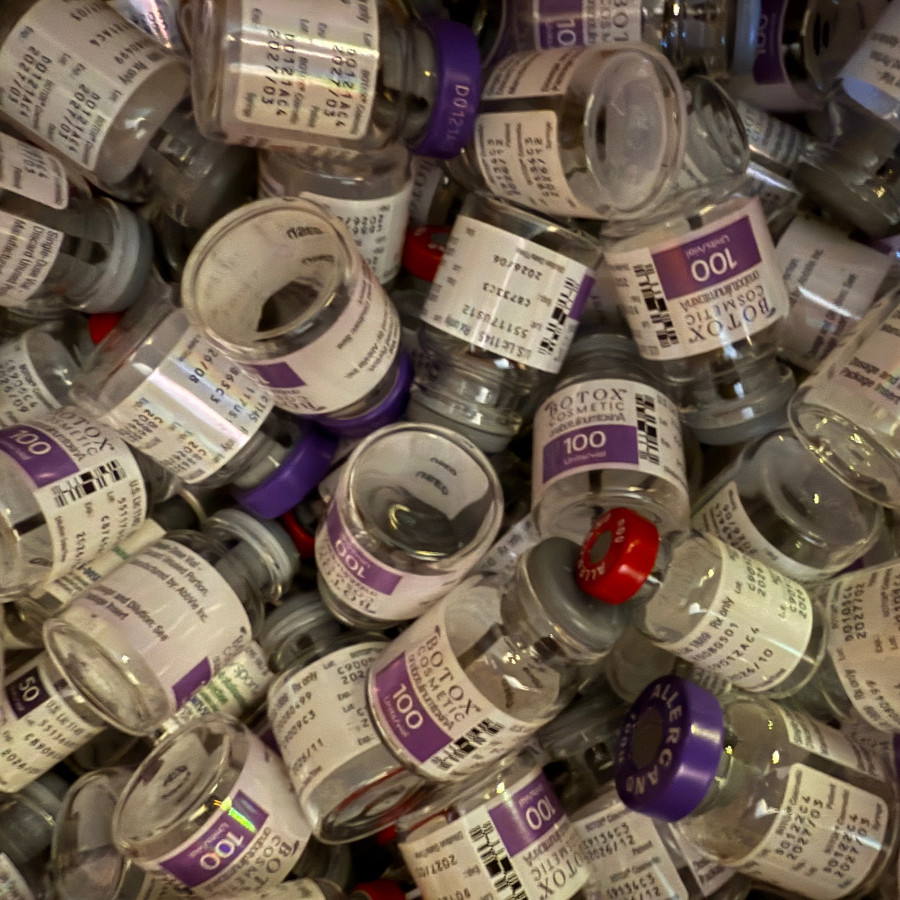
The name for the facelift procedure, or rhytidectomy, comes from the Latin word rhytid meaning wrinkle. Rhytidectomy literally means wrinkle removal. While Board Certified Plastic Surgeons remove wrinkles from all over the body, in Cosmetic Plastic Surgery, the term rhytidectomy is used almost exclusively to describe the surgical procedure that removes wrinkles from the face.
While the facelift is the gold standard for facial rejuvenation, there are many options to consider. This video segment, taken from my appearance on KRON4′s Body Beautiful, discusses the changes that occur in the face as we age. It reviews treatments like botulinum toxin (BOTOX Cosmetic, Dysport) and fillers (Restylane, Perlane, Juvederm), mini-facelifts and the facelift. San Francisco Bay Area residents were able to call in with their questions and have them answered live on the air.
The 800 number in the video below was only used for viewer questions during the live broadcast. If you have questions, or would like to schedule a consultation appointment, please call my Walnut Creek Plastic Surgery office at (925) 943-6353.
This video is provided for general informational purposes only. Specific recommendations can only be made after a careful history and physical examination is performed. Some of the topics covered include:
Loss of facial volume as we age
The effects of gravity
Restoration of volume with fillers
Reducing facial animation lines with Botox/Dysport
What is a facelift?
What areas of the face are addressed with a facelift?
Is the neck included in a facelift?
How is facial volume replacement addressed?
Is it supposed to look tight?
The other segments of this broadcast can be found here:
Rhytidectomy (Facelift) San Francisco – Part 1 of 4 (You are here)
Dysport®, the leading (aka only) United States competitor of BOTOX Cosmetic® (aka Botox), has extended the Dysport® Challenge another month. Now, through May 31, 2010, Dysport® is offering cash back to you for trying Dysport®. Details were originally revealed in my previous post, Take the Dysport® Challenge San Francisco Bay Area. Whether you are considering your first wrinkle reduction procedure, or are a Botox disciple, this is how it works:
The Dysport® Challenge™
In my Walnut Creek Cosmetic Plastic Surgery Office, during April and May of 2010, you can get $75 off any Dysport® treatment. Plus, another $75 off your second treatment whether you love it or leave it.
Love It
If you love Dysport® you can get another $75 off your next Dysport® treatment.
Leave It
If do not love Dysport® you can get another $75 off your next BOTOX Cosmetic® treatment.
For all the details visit DysportUSA or click the logo at the top of this article.
Dysport San Francisco or Botox San Francisco?
The next Botox/Dysport Day in the office is Wednesday, May 19, 2010.
In case you haven’t heard, BOTOX Cosmetic® (aka Botox) has a competitor: Dysport®. BOTOX Cosmetic® was the first to market here in the United States, and has enjoyed a monopoly, until now. Dysport® was first to market in Europe, and has now made it across the pond.
FDA Approved for Facial Wrinkle Reduction
Dysport® received FDA approval last year. It is very similar to BOTOX Cosmetic® in terms of onset of action and duration. While they are not equivalent, they are very similar. Both block unwanted muscle motion, and both reduce stubborn frown lines.
Dysport® came to market at a slightly lower price, but BOTOX Cosmetic® countered with customer loyalty, and discount coupons. The Dysport® people are once again trying to shake the status quo with the Dysport® Challenge™.
The Dysport® Challenge™
In my Walnut Creek Plastic Surgery Office, during March and April of 2010, you can get $75 off any Dysport® treatment. Plus another $75 off your second treatment whether you love it or leave it.
Love It
If you love Dysport® you can get another $75 off your next Dysport® treatment.
Leave It
If do not love Dysport® you can get another $75 off your next BOTOX Cosmetic® treatment.
For all the details visit DysportUSA or click the logo at the top of this article.
Botox/Dysport Day
The next Botox/Dysport Day in the office is Wednesday, March 17, 2010. Happy Saint Partick’s Day.
If this is too soon, the April Botox/Dysport Day is April 21, 2010.
Most plastic surgeons offer more than plastic surgery. Despite the latest glossy ad you may see, there is still nothing that replaces the quality, safety and predictability that today’s cosmetic plastic surgery provides. On the other hand, not every wrinkle needs surgery.
Unlike a facelift, the so called liquid facelift, fillers, cannot correct skin laxity, and unlike a browlift, Botox® and Dysport® cannot lift a sagging brow, but they can help with the wrinkles. I use both these wrinkle reducers to delay and sometimes to enhance the results of my surgical procedures. If you have lines that look like “elevens” between the eye brows, or folds that look like “parentheses” around the mouth, there are non-surgical treatments which can reduce the length and the depth of these lines, and it can be done during a short office visit.
Starting at the Top.
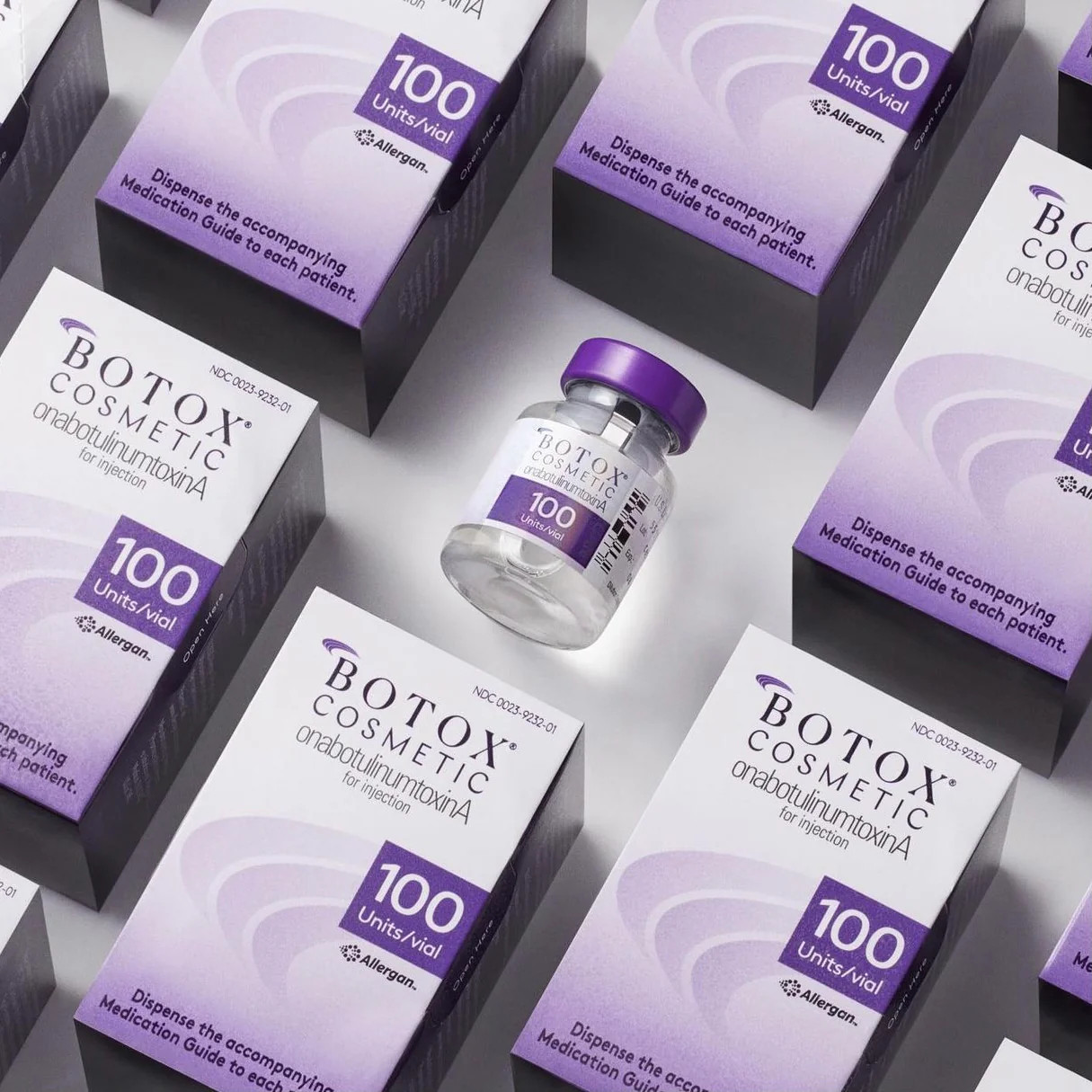
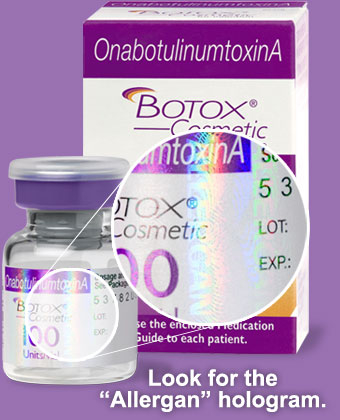
BOTOX Cosmetic from Allergan
Dysport from Medicis
Botox and Dysport can reduce the lines that develop on the upper face. Both products are FDA approved to reduce the frown lines we get between our eyebrows; moreover, they are used off-label, to do much more. In many cases, a skilled plastic surgeon can reduce the following:
Transverse forehead lines
Frown lines (the “elevens” between the eye brows)
Laugh lines or crows feet (around the eyes)
Mild brow ptosis (mild sagging usually of the outer eyebrow)
Botox and Dysport are not fillers. They reduce wrinkles at the source, by inhibiting the muscle action causing them. Care must be taken with these medications, to inhibit the offending muscle actions while always trying to preserve normal animation.
The Mid and Lower Face
Restylane from Medicis
Perlane from Medicis
Juvederm from Allergan
Radiesse from BioForm Medical
Since Botox and Dysport reduce expression, they are not ideal for the mid to lower face. We can look normal without the ability to frown, but we need to be able to smile. This is why fillers are ideal for the correction of the lines around the mouth.
The most popular fillers in the US today are hyaluronic acid (HA) based. HA is a clear gel, and a normal component of our skin and joints. There is no allergy to it, unless we are allergic to ourselves. The most popular HA fillers are:
Restylane
Perlane
Juvederm
The most common areas treated with fillers are:
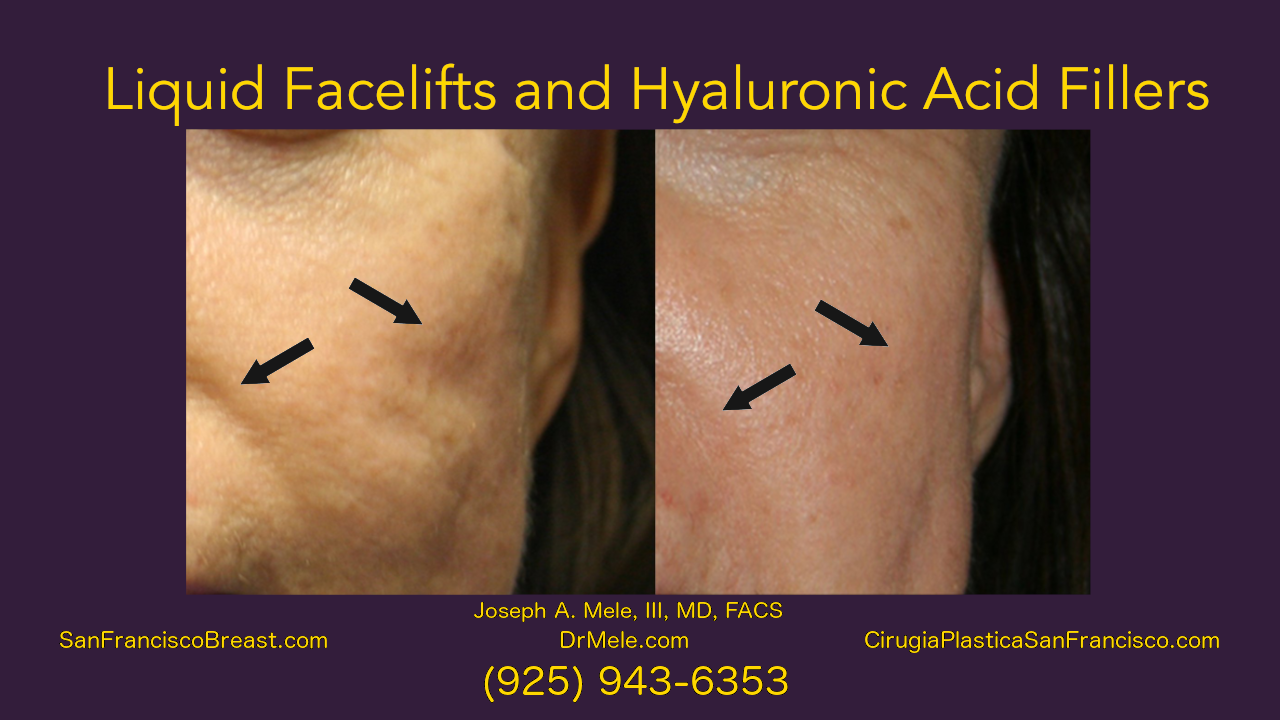
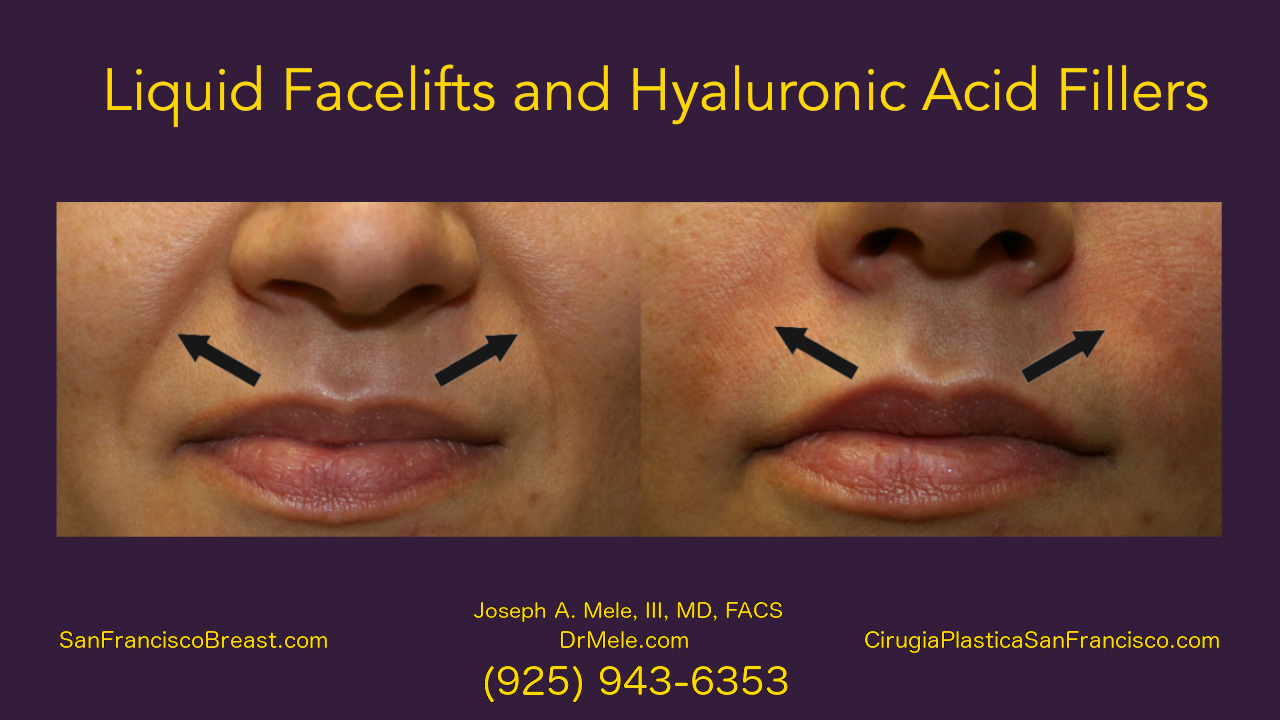
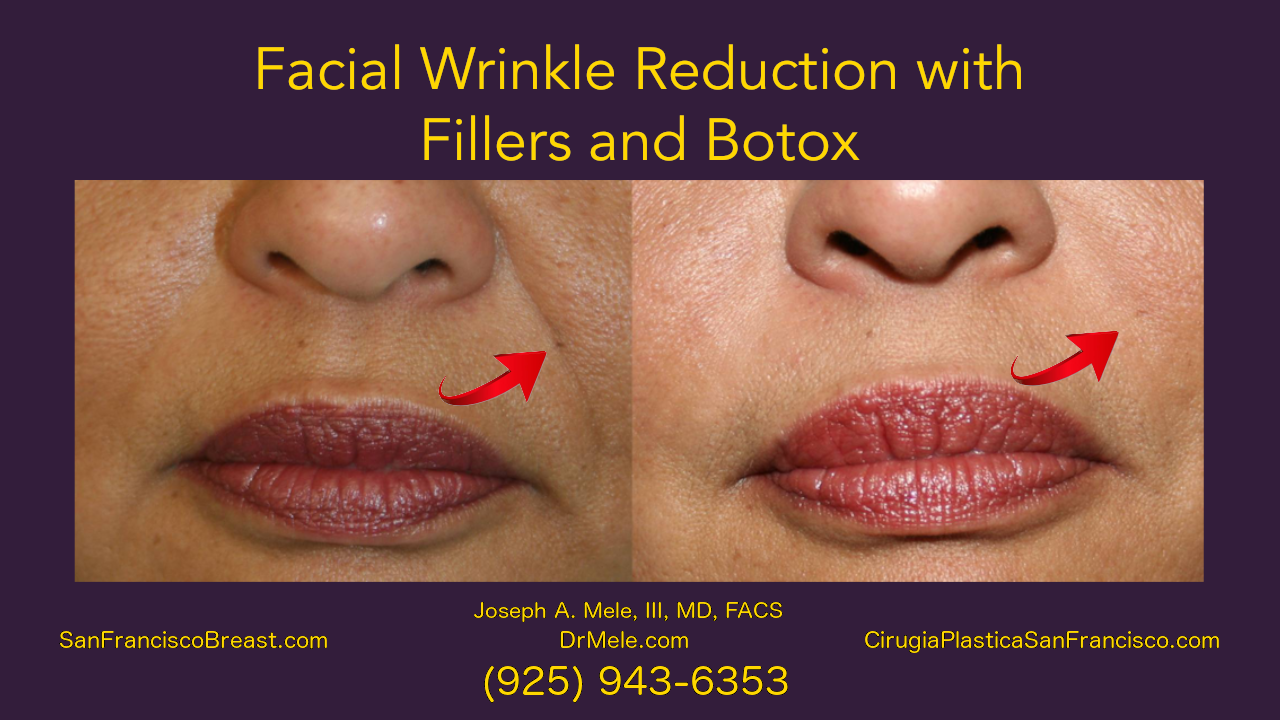
The parentheses (nasolabial and marionette lines bracketing the mouth)
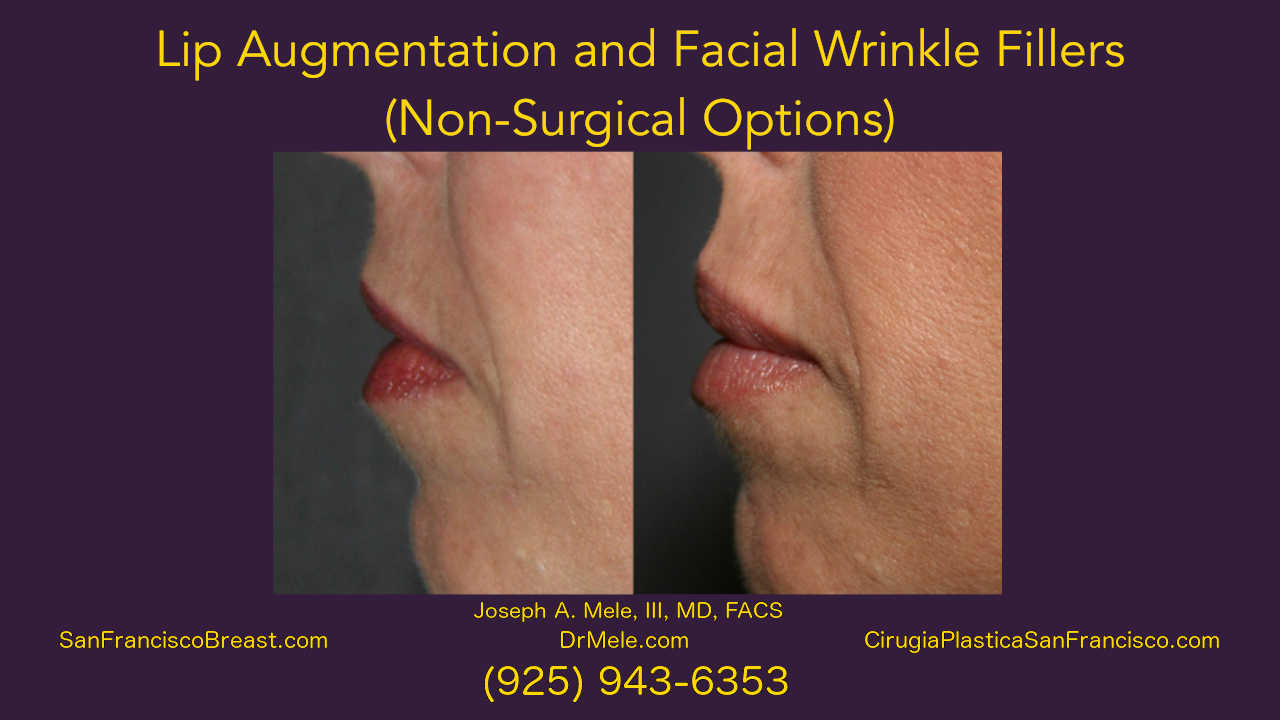
The lips for enhanced fullness
The fine lines around the mouth (smoker’s lines even if you don’t)
Other mild to moderate wrinkles of the face
Radiesse is also a filler, but it is not an HA. It is white and gives a firm result. Good for deep lines like the nasolabial folds and marionette lines (i.e. the parentheses), but not as good superficially like in the lips where it may be seen or felt. Radiesse is also good for mild enhancement of the chin and cheek bones.
It is important to have a face-to-face evaluation with your plastic surgeon to determine if you are a good candidate for a procedure. This includes non-surgical procedures. When performed by a trained professional, the treatment should be simple and easy. If you are in the San Francisco Bay Area, and would like to have a consultation appointment in my Walnut Creek Plastic Surgery office, give me a call at (925) 943-6353. More information on non-surgical wrinkle reduction, check my main web site, www.DrMele.com .
Though not common, possible adverse reactions should be discussed with your plastic surgeon prior to initiating treatment. The most common problem with all these products is mild bruising, so you do not want to have your injections the day before you want your results. The results last for months, so allowing a couple weeks for the optimal results to develop is recommended.
There is some crossover between the botulinum toxins and the facial fillers. Sometimes deeper lines on the upper face may need a little filler to improve the wrinkle reduction and speed the results. Less frequently, Botox and Dysport are used on the lower face, to treat facial asymmetry, lip lines and neck (platysmal) banding. These are special cases and require careful selection in order to provide the best results.
I previously posted articles on what’s new in Plastic Surgery San Francisco including Hydrelle® and Dysport®. Well, there is new information to share with both products, and this information can save you some money too. The news about Dysport® is here … Hydrelle® there.
$75 off coupons coming to a Plastic Surgeon's office near you.
Dysport® is the only FDA approved competitor to BOTOX Cosmetic®. To celebrate the launch of it’s new botulinum toxin, Dysport®, Medicis will be offering $75 rebate coupons to patients receiving Dysport® (botulinum toxin type A) wrinkle reduction. The coupons will be available after the Labor Day Weekend, beginning September 8th, and continuing through October 31st, 2009.
“Botox Day” is the usually third Wednesday of each month (e. BOTOX Cosmetic® and Dysport® will both be available. Other days may be available upon request, call the office for details (925) 943-6353.
If you haven’t heard about Dysport®, please see the post mentioned above. While Dysport® has been available in Europe for years, Medicis has only recently received FDA approval for its use in the US. Expect to hear move from them in the near future. The informational literature and advertisements for the United States have just now passed FDA review, so you will be hearing more about Dysport® soon.
Dysport® and BOTOX Cosmetic® are not fillers but are good for reducing wrinkles on the upper face. Fillers. like Restylane®, Perlane®, Juvederm® and the newest addition Hydrelle® are better for the mid and lower face.
UPDATE: I can no longer recommend this product. I would suggest using Restylane®, Perlane® or Juvederm®. All three are now available with Lidocaine, all three seem to have fewer adverse reactions and superior customer service. Please see “The Ugly” below for details.
I previously posted articles on what’s new in Plastic Surgery San Francisco including two new cosmetic plastic surgery products: Hydrelle® and Dysport®. Well, there is new information to share with both products. The scoop on Hydrelle® is here … Dysport there.
Hydrelle®: the first FDA approved wrinkle filler with numbing added.
Hydrelle® was featured on the hit television series The Doctors.
I have had a chance to use Hydrelle® and it is easy to work with. It is very similar to Restylane®, Perlane® and Juvederm®. If you are familiar with these dermal fillers, the results last for about the same amount of time; however, Hydrelle® is more concentrated.
The Good, the Bad and the Ugly
The good news is that Hydrelle® requires about half the volume of the other products for wrinkle correction. Similar correction, half the volume. Moreover, the local anesthetic (0.3% lidocaine), which is added to Hydrelle®, really cuts down on the discomfort of the injections. While I almost always use a local anesthetic block to administer the current HA fillers, with Hydrelle® I rarely need to block the area before treating.
The bad news is that the concentrated product tends to swell more than the others dermal fillers. This is most apparent the first day or two, and then it settles down. Also, if you are allergic to sulfites (red wine or dried fruit) this product is not for you.
The Ugly
EDIT: Three to four weeks after injecting a patient with Hydrelle® they developed two large sterile abscess on the cheeks which required weeks of antibiotics, steroids, and surgical drainage to treat. This complication is rare, but other examples can easily be found on line. The injection was in the nasolabial folds and technique used was as recommended by the manufacturer, and the same technique I use with the other HA fillers (Restylane®, Perlane® and Juvederm®) This patient’s cultures were negative and they were not allergic to Sulfites.
If I continued to use Hydrelle®, I might go the rest of my career without seeing this extreme reaction again; however, the only way I can be 100% certain the Hydrelle® will not cause more problems in my practice is to no longer use the product. Good, safe and time tested alternatives are available with and without Lidocaine: Restylane®, Perlane® and Juvederm®.
The FDA is currently reviewing this and other reports of adverse reactions submitted regarding Hydrelle®, and for now it remains on the market. I was very excited about this product as it seems to fill better than the other fillers; however, I will no longer be offering Hydrelle® in my Walnut Creek Plastic Surgery office.
I have used HA fillers since they became available in the US, and I have never seen this type of delayed onset and prolonged recovery with any other HA product, and I hope I never do again. Complications can occur with any procedure, so if you develop redness, lumps, pain, increasing swelling, or any other signs of an adverse reaction, be certain to contact your plastic surgeon immediately.
All adverse reactions, for any product not just Hydrelle®, should be reported to the FDA. The FDA’s online submission form is here. My patient sample size is too small to draw any conclusions, and the FDA is there to compile this data and make the appropriate recommendations. If you have had an adverse reaction, you should submit it. The FDA will compare the number of adverse reactions to the number of units sold to see if it is an acceptable number.
Please understand, my results may not be typical, and others will hopefully never have this type of reaction. My only goal in suppling the above information is to improve patient safety.
There’s a new kid in town, at least for Walnut Creek plastic surgery. While Dysport® has been a mover and shaker Europe for years, the US FDA has only recently approved Dysport® for use in San Francisco plastic surgery procedures.
The Number 1 Contender
VS
The Champ
Dysport® (abobotulinumtoxinA) is very similar to Botox® (botulinum toxin type A). While Botox® molecules are all the same size, Dysport® has some variation in size which may explain the slight differences. Since the drugs are very similar, for most people the effectiveness will be the same. The European experience has reported similar outcomes with Dysport® and Botox®. European studies also show a faster onset of action for Dysport® and maybe a longer lasting result with Dysport®. Here are some of the details:
Onset:
Dysport® has a slightly faster onset of action. In other words, the desired effects can be seen faster with Dysport®. Botox® may take 3-7 days for effects to be seen, while Dysport® may take 1 to 5 days. Since there is wide individual variation in the time it takes for these products to work, I’m not certain this is a hugely beneficial, but the advantage goes to Dysport®.
Onset Advantage: Dysport®.
Longevity:
The effects of Dysport® and Botox® last 3-4 months.; however, there is wide individual variation (1 to 12 months). While some reports show Dysport® lasts longer than Botox®, others show no difference. There is no clear winner here.
Longevity Advantage: Unclear (perhaps Dysport®)
Dose:
Dosing is different for the two drugs. Mostly this is due to the way the assay is performed rather than one toxin being stronger than the other. Like any drug, as long as you are given the correct dose for your problem, it doesn’t matter. While there is not a linear correlation, 2.5 Dysport® units give about the same result as 1 Botox® unit.
Dose Advantage: It just doesn’t matter.
Price:
Unsurprisingly, the introduction of Dysport® has temporarily halted the ever increasing rise in the price of Botox®. In fact Dysport®’s slightly lower price has caused Allergan to issue discount coupons. The $50 coupons help offset the price difference and will help Botox® compete, at least until the coupons expire in October. Two other competing products are also in development by Mentor and Merz.
Price Advantage – Consumer
With the current Botox® coupons it is a wash. Since it’s a fixed $50 off for Botox®, lower doses (one area) may be slightly cheaper to treat with Botox®, while treating multiple areas may be less with Dysport®. When the coupons expire in October the advantage will clearly go to Dysport® … unless Botox® has something else up its sleeve.
Another recently FDA approved product for wrinkles is Hydrelle. I can no longer recommend this product. I would suggest using Restylane®, Perlane® or Juvederm®. All three are now available with Lidocaine, all three seem to have fewer adverse reactions and superior customer service. Details here.
The topic for this week is what’s new in plastic surgery. Cosmetic plastic surgery is always changing. We are constantly looking for new and improved ways to provide lasting results. Innovation is constantly supplying new products that provide better results, faster results or less expensive results are always under development and here are a few that have made it.
Surgical Products:
The next major step forward in the cosmetic plastic surgery procedures category will probably come in the area of breast augmentation. Silicone breast implants are evolving. The change has been seen in Europe and Canada; however in the United States we continue to wait patiently. FDA approval of gummy-bear breast implants has been pending for several years. The research is done, additional information has been supplied and the FDA just needs to take a vote. Since the vote has been pending for several years, your guess is as good as mine as to when gummy-bear implants will available for San Francisco Breast Augmentation.
These new implants are form stable, silicone gel implants that can’t leak. They are a soft solid that can be formed into specific shapes. In certain situations this is a superior implant with fewer risks. Given the two implants that are currently approved, the decision to approve this implant seems inevitable.
Natrelle Style 410 Highly Cohesive Breast implants (Gummy Bear Implants) come in 16 basic shapes, and each shape comes in many sizes.
Non-surgical Products
Two other new products area currently available for minimally invasive office procedures:
Number one is Dysport® (Medicis and Ipsen) – Botox® (Allergan) competitor.
Dysport® the first FDA approved Botox® competitor.
Number two is Hydrelle® (Coapt Systems)- a new dermal filler (hyaluronic acid) with a numbing agent (lidocaine) added for pain control – a competitor for Restylane® (Medicis), Perlane® (Medicis) and Juvederm® (Allergan).
Hydrelle the first FDA approved wrinkle filler with a numbing agent added.
I can no longer recommend this product. I would suggest using Restylane®, Perlane® or Juvederm®. All three are now available with Lidocaine, all three seem to have fewer adverse reactions and superior customer service. Details here.