Lisa Rinna has had a very successful Hollywood career which she credits, in part, to her large, Augmented Lips. When it comes to a beautiful face, the lips are second only to the eyes. Subconsciously, we associate fuller lips with youth and fertility. Larger lips are a big contributor to the “glow” of a pregnant woman’s face. As we age, so do our lips, and gradually they become thinner and thinner. Lip augmentation can be an integral part of facial rejuvenation.
Lisa Rinna is putting her lip troubles behind her.
Lip Augmentation with Silicone Injections
Lisa Rinna had been very forthcoming with the fact that her lips were enhanced with injectable silicone. Liquid silicone injections are problematic, and her honesty has helped other young women avoid the same fate. Right after silicone injections everything looks great, but with time, the body creates scar tissue around the globs of silicone. The result is palpable, and often visual, lumps and lip distortions. Lisa does not regret her decision, but 20 years after the Silicone Injections, her lips were a lumpy mess. She underwent surgery to remove as much of the silicone and scar as possible. Here is the story in her own words:
“Here’s the story: 25 years ago, I had my lips injected with silicone. Stupid thing to do at 24. I saw ‘Beaches.’ Remember that movie ‘Beaches’? I did it with my best girlfriend, so she and I go and we get our lips done. Fine. I have it like that for my whole career, right? So then cut to a couple of years ago, I have a doctor remove as much as they possibly can because it got to the point where they were yucky. You know, they get hard. It’s gross. They are now whatever that was after they took out as much of the silicone as they could.”
Surgical Correction after Silicone Injections to the Lips
Lucky for Lisa, her lips still look fine. Twenty-five years ago, the risks of silicone injections were not as clear cut, and the only approved injectable was Collagen, which was hard and completely gone in a month or two. Today, we have much better alternatives. Lip Augmentation can be performed with injectable HA’s like Restylane and Juvederm in a few minutes in the office. The results do need to be maintained; however, the results are full and soft, something that has not been possible previously without surgery. How long the results last is variable. Average results are 4-6 months and if you decide you not longer need it, after the plateau phase, the lips gradually return to their original size.
Permanent Lip Augmentation
Since lips thin as we age, there are no Permanent Lip Fillers. Even the perfectly sized lips will need a little maintenance to counteract the normal aging process. Inserting permanent fillers, like silicone, promotes the formation of chronic scars and foreign body reactions like granulomas. HA fillers are made from Hyaluronic Acid (HA), a normal component of skin and joints. Unlike free silicone injections, our bodies recognize HA as a normal component of the skin, and we have natural hyaluronidase, an enzyme that can clean up HA.
Lip Augmentation Before and After Pictures
Lip Augmentation Before and After Photos: Lip enhancement performed with HA filler.
Lip Enhancement Consultations
If you are considering Lip Augmentation, especially if it is your first time, consider a brand name HA filler like Restylane or Juvederm. They can give a soft natural result, which is easy to maintain. Swelling is minimal, and with ice and elevation, the appearance is normal in 24-48 hours. Longer lasting alternatives are available, but they require a longer recovery, and are best when the goal size is well known.
Other Lip Enlargement Resources
Other articles on lip augmentation are available on the San Francisco Plastic Surgery Blog and my main web site. Here are the links:
A large portion of a Plastic Surgeon‘s day is spent sharing information. Whether it’s one-on-one in the office, or during a live television broadcast, my goal is the same. Knowledge is power, and the sharing of knowledge can be extremely powerful, but as the saying goes, a little knowledge….
Frequently Asked Questions About Plastic Surgery
Plastic Surgery Frequently Asked Questions
People come to my Walnut Creek Plastic Surgery office every day with questions about the procedures I offer. Whether cosmetic or reconstructive, the questions are the same:
What can be done?
How is it done?
Where is it done?
Who helps you?
How many have you done?
What is the recovery?
After a consultation, the answers are usually simple, but the answers will vary from patient to patient.
Specific Answers for Specific Patients
I try to give solid information about my San Francisco Bay Area Plastic Surgery practice on my web sites. Sharing information about the procedures I do is easy. Unfortunately, the information must remain somewhat generic. Answers to questions about a specific procedure will vary depending on your anatomy and needs. Sometimes, even the best procedure will change. The differences can cause confusion, but are also responsible for better results. So I spend a lot of time explaining. In person, it’s an interactive process, but explanations via email can be difficult, especially if we have not yet met.
Plastic Surgery Consultation Appointments
Even during a full consultation appointment, I cannot share every nuance. I did not learn everything I know about Breast Augmentation in an hour, but I can get the important questions answered. I can also tailor my answers to you, so that some of the unknowns are removed for the procedure. The goal is to make the reasons for the choices clear. It provides direction, fosters trust and removes some of the unknowns and worries from the process.
A Little Knowledge is a Dangerous Thing
We have all heard the expression, “A little knowledge is a dangerous thing.” It works both ways. If you don’t have enough knowledge about how to get the results you expect, you may pursue the wrong procedure or practitioner. If I don’t have all the information, I can’t make the best decisions for you. It is important to share with your plastic surgeon. I need to know not only what you expect from the procedure, but all other health issues, the medications you take, even something as simple as the best way to reach you can make a difference. Something as little as forgetting to mention you take a baby aspirin every day can be a big problem. Trust works both ways. To get the maximum benefit from our knowledge and experience, there needs to be trust.
Trust and Television
Television is a great medium. It provides sound and picture and the detailed descriptions of the story told are quite compelling. It works well for entertainment, where a certain suspension of belief is necessary; however, for describing plastic surgery, it is lacking. There is not enough time to describe every aspect of the decision making that goes into a Facelift. So instead, the answers are made to fit an imaginary patient, and the details necessary to provide better individual results as glossed over. The devil is in the details.
Zithromax
I think of the recent news stories about Zithromax causing arrhythmias. The tag line is “FDA warns Zithromax can cause fatal irregular heart rhythm.” It good information, but it’s also a little knowledge, without the benefit of tailoring that information to your specific needs. What is left out is the millions and millions of stories of people world wide who benefit from the simple effectiveness of a once a day Z-pack. Covering that would be fair and balanced, but also extremely boring and would likely be protested as nothing more than corporate influence. Now I’m not saying it is wrong to question your doctor if they prescribe Zithromax. In fact you should; however, after all the information has been shared (in both directions), at some point it comes down to trust. From your doctor’s viewpoint, every medication has the potential to do good and to do harm. We are trying to pick the best medication, with the best ratio of risk to benefit, for our patients specific situation.
New and Exciting Plastic Surgery Breakthroughs
I don’t prescribe a lot of Zithromax, but I do perform a lot of surgery, and the same rules apply. Surgery has the potential to provide great deal of benefit, but no procedure is perfect. When I tell someone that they have too much loose skin for me to do Liposuction, and that the better operation would be a Tummy Tuck, it’s not because I’d rather do a Tummy Tuck. It’s because, in that specific situation, Liposuction is not the best choice. Liposuction, whether it’s Smart-Lipo or Dumb-Lipo, cannot fully correct loose skin. When there is too much loose skin, Liposuction has less potential to do good, and more importantly, an increased risk of making things look worse.
There is little new about the Tummy Tuck. It is tried and true, with well defined benefits and risks. As a result, there is very little coverage about Tummy Tucks in the news. Over 150,000 women had a tummy tuck in 2012, but unless your name is Star Jones, Kate Gosselin or Shar Jackson, it didn’t make the news.
Informercials offering magical belts, creams and exercise DVD’s, that claim to do what a Tummy Tuck can do, are broadcast just about any hour of the day. If they did work, I’d be offering them. I am all for using the simplest solution to a problem, but it has to work. A Tummy Tuck can cost $8000 to $10000, if an $80 cream worked, I’d be selling it, and a lot of it! But creams don’t work. Tummy Tucks, on the other hand, receive a 95% worth it rating on RealSelf by almost 4000 patients. So with that little bit of knowledge, who do you trust?
Cosmetic Plastic Surgery Consultations
Get Answers About Plastic Surgery.
If you are considering cosmetic plastic surgery, be certain to find a Board Certified Plastic Surgeon in your area who as experience in the procedure you need. Spend time researching not only your procedure, but also your doctor. Above all else, choose a doctor you can trust, who is willing to share more than just a little knowledge.
You may always ask me questions via the contact form on the left, but for specific questions, I will likely need to see you. The more information I have, the better the answer you get, and it’s hard to beat an in person consultation. Call (925) 943-6353 today, to schedule your Personalized Plastic Surgery Consultation Appointment.
The American Society for Aesthetic Plastic Surgery (ASAPS) released the latest cosmetic plastic surgery stats today. In 2012. Americans received over 10 million nips, tucks, relaxations and plumps, representing a 10% increase from 2011. Here are the details:
Non-surgical Cosmetic Procedures
Five out of six procedures were non-surgical with the injectables in the lead again in 2012. The relaxers, Botox and Dysport (botulinum toxins), retain the number one position. Plumpers come in number two including the dermal fillers: Restylane, Juvederm, Perlane, Belotero, Prevelle, Elevess and Radiesse. Laser hair removal secured the number three spot, with microdermabrasion and chemical peels rounding out the top five.
Cosmetic Plastic Surgery Procedures
Cosmetic surgery procedures also increased from 2011 to 2012. Breast augmentation remains the number one American cosmetic plastic surgery procedure, followed closely by Liposuction. The other half of the Mommy Makeover, the Tummy Tuck (Abdominoplasty), comes in third. While cosmetic facial plastic surgery procedures, Blepharoplasty (Eyelid Lift) and Rhinoplasty (Nose Job), come in fourth and fifth, respectively.
For the first time, the ASAPS has included “Worth It” ratings from the popular plastic surgery consumer review web site RealSelf. The non surgical procedures typically receive worth it ratings from 60-70%, while the top five surgical procedures rank higher as follows: Breast Augmentation 93%, Liposuction 74%, Abdominoplasty 95%, Blepharoplasty 77% and Rhinoplasty 82%.
Considering a Cosmetic Procedure in 2013?
If you are considering a cosmetic plastic surgery procedure in 2013, give us a call at (925) 943-6353, or use the contact form to the left to arrange a private, personalized consultation appointment.
Gynecomastia is an enlargement of male breast tissue. It can present as a palpable mass beneath the nipple, puffy nipples or enlargement of the entire male breast.
Large amounts of gynecomastia have a feminizing effect on the chest. After Gynecomastia Reduction, male breast reduction, the chest is decidedly masculine.
Gynecomastia at Birth
Gynecomastia is something every male is born with. The mother’s hormones cross the placental barrier and cause enlargement of the newborn’s breast tissue. After birth, the levels of these hormones drop quickly, causing the gynecomastia to resolve.
Gynecomastia at Puberty
Gynecomastia frequently occurs at puberty. In many cases, the overdevelopment of the breast tissue resolves in a year or two. Often, however, it persists. When a significant amount of breast tissue develops, the fullness can be noticeable.
Gynecomastia and Steroid Use
Gynecomastia can develop in response to exogenous hormones too. Anabolic steroids can lead to growth of breast tissue in men. Anabolic steroids are androgenic, however, an enzyme (aromatase), converts testosterone to estradiol. Side effects include testicular atrophy, infertility and gynecomastia.
Gynecomastia usually presents as a firm, rubbery mass directly behind the nipple and areola. Once it forms, it stays, and does not resolve even after stopping steroids. Aromatase inhibitors, like those used for the prevention of breast cancer recurrence, are not effective for reducing the gynecomastia after it has formed.
Gynecomastia and Medications
The most common reason for adult onset gynecomastia is prescription drug use. Many common medications used to treat high blood pressure and heart disease have gynecomastia formation as a side effect. The hormones used to treat prostate cancer also can cause significant breast tissue development. Marijuana is also common causal agent.
Gynecomastia and Cancer
Gynecomastia, by definition, is a benign enlargement of the male breast tissue. Breast lumps in men are rarely cancerous. Gynecomastia is firm but rubbery and is mobile within the breast. The possibility of a breast cancer is increased for hard, fixed masses, especially if they continue to enlarge. Testicular cancer can also present as gynecomastia.
Male Breast Reduction and Gynecomastia Reduction
Once overdeveloped, male breast tissue does not usually spontaneously shrink. Often, the enlargement is enough to be noticed even through clothing. Many men with gynecomastia are uncomfortable wearing t-shirts, and will dress in layers to hide their embarrassment. Plastic surgeons can discretely remove the offending tissue and restore a more masculine chest.
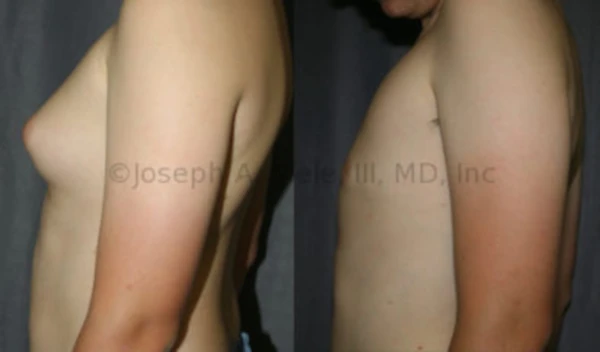
Gynecomastia – Male Breast Reduction – Before and After Pictures
Softer forms of gynecomastia can be removed with liposuction alone. Liposuction was performed on the chest and abdomen in the before and after pictures shown above.
Gynecomastia Surgery
The primary methods for removing gynecomastia are Liposuction and direct excision of the glandular tissue. Soft tissue can be removed via small liposuction incisions, while firmer tissue requires an incision placed around the lower areola for direct removal. In rare cases when the skin itself has been stretched out of shape, removal of skin maybe required, and an incision may be placed in the fold under the breasts.
Schedule Your Gynecomastia Consultation
The best way to review your options for Gynecomastia Reduction is during a consultation with a Board Certified Plastic Surgeon. After a brief history and examination, I can discuss the treatment(s) most likely to achieve the best results. Male Breast Reduction is an outpatient procedure, so no hospitalization is required. You can go home the same day, and resume most activities in a few days to a week. Vigorous workouts and contact sports require a few weeks of rest. More information about gynecomastia treatment is available here: Gynecomastia Information.
Call our San Francisco Bay Area Plastic Surgery office in Walnut Creek, California, to schedule your Gynecomastia consultation today at (925) 943-6353, or ask your gynecomastia reduction questions via the contact form to the left.
Every plastic surgeon’s short list of hoped for advancements would include body Bondo, a skin shrinking ray and made-to-order body parts. Well, we may be getting a little closer to spare parts off-the-shelf.
Print your own parts.
Cornell is All Ears
Cornell bioengineers and physicians armed with a digitized image of an ear, a 3-D printer and a cellular Jell-O are able to produce structures as complex as the cartilage of the external ear. This is incredible news for anyone born without an external ear (1-4 per 10000 births) or who has lost their external ear due to trauma or cancer.
How to Reconstruct an Ear
Most ear reconstruction involves rearranging any available parts. When the entire structure is missing, the needed tissues must be borrowed from other parts of the body. While skin is readily available, cartilage for the complexly shaped frame work is not. Currently, it needs to be borrowed from the junction between the sternum and the ribs, and the structure needs to carved and assembled into the proper shape. It takes a fair amount of artistry to get the best results. When both ears need to be reconstructed, and one reconstruction fails, there may not be enough cartilage left for another attempt.
The Advantage of Printing Parts
There are many advantages to the availability of ears off-the-shelf. The most obvious is the potentially limitless supply, but there is also no donor site to heal. Since the new ears can be digitally designed, the shape can be easily modified. When the opposite ear is normal, it can be scanned, digitally flipped and manufactured for a perfect match.
What Else Can We Make?
Anything made of cartilage can be fashioned. Plastic surgeons are looking forward to ears and nasal tips. If the cells could be made firm enough, my Orthopedic colleges may be able to reline, rather then replace, joints. While hips and knees may be farther off, fingers with less weight bearing seem a hopeful candidate. Of course, the friction experienced in joint means the cartilage must be self repairing or it will quickly wear out.
In cases of severe bone loss, bone grafts are currently used. If the cartilage can be treated with a bone morphogenic protein, artificial bones are logical leap. In cases of severe trauma or bone cancer, new bones could replace metal hardware.
Not Your Father’s Otoplasty
Otoplasty is any procedure used to change the shape of the ear. The most common procedure is ear pinning, to reduce prominent ears. In these cases the cartilage is more than adequate, so 3-D printing is not necessary. Off-the-shelf ears are a help when there is not enough or a complete absence of ear cartilage. For more information, click the link to the Cornell Chronicle.
Allergan Natrelle 410 Breast Implants get FDA Approval.
Seven years and 941 women later, Allergan has received FDA approval for its newest cohesive silicone gel breast implant. The Natrelle 410 Breast Implants are teardrop shaped, highly cohesive (gummy bear) implants that are approved for the cosmetic enhancement of breast volume in women 22 years or older, and for breast reconstruction at any age. Since the gel in these new breast implants is firmer, it retains its teardrop shape, but still gives when touched.
New Breast Implants Approved with a Condition
The approval comes with a condition. A breast implant follow-up study must be completed including 3500 women followed for 5 years and 2000 women for 10 years. Follow-up studies have been an FDA recent requirement for the approval of implantable devices, including previously approved breast implants.
What is a PMA Study, and Why They are Important?
I have been an investigator for the post-market approval (PMA) studies for all three US Breast Implant Manufacturers: Allergan, Mentor and most recently, Sientra. PMA studies are very important. They assure us that the new breast implants are as good as the pre-market research proved. The PMA studies also provide objective data that can be used to compare one type of breast implant to another. Larger numbers of participants also allow for the identification of the very rare occurrences.
Join a PMA study – It’s Less Than Free
PMA studies for breast implants carry no additional risk, and often include a small financial incentive to encourage continued participation. The amount is not enough to cover a Breast Augmentation, so it shouldn’t encourage anyone to get breast implants who wasn’t already considering the idea. However, the small financial carrots may help with the biggest problem encountered in long-term studies — people dropping out and becoming “lost to follow-up.”
Who is Eligible to Join?
PMA studies are designed to learn what happens after implantation. Participants are enrolled prior to surgery, and need to meet certain minimal requirements. The studies are closed once enough participants are recruited, and these participants will continue to be followed for the duration of the study (5 to 10 years). For Breast Implant Follow-up Studies, a yearly survey is completed in the comfort of your own home, and periodic follow-up examinations are performed in the office. Typically these are at 1, 5 and 10 years, though there is some variation.
Current PMA Studies with Open Enrollment
Currently, Sientra is enrolling new Breast Augmentation patients for the Sientra PAS (Post-Approval Study). It is named OASIS (Online Annual Sientra Implant Study). The PMA Studies for Saline and round Cohesive Silicone Gel Implants for Allergan and Mentor are closed; however, with the release of the 410′s a new PMA should be opening up. The investigators have not yet been selected. Stay tuned to the San Francisco Plastic Surgery Blog for more details!
One of the first, if not the first, in the area to complete FDA mandated training on the use of Allergen’s Natrelle 410 Breast Implants.
Every now and then I am reminded what is great about being a doctor. I came across a posting on the Internet entitled: This letter from my late mother’s doctor has changed my life. It’s short and sweet and reminds me how big an impact one person can have on another.
The redacted version is included here, and a copy of the letter is included at the end of this post. It says a lot in a few words:
Dear Mr. (blacked out),
I am the Emergency Medicine physician who treated your wife Mrs. (blacked out) last Sunday in the Emergency Department at the New York Presbyterian Hospital. I learned only yesterday about her passing away and wanted to write to you to express my sadness. In my twenty years as a doctor in the Emergency Room, I have never written to a patient or a family member, as our encounters are typically hurried and do not always allow for more personal interaction. However, in your case, I felt a special connection to your wife (blacked out), who was so engaging and cheerful in spite of her illness and trouble breathing. I was also touched by the fact that you seemed to be a very loving couple. You were highly supportive of her, asking the right questions with calm, care and concern. From my experience as a physician, I find that the love and support of a spouse or a family member is the most soothing gift, bringing peace and serenity to those critically ill.
I am sorry for your loss and I hope you can find comfort in the memory of your wife’s great spirit and of your loving bond. My heartfelt condolences go out to you and your family.
(blacked out), MD
These short paragraphs say it all. Taking care of patients, even in the waining hours of health and life, is a great responsibility and privilege. To be a doctor, is a choice I made early in life that I have never regretted. I can hear the cynics out there saying, “You’re a Plastic Surgeon, not a real doctor.” Heck, I’ve heard some of my colleges make the same comment, but that’s not how I feel about it. I do specialize in Cosmetic Plastic Surgery, but “Do no harm” means knowing a lot more than how to do liposuction. I do also practice Reconstructive Plastic Surgery, and I don’t always get to give good news.
My thanks goes out to the gentleman who publicly shared this handwritten note from his mother’s ER doctor, as well as the doctor for so simply and legibly, expressing the impact that patients can have on their doctors, even if it’s just one visit. Last, but not least, thank you to my pateints for your trust and kindness.
Here is a copy of the original letter:
Excellent Medicine – A thoughtful letter from an ER doctor to a grieving family.
Dr. Mele is Board Certified by the American Board of Plastic Surgery
Any licensed physician can call himself or herself a Cosmetic Surgeon, so the importance of finding a properly trained and certified provider is paramount. The goal of this post is help patients looking for a qualified Plastic Surgeon know what to ask and how to check on their prospective doctor. I encourage everyone considering cosmetic plastic surgery to spend as much time researching their doctor as their procedure.
For Plastic Surgery Think PS
If you are considering cosmetic surgery there are three main goals that are mandatory, and the first two letters of Plastic Surgery can help. The three goals are:
Proper Surgery
Proper Surgeon
Proper Setting
You want the most appropriate procedure performed by a qualified and experienced surgeon in a setting that provides for your safety.
Underground Plastic Surgery
Underground Plastic Surgery has grown along with the Board Certified variety. As Cosmetic Plastic Surgery has gained acceptance and popularity so has the quest for a bargain. There are no exact numbers, because those practicing cosmetic surgery illegally do not track or report their procedures to a national society like the American Society of Plastic Surgeons (ASPS) or the American Society for Aesthetic Plastic Surgery(ASAPS), but more about them later.
The way we usually hear about illegal plastic surgery is when something goes horribly wrong. On January 3, 2013, a second person was arrested and charged in the death of a 37-year-old woman who died from pulmonary complications after receiving silicone-like injections to enlarge her buttocks. The patient was introduced to the unlicensed practitioner after paying $200 to an Internet referral source. The fact that the procedure was performed at home, rather than a medical facility, should have been a big red flag.
This unfortunate patient had the wrong procedure, performed by the wrong person in the wrong setting. While fat grafting has gained some traction as a viable way to provide buttock enlargement in selected cases, there are currently no FDA approved off-the-shelf injections available in the US for buttock enlargement. Anyone offering these types of injections, no matter how low the cost, is not doing you a favor, and is not practicing medicine within the current standard of care.
Licensed Plastic Surgery
As mentioned above, any licensed physician can call himself or herself a cosmetic surgeon. At one meeting. I met a doctor, not from the San Francisco Bay Area, who performs Breast Augmentation one day a week, and works as an Emergency Room doctor the rest of the week. The state of California finds this perfectly reasonable, because he is a licensed physician.
Plastic Surgery was born from a union of General and Head & Neck Surgeons, who had an interest in plastic and reconstructive surgery. There is a lot of overlap between Plastic Surgeons and other specialists like Otolaryngologists, Ophthalmologists and even Gynecologists. Each of these specialists receives specific surgical training in their discipline, but Emergency Medicine?
Trained Plastic Surgery
I knew early on that I wanted to be a Plastic Surgeon. As a result, I chose the most direct path available: Surgical Internship, General Surgery Residency and Plastic Surgery Fellowship. All along the way I had my eye on the prize, to become a Board Certified Plastic Surgeon. I did not start learning plastic surgery after completing some other discipline. My desire to be a plastic surgeon shaped my training from its inception. I was fortunate enough to be in a General Surgery training program that had Plastic Surgeons, but no plastic surgery residents. This gave me the opportunity to get a head-start on my Plastic Surgery Training well before my Plastic Surgery Fellowship.
After finishing my General Surgery Residency, I completed a three-year Plastic Surgery Fellowship. There I concentrated only on plastic surgery. I was fortunate to train in a program that not only provided a firm foundation in Reconstructive Plastic Surgery, but also was strong in Cosmetic Plastic Surgery. This depth and breadth of this training cannot be provided by a weekend course, or a few proctored cases. It’s the best way to learn plastic surgery, and it is why I chose to complete a Plastic Surgery fellowship as my path to becoming a Plastic Surgeon.
Board Certified Plastic Surgery
The San Francisco Bay Area is currently home to two Plastic Surgery Training programs: UCSF and Stanford, and for a long time was home to the oldest plastic surgery training program west of the Mississippi at Saint Francis Memorial Hospital. Additionally, the Bay Area is a nice place to live, so finding a well trained Plastic Surgeon in our area is pretty easy.
Board Certification is a process that occurs throughout the course of a Plastic Surgeons practice. Lifetime certificates where given out before I started my training, but currently certification requires continuous maintenance. The details for Plastic Surgery Board certification are available here: Certification by the American Board of Plastic Surgery.
The goal of Board Certification is to provide recognition for the most qualified practitioners in their discipline. It means they have the best training and have been vigorously evaluated by other Board Certified doctors to make sure their expertise is up to the standard of care.
The Three PS’s
PS #1 – Proper Surgery - Finding the proper procedure on the Internet can be difficult. While there are many sources of good information, there are a lot of claims that are too good to be true. While it is good to have an idea of what procedure will work, it is best to reserve final judgement until after an in-person consultation. A big part of my job is listening to what is bothering you, and finding the best way to fix it.
PS #2 – Proper Surgeon - Finding a Board Certified Plastic Surgeon is a good start in being certain you have the proper surgeon. For selected procedures, there is overlap with other specialties. Board Certified Ophthalmologist are well trained in Blepharoplasty and Board Certified Otolaryngologists are well trained in Rhinoplasty. What you will need is a well trained professional with experience. This helps assure that good skills are coupled with good judgement.
PS #3 – Proper Setting - Real surgery requires the correct setting. While Botox and Injectable Fillers, and minor surgical procedures can be safely done in an office setting, Breast Augmentation, for example, should be performed in an operating room. An operating room in an accredited facility is preferable. Placing a Breast Implant requires an FDA approved device and sterile technique; otherwise, you won’t be keeping it long.
Membership Counts
To be an ASPS Member Surgeon, a physician must meet these rigid requirements:
Board certified in plastic surgery by the ABPS
Graduate from an accredited medical school
Complete a combination of at least five years of general surgery and plastic surgery residency training
Pass comprehensive oral and written exams
Operate only in accredited medical facilities
Adhere to a strict code of ethics
Fulfill continuing medical education requirements, including standards and innovations in patient safety
An easy way to be certain you have the PS’s covered is to seek an ASPS member. If you are considering cosmetic plastic surgery, a subset of the society, the ASAPS, are ASPS members dedicated to the cosmetic side of plastic surgery.
You Owe it to Yourself
It takes dedication, persistence and effort to maintain Board Certification, and so does being a Plastic Surgeon. You owe it to yourself to do the research and check your plastic surgeon before having any procedure. The Internet makes it easy. The following links, will make it even easier. Just click on what you want to do:
Since the invention of Reality(less) TV, plastic surgery has received its share of exposure over the last decade. The best known prime time incarnation, ABC’s Extreme Makeover, debuted in 2002. Unlike most its spawn, the show did obtain approval from the American Society of Plastic Surgery, but the emphasis was on the extreme end of the makeover. Plastic Surgery Reality TV peaked in 2004 with shows like: E!’s Dr. 90210, Fox’s The Swan, MTV’s I Want a Famous Face and Bravo’s Miami Slice. But reality TV’s infatuation with the fringes of plastic surgery has not died. As if brides were not stressed-out enough, in 2010 E! offered up Bridalplasty. Just this week, Toddlers and Tiara’s spin-off, Here Comes Honey Boo Boo, was followed by Plastic Wives.
Yep, they are in there.
More shock than substance, the pilot featured a woman who keeps her labia in a jar, and a former Extra host who seems to be considering it. While intellectually we all know that Reality TV is unreal, these types of shows feature real people, expressing real emotions in their own words, although edited for effect. The fantasy of it is seductive, but while for those featured it’s the truth, it is not the whole truth. A link to the Plastic Wives Preview is supplied; however, parental guidance is suggested.
There’s More to the Plastic Surgery Story
Plastic surgery is not all Boob Jobs. Don’t get me wrong, breast augmentation is an excellent procedure that improves the lives of hundreds of thousands of women every year in the US alone. One of the main reasons I enjoy practicing Plastic Surgery in the San Francisco Bay Area is the ability to provide a wide range of what plastic surgery has to offer. The range covers cosmetic surgery to congenital anomalies, and botox to breast reconstruction.
What do Plastic Surgeons do?
The yin and yang of Plastic Surgery are innate in the profession. Fifty years ago, American plastic surgeons Thomas Cronin and Frank Gerow invented the breast implant, and plastic surgeon, Joseph E. Murray performed the first cadaveric renal transplant. Granted, most people outside of medicine associate breast implants with plastic surgery; however, not too many know that the 1990 Nobel Prize in Medicine went to a plastic surgeon, Dr. Murray, and hematologist, E. Donnall Thomas, a fellow engineering major.
The 1990 Nobel Prize in Medicine was awarded to a Plastic Surgeon.
The two met at the Peter Bent Brigham Hospital in Boston, and remained friends and colleagues over the years because of their common interests in transplantation.
1990 Nobel Prize in Medicine
Dr. Murray refined many of the transplantation techniques and performed the first successful human kidney transplant on identical twins Richard and Ronald Herrick on December 23, 1954. The 1990 Nobel Prize was awarded for “discoveries that have enabled the development of organ and cell transplantation into a method for the treatment of human disease.” Transplant surgery has blossomed into a profession currently limited by donors rather than demand. New research into human tissue growth may soon remove this road block. While stem cell research and tissue engineering remain controversial, controversy seems to be an important governor of plastic surgery that improves, rather than hinders its outcomes.
Two is Better Than None
Dr. Murray and Dr. Thomas demonstrated how much we can accomplish when we work together. Both men passed away last fall, and they will be missed. A month after their passing, transplant surgery reached a new milestone. Iraq War veteran, Brendan Marrocco, became the first recipient of a dual arm transplant. Plastic and Orthopaedic Surgeon, Dr. Wei-Ping Andrew Lee, is carrying the transplantation torch over new ground, and Mr. Marrocco, who thrice had no pulse after loosing both arms and legs, is making unbelievable progress, back at home after his extensive surgery. It will be two more years before we will know if injured nerves in his shoulders will be able to reestablish a nerve supply, sensation and motion to the donor arms.
Opposites Attract
While Reality TV tends to put the spotlight on many of the most superficial aspects of our existence, there is much more beneath the surface.
Kiss nightclub fire in Santa Maria, Brazil.
Last week, Brazil suffered one of the worst accidents in its history. More than 200 young people died in a night club fire in Santa Maria, a university city located in southern Brazil. Dr. Carlos Uebel, president of the International Society of Aesthetic Plastic Surgery (ISAPS), lives about 150 miles away from the tragedy. He sent a personal account of the aftermath to me and the other ISAPS members:
1,500 boys and girls were in the private club to commemorate their graduation when suddenly a pyrotechnic show started the fire that burned all the walls and the ceiling material. Very toxic smoke spread over the people who could not exit quickly enough through the front door. Many of them were trampled and crushed on the floor. Only 10% suffered serious burns with about 16 patients being treated in ICU burn centers in Santa Maria and Porto Alegre; however, many more out patients are coming for treatment.
Our southern Brazil chapter of plastic surgery, coordinated by the president, Paulo Amaral, promptly engaged more than 50 plastic surgeons from the area to help in this uncommon accident. We have received emails expressing solidarity from all around the world. Eduardo Leão in Belo Horizonte has opened his burn center to the victims. Our colleagues in Buenos Aires sent a message offering artificial skin. Einstein Hospital in São Paulo is sending a Task Force on Lung Bioquimic Diseases. So many other centers from all around South America are demonstrating their charity.
Our “gaucho” families are suffering the second largest burn catastrophe in our country after the circus fire tragedy that occurred in Rio in 1961, and the third one to occur in worldwide night clubs. From this horrific tragedy, we have learned again that pyrotechnics inside a night club cannot be allowed; that building materials should be atoxic; that emergency exits are mandatory; and that occupancy laws must be obeyed.
Our plastic surgeon colleagues from South Brazil thank those who have sent so many messages of support and condolence from around the world in this moment of intense sorrow.
The Reality of Plastic Surgery
This too is the reality of Plastic Surgery. It’s not all boobs. There will always be a large gap between the extremes of what we need and what we want, or even where the line is drawn in the grey in-between. Plastic Surgery is a large tent, with more than its fair share of sideshows. Even we Plastic Surgeons bicker amongst ourselves about what a “real” plastic surgeon is, but the discussion remains healthy. The knowledge and creativity that drive the profession fuel the extremes, but also foster an environment that allows for explosive growth. There is a big difference between reality and reality TV, for plastic surgery there is no exception. Whether we are replacing arms or just tightening them up, we are still plastic surgeons. For better of for worse, it a profession that offers something for everyone. Whether it is a moment of need, or want, Dr. Gaspare Tagliacozzi summed it all up back in 1597:
We restore, repair and make whole, those parts which nature has given, but misfortune has taken away, not so much that they might delight the eyes of the beholder but that they may buoy up the spirit and help the mind of the afflicted.
Answering your questions is one of my favorite parts of being on Body Beautiful. Since it is a live show, I never know what you’ll ask, but it gives me a chance to share a bit of what I have learned in over 15 years of my private practice of Plastic Surgery in the San Francisco Bay Area city of Walnut Creek, CA.
Breast Augmentation Video Presentation
Breast Enhancement was the theme for my recent appearance on the San Francisco Bay Area’s News Station, KRON4‘s Body Beautiful. Watch the Breast Implant Questions Video segment below for the latest information about Breast Augmentation and Breast Implants. Our caller, Sonia from Pacifica, asks good questions, and I supply her answers about Breast Lifts, Breast Augmentation, Mastopexy Augmentation (the combination of the two), and Breast Implants.
Breast Implant Video
The following Breast Augmentation Video is the last of four segments on Cosmetic Breast Enhancement Surgery. In this segment, the newest information is presented about Breast Augmentation including: updates about the procedure, breast implants like the new gummy bear breast implants, techniques, options, recovery and the importance of choosing an experienced Board Certified Plastic Surgeon for your breast procedures. The (415) phone number shown in this video, was for viewers to call in with questions during the live show. If you have a question, please call my Walnut Creek Plastic Surgery office directly at (925) 943-6353. We are open weekdays from 9 am to 5 pm.
The Lastest in Breast Augmentation (with Breast Implants)
Reduction Mammoplasty – Breast Reduction Information
This Breast Enlargement Surgery Video includes answers to frequently asked questions and general information about:
Is a Breast Lift enough?
Can a Breast Implant be used during a Breast Lift?
What is the lifespan of a Breast Implant?
When do Breast Implants leak?
What is the leakage rate for Breast Implants?
What is a Breast Implant warranty?
Adding a Tummy Tuck, Is that a Mommy Makeover?
Who is qualified to perform Breast Augmentation?
What does it mean when my Plastic Surgeon is Board Certified?
Who gets Plastic Surgery more men or women?
What types of Plastic Surgery do men get?
More Breast Enhancement Information
The other video segments from my Body Beautiful appearance are available here:
The best information is obtained in person. If you are considering Cosmetic Breast Surgery, the most reliable way to clarify the specific options that will work for you is with a personal consultation. To schedule a Breast Reduction consultation in our San Francisco Bay Area, Walnut Creek Plastic Surgery Office, call (925) 943-6353, or use the contact form to the left.