A large portion of a Plastic Surgeon‘s day is spent sharing information. Whether it’s one-on-one in the office, or during a live television broadcast, my goal is the same. Knowledge is power, and the sharing of knowledge can be extremely powerful, but as the saying goes, a little knowledge….
Frequently Asked Questions About Plastic Surgery
Plastic Surgery Frequently Asked Questions
People come to my Walnut Creek Plastic Surgery office every day with questions about the procedures I offer. Whether cosmetic or reconstructive, the questions are the same:
What can be done?
How is it done?
Where is it done?
Who helps you?
How many have you done?
What is the recovery?
After a consultation, the answers are usually simple, but the answers will vary from patient to patient.
Specific Answers for Specific Patients
I try to give solid information about my San Francisco Bay Area Plastic Surgery practice on my web sites. Sharing information about the procedures I do is easy. Unfortunately, the information must remain somewhat generic. Answers to questions about a specific procedure will vary depending on your anatomy and needs. Sometimes, even the best procedure will change. The differences can cause confusion, but are also responsible for better results. So I spend a lot of time explaining. In person, it’s an interactive process, but explanations via email can be difficult, especially if we have not yet met.
Plastic Surgery Consultation Appointments
Even during a full consultation appointment, I cannot share every nuance. I did not learn everything I know about Breast Augmentation in an hour, but I can get the important questions answered. I can also tailor my answers to you, so that some of the unknowns are removed for the procedure. The goal is to make the reasons for the choices clear. It provides direction, fosters trust and removes some of the unknowns and worries from the process.
A Little Knowledge is a Dangerous Thing
We have all heard the expression, “A little knowledge is a dangerous thing.” It works both ways. If you don’t have enough knowledge about how to get the results you expect, you may pursue the wrong procedure or practitioner. If I don’t have all the information, I can’t make the best decisions for you. It is important to share with your plastic surgeon. I need to know not only what you expect from the procedure, but all other health issues, the medications you take, even something as simple as the best way to reach you can make a difference. Something as little as forgetting to mention you take a baby aspirin every day can be a big problem. Trust works both ways. To get the maximum benefit from our knowledge and experience, there needs to be trust.
Trust and Television
Television is a great medium. It provides sound and picture and the detailed descriptions of the story told are quite compelling. It works well for entertainment, where a certain suspension of belief is necessary; however, for describing plastic surgery, it is lacking. There is not enough time to describe every aspect of the decision making that goes into a Facelift. So instead, the answers are made to fit an imaginary patient, and the details necessary to provide better individual results as glossed over. The devil is in the details.
Zithromax
I think of the recent news stories about Zithromax causing arrhythmias. The tag line is “FDA warns Zithromax can cause fatal irregular heart rhythm.” It good information, but it’s also a little knowledge, without the benefit of tailoring that information to your specific needs. What is left out is the millions and millions of stories of people world wide who benefit from the simple effectiveness of a once a day Z-pack. Covering that would be fair and balanced, but also extremely boring and would likely be protested as nothing more than corporate influence. Now I’m not saying it is wrong to question your doctor if they prescribe Zithromax. In fact you should; however, after all the information has been shared (in both directions), at some point it comes down to trust. From your doctor’s viewpoint, every medication has the potential to do good and to do harm. We are trying to pick the best medication, with the best ratio of risk to benefit, for our patients specific situation.
New and Exciting Plastic Surgery Breakthroughs
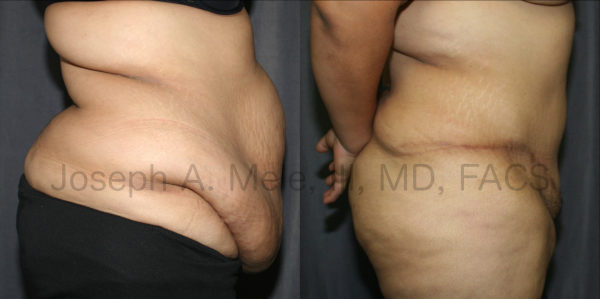
I don’t prescribe a lot of Zithromax, but I do perform a lot of surgery, and the same rules apply. Surgery has the potential to provide great deal of benefit, but no procedure is perfect. When I tell someone that they have too much loose skin for me to do Liposuction, and that the better operation would be a Tummy Tuck, it’s not because I’d rather do a Tummy Tuck. It’s because, in that specific situation, Liposuction is not the best choice. Liposuction, whether it’s Smart-Lipo or Dumb-Lipo, cannot fully correct loose skin. When there is too much loose skin, Liposuction has less potential to do good, and more importantly, an increased risk of making things look worse.
There is little new about the Tummy Tuck. It is tried and true, with well defined benefits and risks. As a result, there is very little coverage about Tummy Tucks in the news. Over 150,000 women had a tummy tuck in 2012, but unless your name is Star Jones, Kate Gosselin or Shar Jackson, it didn’t make the news.
Informercials offering magical belts, creams and exercise DVD’s, that claim to do what a Tummy Tuck can do, are broadcast just about any hour of the day. If they did work, I’d be offering them. I am all for using the simplest solution to a problem, but it has to work. A Tummy Tuck can cost $8000 to $10000, if an $80 cream worked, I’d be selling it, and a lot of it! But creams don’t work. Tummy Tucks, on the other hand, receive a 95% worth it rating on RealSelf by almost 4000 patients. So with that little bit of knowledge, who do you trust?
Cosmetic Plastic Surgery Consultations
Get Answers About Plastic Surgery.
If you are considering cosmetic plastic surgery, be certain to find a Board Certified Plastic Surgeon in your area who as experience in the procedure you need. Spend time researching not only your procedure, but also your doctor. Above all else, choose a doctor you can trust, who is willing to share more than just a little knowledge.
You may always ask me questions via the contact form on the left, but for specific questions, I will likely need to see you. The more information I have, the better the answer you get, and it’s hard to beat an in person consultation. Call (925) 943-6353 today, to schedule your Personalized Plastic Surgery Consultation Appointment.
Over 13.8 million cosmetic procedures where performed last year, and we are counting down the top five cosmetic plastic surgery procedures as reported by the American Society of Plastic Surgeons.
Top 5 Plastic Surgery Videos
Today’s Top 5 Plastic Surgery Video is from a recent Body Beautiful appearance on the Bay Area’s News Station KRON4. This video reveals the procedures tied for fifth place. The top four procedures will be revealed in the coming weeks.
If you have general questions about the Facelift or Tummy Tuck procedures please call (925) 943-6353. You can also schedule an in person private consultation appointment for specific recommendations to achieve your goals. The (415) number shown in this video was only for the live show, for viewers to call in with questions.
Non-Surgical Cosmetic Procedures
12.2 million are non-surgical procedures for Wrinkle Reduction, accounting for 89% of all cosmetic procedures. Treatments with neuromodulators (Botox and Dysport), wrinkle fillers (Restylane, Juvederm, Perlane and Radiesse) and chemical peels lead the way. Laser hair removal and microdermabrasion are also included in the top 5, non-surgical numbers.
Surgical Cosmetic Procedures
1.6 million cosmetic plastic surgeries were performed in the United States last year. With the top 6 procedures accounting for 75% of total cosmetic surgeries performed, a percentage I can confirm at my San Francisco Bay Area plastic surgery practice in Walnut Creek, CA.
Facelifts (Rhytidectomy) and Tummy Tuck (Abdominoplasty) – It’s a Tie
With 120,000 surgeries performed for each last year, the Facelift and the Tummy Tuck are tied for fifth place in our countdown of the most popular cosmetic plastic surgery procedures.
To learn more about the cosmetic procedures listed above, please feel free to search the San Francisco Plastic Surgery Blog or follow the links under Categories. For specific questions, use the contact form or give us a call at (925) 943-6353. The office is open weekdays from 9 AM to 5 PM.
Live on KRON channel 4 next Monday, March 12, 2012, at 11:00 AM, I will be discussing the top 5 (or 6) cosmetic plastic surgery procedures. The show is live, so you can call in with any questions you might have.
The American Society of Plastic Surgeons 2011 Cosmetic Plastic Procedure Statistics are Released.
Every year the American Society of Plastic Surgeons (ASPS) and the American Society for Aesthetic Plastic Surgery (ASAPS) publish their Cosmetic Plastic Surgery Statistics. The 2011 statistics show a gradual increase in the number of cosmetic plastic surgery procedures.
Cosmetic Procedures on the Rise
Overall Americans had 13.8 million cosmetic procedures in 2011. The majority of these were minimally invasive procedures with the neuromodulators (Botox, Dysport) and dermal fillers (Restylane, Juvederm, Perlane and Radiesse) accounting for the majority of treatments.
The Top 5 Minimally Invasive Procedure
Top 5 Minimaly Invasive Cosmetic Procedures
12.2 million minimally invasive procedures were performed in 2011. Here is how the top 5 minimally invasive procedures rank:
1.6 million cosmetic surgery procedures were performed in 2011. Breast Augmentation remains the number one choice, while the Facelift and Tummy Tuck are essentially tied for fifth place. Here are the numbers:
To schedule a consultation appointment, please call my office at (925) 943-6353. You can click on names of any of cosmetic plastic surgery procedures listed above to visit the main website, or use may use the contact form in the side bar to send your questions to me. Thanks for visiting the San Francisco Plastic Surgery Blog.
In the last few decades, plastic surgery has moved from a secretive, back door affair, to main street, and the Facelift (Rhytidectomy) is no exception. Mini-facelifts and “weekend facelifts” like the Lifestyle Lift®, QuickLift™ are household words, and nothing says mainstream more than a brand name, late night informercial, but has it gone too far?
I had never heard of astroturfing until the LifeStyle Lift came along. It illustrates the hazards of purchasing a procedure from a corporation with a large marketing budget, rather than from a Board Certified Plastic Surgeon. More importantly, is the one-size-fits-all facelift a good idea?
The One-Size-Fits-All Facelift
To my eye, facelifts are individualized procedures. Each face is different and every face ages differently. When I evaluate a new patient for a facelift, I evaluate many specific areas. I can tailor my approach to maximize the benefit to the areas that need it the most. The advantage of knowing how to do more than one type of facelift is that I can choose the method that is most likely to help your specific needs.
Sometimes a mini-facelift is enough. Sometimes the traditional full facelift is necessary. Sometimes a deeper plane also needs to be addressed. Should the facelift be en-block or bidirectional? Differences between the mini and full facelifts are explained in my post: Facelift (Rhytidectomy) v. Mini Facelift (Mini Rhytidectomy). Mini and full facelift before and after pictures are also included. Which approach to use is a decision I make after I see you. With mass marketed mini-facelifts, one-size-fits-all, the treatment is largely determined before the evaluation. It’s akin to selecting a tool, before knowing what you are supposed to do with it.
The Buck Stops Here
When I see you in my office for any procedure, I want all the information I can get before selecting a plan. I want to know:
Where are the problems?
What needs to be addressed?
Is it fixable?
Are the goals realistically achievable?
How best to proceed is determined after defining the goals, reviewing the options and building trust. My goal is to provide you with sufficient information so that there are no surprises. A good result takes communication and teamwork throughout the process. A good result takes careful planning and keeping all the options open until the best method is defined.
A facelift is not a one-size-fits-all commodity. Honest discussion beforehand, yields better results and higher satisfaction. If there was one, singular best way to do a facelift, every plastic surgeon would do the same procedure every time. The variety in approaches to the facelift, reflects the variety seen in the face.
Body Beautiful
The 800 number in the video below was only used for viewer questions during the live broadcast. If you have questions, or would like to schedule a consultation appointment for a facelift, please call my Walnut Creek Plastic Surgery office at (925) 943-6353.
Information in this video is provided for general informational purposes only. Specific recommendations can only be made after a careful history and physical examination are performed. Some of the topics covered include:
Brand name mini-facelifts (Lifestyle Lift®, QuickLift™, …)?
The importance of investigating your doctor before scheduling an appointment
Who will take care of you if there is a problem?
How to find a Board Certified Plastic Surgeon
Viewer questions are answered about Blepharoplasty (Eye Lid Surgery)
The other segments of this broadcast can be found here:
The two most important aspects of any surgical procedure are predictability and safety. The facelift (rhytidectomy) is no exception. If you are considering a facelift, you want to know:
What will a facelift can do for my face?
How can I have a facelift in the safest possible manner?
The video segment from KRON4′s Body Beautiful answers these questions, and explains:
The goals of facelift surgery
How to make it safe
The facelift addresses three main areas:
The Cheeks – Nasolabial Folds and Marionette Lines
Sometimes called the “parentheses,” because they bracket the mouth, the nasolabial folds are the wrinkles that run from the base of the nose to the corners of the mouth. The creases that continue from the corners of the mouth down to the chin are called marionette lines.
These areas are frequently treated with Hyaluronic Acid (HA) fillers like Restylane®, Perlane® and Juvederm®. Now that all the HA fillers come with a local anesthetic (Lidocaine) added, it is a more comfortable procedure. Facelifts reduce nasolabial folds and marionette lines in an entirely different way. By elevating the cheeks, and reducing the amount of skin that folds over them, the depth and shadowing of these aging folds are reduced. For deeper lines, a combination of filler and lift may be necessary. Your own cells can be used to fill the area too. When performing a facelift, I will often use a dermal graft to further reduce the facial folds in the nasolabial and marionette areas.
The Neck
The facelift includes the cheeks, jawline and neck. If you only have loose skin on the neck, then a necklift may suffice, but most of the time, both areas age in parallel. If you have loose neck skin, or bands on the front of the neck from the platysma muscle, a facelift can attenuate them.
The Jawline and The Jowls
The jawline is the boundary between the face and the neck. As we age, this boundary becomes blurred. The jowls begin to break up the youthful smooth contours, and the definition between the face and neck becomes less distinct. Since the face and neck are both treated, the jawline between them is also addressed with a facelift. San Francisco Bay Area patients have come to expect the best in facelift surgery. Rejuvenation without distortion is the key. A clean jawline goes a long way toward a youthful face.
Facelift Safety
The safety of a facelift is enhanced by a thorough preoperative workup. This includes everything done leading up to the surgery. If you have high blood pressure, being certain that is it well controlled before surgery is imperative. If you smoke, stopping four weeks before surgery reduces the risk of healing problems by a factor of six.
Doing the facelift procedure safely is also important. The proper facility and equipment help ensure that you are properly monitored the day of surgery.
Last, and certainly not least, the training of you Plastic Surgeon is important. A well trained surgeon is a safe surgeon. By selecting a Board Certified Plastic Surgeon, you can be certain they have the most specialized and thorough training available. Members of the American Society for Aesthetic Plastic Surgery (ASAPS) are uniquely qualified in the realm a Cosmetic Plastic Surgery. As a condition of membership, I have to be a Board Certified Plastic Surgeon and specialize in the Cosmetic aspects of Plastic Surgery.
On With the Show
The 800 number in the video below was only used for viewer questions during the live broadcast. If you have questions, or would like to schedule a consultation appointment for a facelift, please call my Walnut Creek Plastic Surgery office at (925) 943-6353.
This video is provided for general informational purposes only. Specific recommendations can only be made after a careful history and physical examination are performed. Some of the topics covered include:
The changing acceptance of the Facelift
The increasing popularity of Facelifts (about 100000 facelifts are performed a year)
The goals of the Rhytidectomy
The hazards of overcorrection
The differences between male and female Facelifts
Facelift do’s and don’t's
How to assess preexisting medical conditions – preoperative optimization
Should you see your primary medical doctor before having surgery?
Smoking and Facelifts
The importance of a Board Certified Plastic Surgeon
The importance of an Accredited Surgery Center
Can other facial rejuvenation procedures be safely combined with a facelift?
The other segments of this broadcast can be found here:
Almost 100,000 facelifts were performed by Board Certified Plastic Surgeons in the United States last year. It is one of the most frequently requested cosmetic plastic surgery procedures I perform. While rhytidectomy means wrinkle removal, the goal is to achieve a youthful, rested appearance that maintains expression.
This video segment, taken from my appearance on KRON4′s Body Beautiful, discusses the changes that occur with a facelift. Facelift before and after pictures are included. The specific areas of treatment are compared for the rhytidectomy and mini-rhytidectomy. The pro’s and con’s of the facelift are contrasted with the mini-facelift. San Francisco Bay Area residents had their questions about facelifts and necklifts answered live.
The 800 number in the video below was used for the live broadcast. If you have questions, or would like to schedule a consultation appointment, please call my Walnut Creek Plastic Surgery office at (925) 943-6353. Questions can also be asked using the contact form on the lower left aspect of this page.
This video is provided for general informational purposes only. Specific recommendations can only be made after a careful history and physical examination are performed. Some of the topics covered include:
How popular is the Facelift procedure?
Before and after pictures of Facelifts
Before and after pictures of Mini-Facelifts
Description of the Facelift
What is a Mini-Facelift?
What areas of the face and neck are addressed with a Facelift?
How is a Necklift different from a Facelift?
Can Liposuction take the place of a Facelift?
How is the definition of the neck restored?
The other segments of this broadcast can be found here:
The name for the facelift procedure, or rhytidectomy, comes from the Latin word rhytid meaning wrinkle. Rhytidectomy literally means wrinkle removal. While Board Certified Plastic Surgeons remove wrinkles from all over the body, in Cosmetic Plastic Surgery, the term rhytidectomy is used almost exclusively to describe the surgical procedure that removes wrinkles from the face.
While the facelift is the gold standard for facial rejuvenation, there are many options to consider. This video segment, taken from my appearance on KRON4′s Body Beautiful, discusses the changes that occur in the face as we age. It reviews treatments like botulinum toxin (BOTOX Cosmetic, Dysport) and fillers (Restylane, Perlane, Juvederm), mini-facelifts and the facelift. San Francisco Bay Area residents were able to call in with their questions and have them answered live on the air.
The 800 number in the video below was only used for viewer questions during the live broadcast. If you have questions, or would like to schedule a consultation appointment, please call my Walnut Creek Plastic Surgery office at (925) 943-6353.
This video is provided for general informational purposes only. Specific recommendations can only be made after a careful history and physical examination is performed. Some of the topics covered include:
Loss of facial volume as we age
The effects of gravity
Restoration of volume with fillers
Reducing facial animation lines with Botox/Dysport
What is a facelift?
What areas of the face are addressed with a facelift?
Is the neck included in a facelift?
How is facial volume replacement addressed?
Is it supposed to look tight?
The other segments of this broadcast can be found here:
Rhytidectomy (Facelift) San Francisco – Part 1 of 4 (You are here)
If you are looking for facial rejuvenation, but are not ready for a facelift, a mini-facelift might be the right procedure for you. Mild to moderate lines can be improved with dermal fillers (Restylane®, Juvederm®, Perlane® and Radiesse®), but loose skin needs something more. If fillers aren’t filling like they used to, it might be time to consider a little nip and tuck. For the right patient, a mini-facelift can provide big results in a mini package.
The Full Facelift
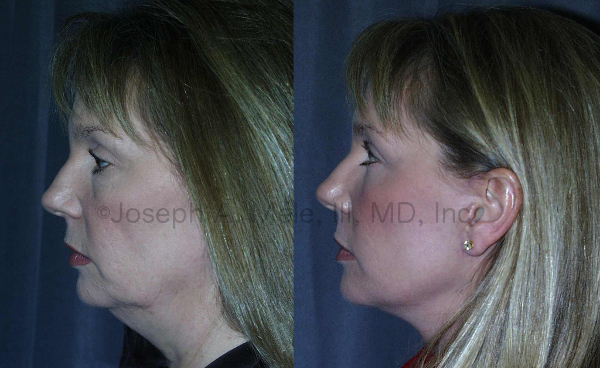
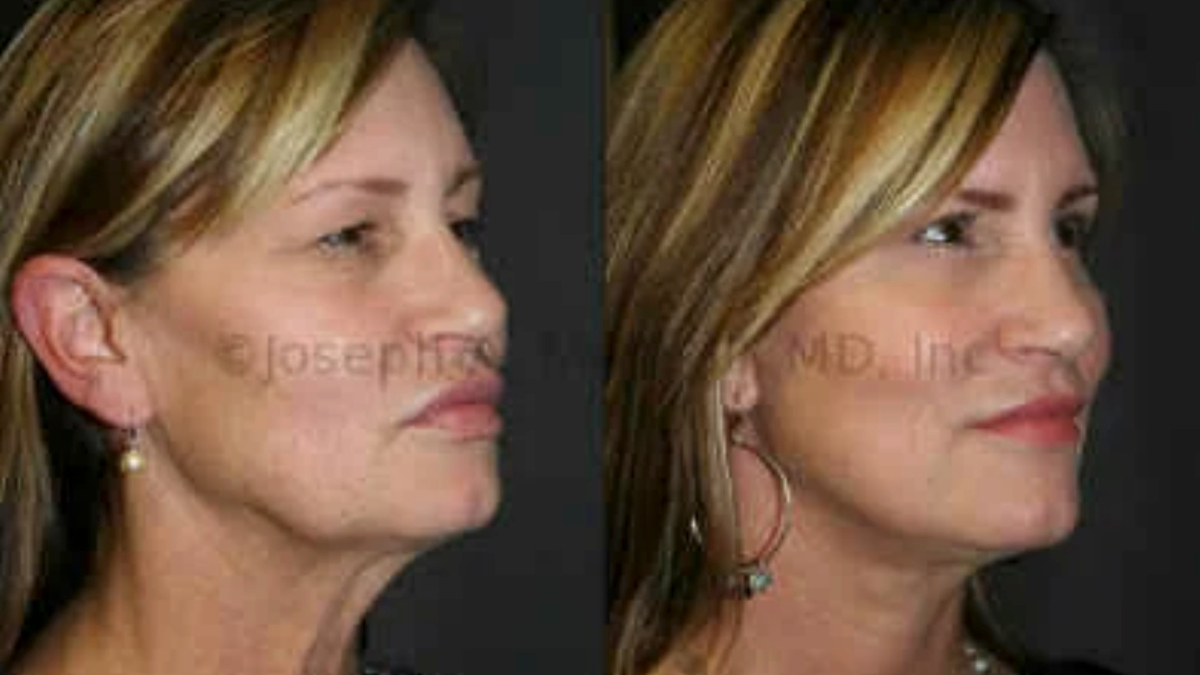
Before a Full Facelift - The skin of the lower face and neck is loose, and the anatomic definition between the face and neck is lost.
After a Full Facelift - The skin of the lower face and neck is firm, and the anatomic definition between the face and neck is restored.
The traditional facelift is the gold standard of facial rejuvenation. It can correct more aspects of the aging face, and can do so to a greater extent, than the mini-facelift. Severe skin laxity, platysmal banding and sagging of the cheek fat pads can be quickly and accurately improved with a facelift. While a facelift does more, and lasts longer, it requires more downtime for recovery. A facelift also takes longer, requires more anesthesia and accordingly costs more. The patient shown above had a full facelift with upper and lower eyelid surgery.
The Mini Facelift
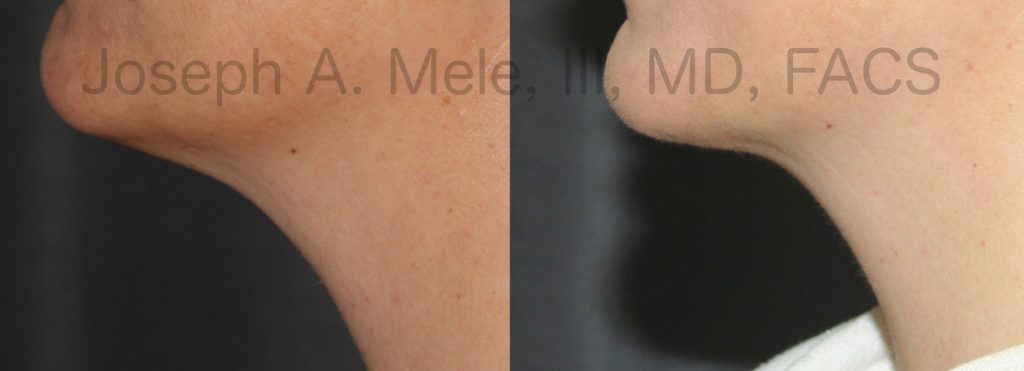
Mini Facelift Before - Loose skin on the lower face and neck obscures the jawline.
Mini Facelift After - The jawline is clean and the jowls are removed.
If your primary problem is mild to moderate skin laxity, and the structures underneath the skin are in good shape, a mini-facelift may be able to get you the younger, rested look you want. A mini-facelift is a shorter procedure, which can be done under local anesthesia, resulting in a quicker recovery and a lower cost. The mini-facelift is great for early intervention, and while it cannot replace a full facelift in terms of the amount it can do, or how long it will last, it can significantly delay the need for a full facelift. A mini-facelift can also be used to rejuvenate a previous facelift, with relatively less effort. The patient shown above had a mini-facelift with lower eyelid surgery.
Caveat Emptor
Many brand name mini-facelifts have recently emerged: The Lifestyle Lift™, QuickLift™ and NewLift™. They try to keep the techniques secret (even from their patients), but they are essentially mini-facelifts. The companies that market the lift will train a doctor to perform the procedure for a price. They have tried to carve out a niche in the Cosmetic Plastic Surgery Market with a gimmicky name and massive advertising, but buyer beware. When you are purchasing a mini-facelift you are not just purchasing a one-size-fits-all procedure; you are purchasing the skills of the individual physician performing your surgery. There is nothing magical about a Lifestyle Lift™, QuickLift™ or NewLift™. It is a mini-facelift, and at a minimum, you will want to check for yourself the ABMS Board that has certified your potential surgeon (see links at the bottom of this article).
You Deserve a Board Certified Plastic Surgeon
When you check, you will find, most Board Certified Plastic Surgeons do not perform brand name lifts. Most Board Certified Plastic Surgeons do, however, offer similar procedures at a competitive rate. The American Society of Plastic Surgeons (ASPS) and the American Society for Aesthetic Plastic Surgery (ASAPS), find it unethical for a plastic surgeon to patent a procedure. Instead, new techniques are freely shared and discussed at our professional society meetings. This is how we reinvest in our profession, and allow the practice of plastic surgery to grow.
Board Certified Plastic Surgeons learn how to do facelifts and mini-facelifts during years of training, and continue to refine their technique with practice, continuing medical education and instructional courses. I find that one facelift technique is not enough, and I would rather tailor your facelift to the specific needs of your face.