February 16th, 2011 Dr. Mele
Tubular breast deformity is a common, congenital breast abnormality found in both women and men. In men, the treatment is straight forward (see the bottom of this article). In women, however, additional aesthetic norms come into play, making the repair more complex.
Tubular Breast Deformity in Women
Tubular breast deformity is known by many names:
- Tubular breast deformity
- Tuberous breast deformity
- Snoopy Nose or Snoopy’s Nose deformity
- Constricted breast deformity
Women with mild constriction often come to see me to simply increase the size of their breast, not aware of the diagnosis. Women with more severe deformity, however, are often reluctant to show their breasts to others, and want to improve the size and the shape of their breasts. Correcting these types of problems is more challenging, but at the same time, quite rewarding.

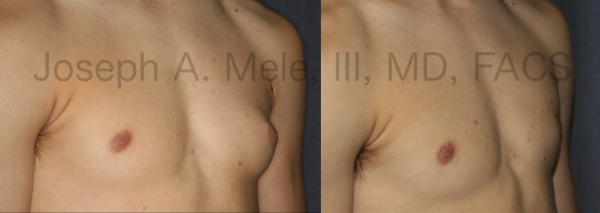
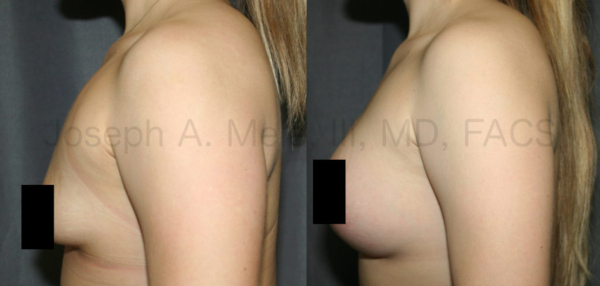
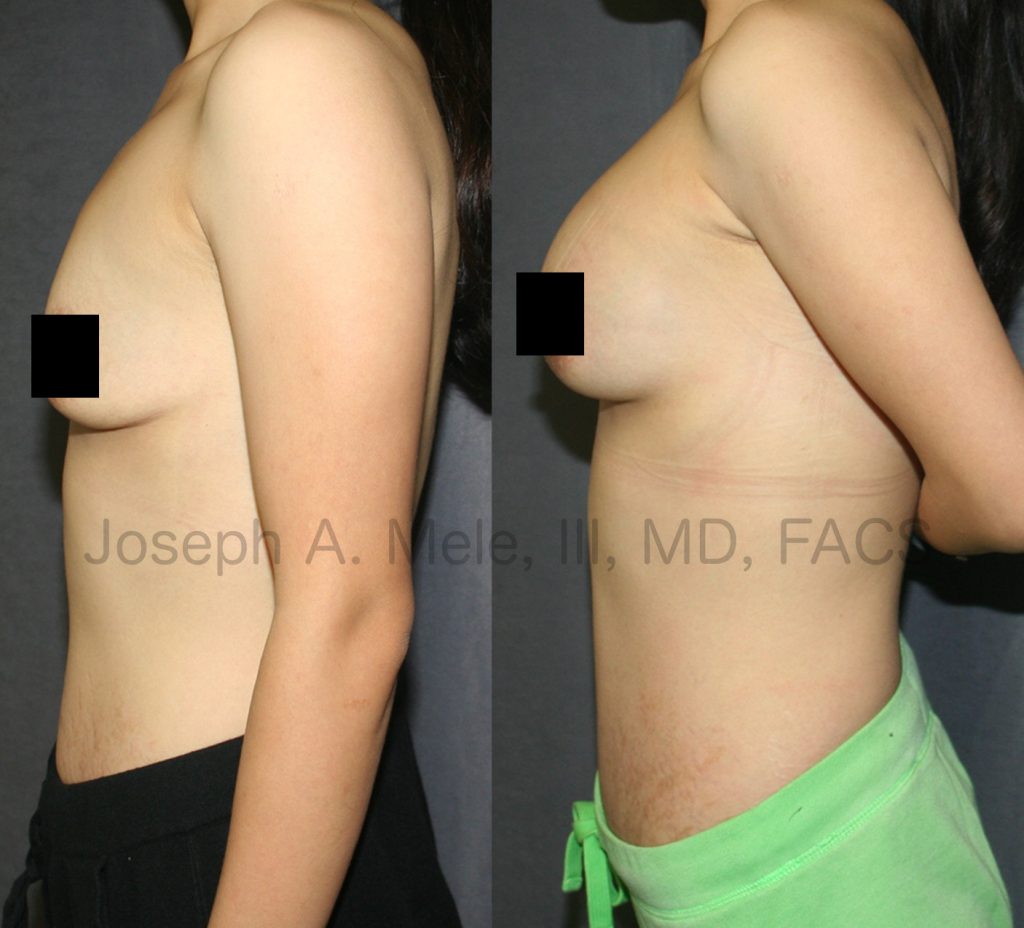
Mild tubular breast deformity with constricted base was corrected with sub-pectoral breast augmentation (behind the muscle) and internal release (no lift needed)
Tubular Breast Abnormality is a Congenital Breast Deformity
While present at birth, the full extent of the tubular breast deformity is often not appreciated until puberty. This is when the breasts normally develop, and the full extend of abnormalities are revealed. While women with tubular breasts have smaller than average sized breasts, not all small breasts are tubular breasts. While the extent to which the deformities manifest can vary widely, several specific abnormalities are present.
Signs and Presentation of Tubular Breast Abnormality
Besides smaller size, the main components of the tubular breast are a constricted base and a tubular shape to the breast. This can be exacerbated by herniation of the breast tissue into the areola, causing “puffy nipples”. Technically, the nipple is not affected, but the areola, the colored skin around the nipple, may project out from the breast mound. The overall effect is an elongated or tubular shape to the breast. The true tubular shape is most noticeable in more severe cases.
The colloquial name for tuberous breasts is the Snoopy Nose or Snoopy’s Nose deformity. Snoopy is Charlie Brown’s white beagle of Peanuts fame. Picture the front of Snoopy’s muzzle. If you are not familiar with Snoopy click the link above. His white face represents the breast mound, his black nose sits like a ball on the end, and represents the herniated breast tissue filling the areola.
Treatment of the Tuberous Breasts
As mentioned above, tubular breasts tend to not fully develop. Often patients with tubular breasts desire breast augmentation to increase the size of their breasts. For mild tubular breast deformity, a breast implant may be sufficient treatment. When the breasts are more tubular, additional maneuvers are necessary to provide an enhanced result.
If the areola is overly full, a periareolar lift can reduce the puffy nipples, and prevent the breast tissue from herniating. Unlike for men, the breast tissue is not usually removed, just pushed back into its normal anatomical position. The constricted base seen with tuberous breasts also tends to shorten the distance between the areola and the base of the breast. The lift has the additional benefit of moving the areola higher on the breast, helping to center the nipple on the breast mound.

Moderate tubular breast deformity with constricted base, elongated breast and mild areolar breast tissue herniation, best seen in right breast (your left). Both size and shape were corrected with breast augmentation and peri-areolar lifts.
Traditionally, tubular breast were treated with breast implants placed in front of the muscle. With a periareolar lift, it usually possible to place the implant behind the muscle. This gives a more natural appearing breast mound, and makes it easier to perform mammography in the future. While silicone and saline breast implants can both give good looking results, for smaller breast, a silicone gel implant may give a better feeling result. It is important to discuss the pro’s and con’s of each option with your Board Certified Plastic Surgeon.
Tubular Breast Deformity in Men
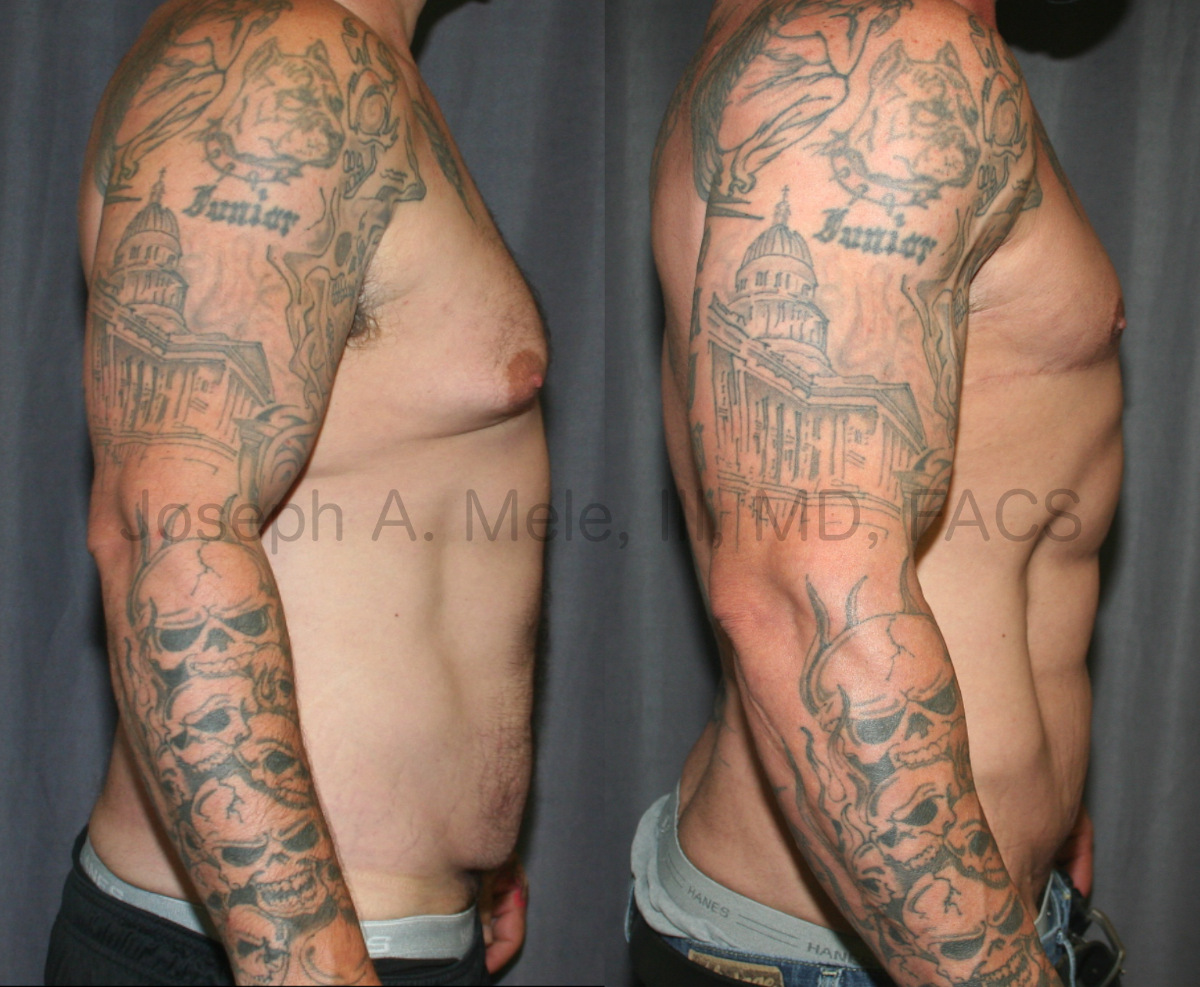
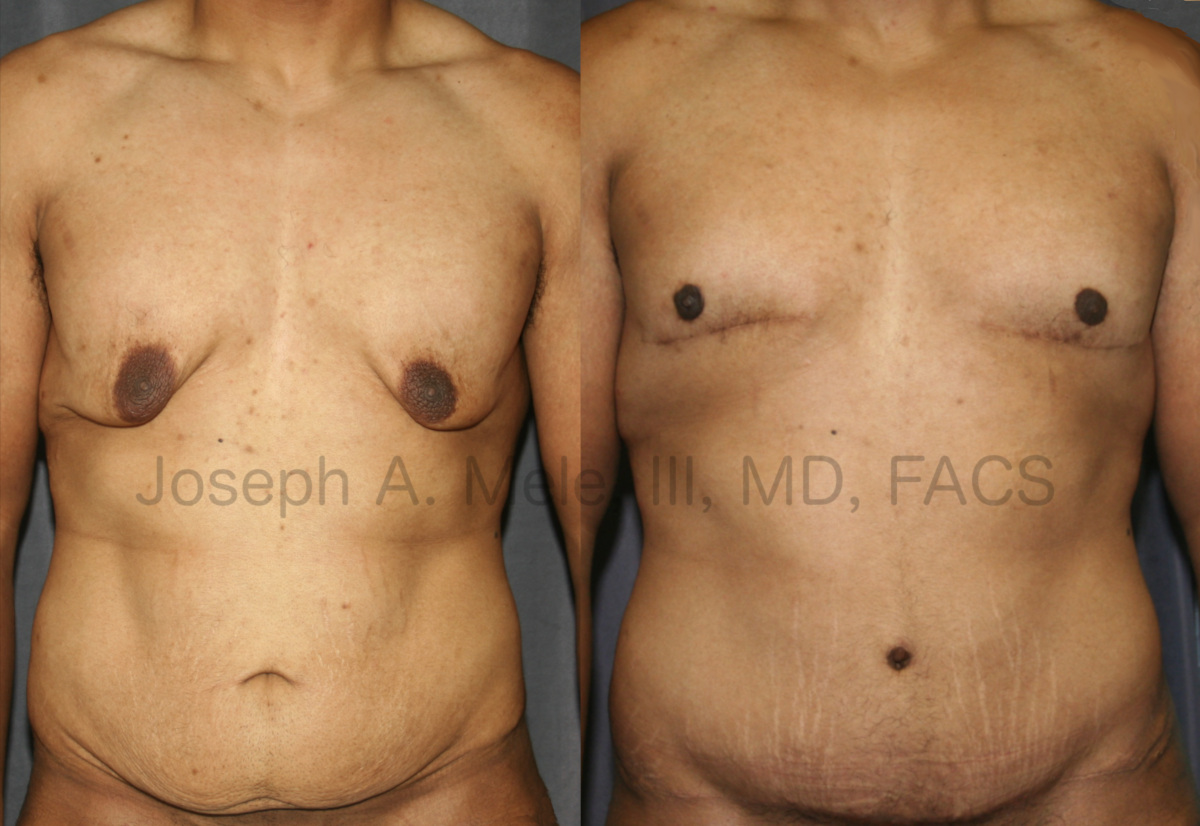
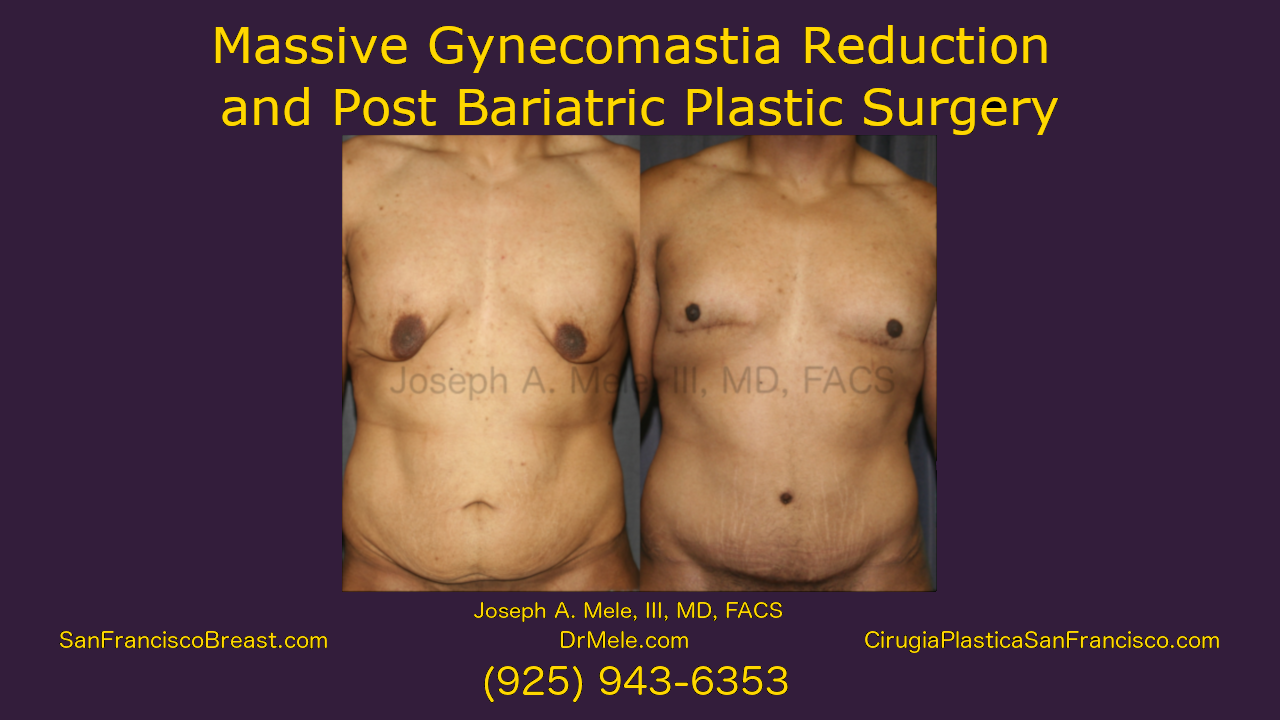
In men, tubular breast deformity presents as an overly full areola or “puffy nipples”. Since men like flat chests, tuberous breasts are easily treated in with resection of the excess tissue. The procedure is similar to that used for Gynecomastia. A small “smiley-face” incision is made from 4 to 8 o’clock around the lower edge of the areola, and the excess glandular tissue is removed. The procedure provides a smoother contour, and a quick recovery.
Information on Tubular Breasts
More information on tubular breasts is available on the breast abnormalities page of my specialty breast site under Congenital Abnormalities – Tuberous or Tubular Breasts, and the Snoopy Nose Deformity. Tubular Breast Augmentation Before and After Pictures are also available in my main web site. The best information, however, is only available in person. If you would like to schedule a consultation appointment in my Walnut Creek Cosmetic Surgery office, please give me a call at (925) 943-6353, or use the contact form in the column to the left.
Posted in Areolar Reduction, Breast Asymmetry, Breast Augmentation, Breast Lift (Mastopexy), Home, Tubular Breasts | No Comments »
December 10th, 2010 Dr. Mele

Dr. Joseph Mele appears on KRON4's Body Beautiful.
To celebrate the debut of the new San Francisco Breast dot com (SanFranciscoBreast.com), a site dedicated to cosmetic breast surgery for the San Francisco Bay Area, I will be dedicating my appearance on Monday’s Body Beautiful on KRON4 to the breast. Breast augmentation, breast lifts, breast reductions, breast implant revisions, everything related to enhancing the breasts is open for discussion.
Body Beautiful is broadcast live at 11:00 AM on KRON4, so tune in and phone in with your breast questions. Whether you have had breast surgery, or are considering it, the show will cover a variety of topics. For a preview of what’s in store visit SanFranciscoBreast.com.
What’s new in Breast Enhancement Surgery?
The new web site is a comprehensive and authoritative review of the latest techniques in aesthetic breast surgery. Located in the San Francisco East Bay Area city of Walnut Creek, Plastic Surgeon, Joseph Mele, has lent his years of experience, and breast expertise, to this free patient education resource. The site is illustrated with graphics, videos and before and after pictures, and there is more to come. The list of topics covered is long and includes:
-
Breast Augmentation
-
Breast Augmentation Lift
-
Breast Augmentation Revision
-
Breast Lift
-
Breast Reduction
-
Gynecomastia Reduction – Breast Reduction for Men
-
Specialty Breast Procedures – Correction of Other Breast Abnormalities
I look forward to hearing from you on Monday. If you will not be able to watch KRON4 at 11 AM on Monday, December 13, 2010, and you have a question you want answered, you can send your question via the contact form to the left. I will send you a personal response, and perhaps your question will be answered live during Body Beautiful.
Posted in Areolar Reduction, Breast Asymmetry, Breast Augmentation, Breast Implant Revision Surgery, Breast Lift (Mastopexy), Breast Reduction, Breast Reduction (Men), Breast Reduction (Women), Capsular Contracture, Home, Inverted Nipples, Nipple Reduction | No Comments »
September 21st, 2010 Dr. Mele

Dr. Joseph Mele appears on the Bay Area's News Channel, KRON4's Body Beautiful
Thank You
Thank you Bay Area plastic surgery patients, for a great show yesterday. We discussed breast augmentation, breast lifts, breast reduction and combinations of all the above. For anyone who missed the show, and is interested in seeing the broadcast, I will be posting it here in the San Francisco Plastic Surgery Blog very soon.
KRON4′s Body Beautiful
Body Beautiful is a live show that allows you to call in with your questions. Unfortunately, it was not possible to answer everyone’s questions in half an hour. However, you can always send me your question by using the contact form found in the lower left corner of this page.
Breast Lift Before and After Pictures
Several pictures where used to illustrate the results possible with Breast Augmentation (Mammaplasty) , Breast Lift (Mastopexy) and Breast Augmentation Lift (Augmentation Mastopexy). While censored for television, the breast augmentation before and after pictures demonstrated the natural fullness that can be achieved with a breast implant. The breast lift before and after pictures showed how the breast and nipple are lifted with the mastopexy. The two procedures can also be combined and the breast augmentation mastopexy, or breast augmentation lift. The breast augmentation mastopexy before and after pictures show what the procedures can achieve when performed together.
Breast Lifts not only lift the breast, but also reposition the nipple. Since the nipple and areola on the before and after pictures have to be censored for the breast lift video segment shown on network television, some of the details are lost. I will show you here, what I cannot broadcast on television.
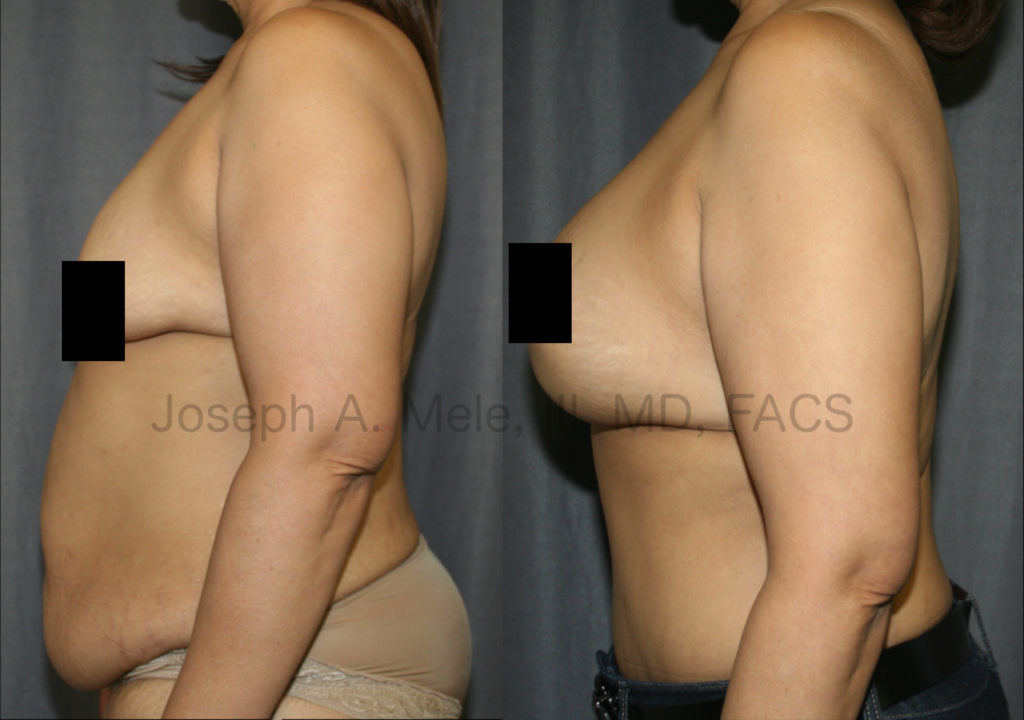
 Before Breast Lift with Breast Reduction: Notice the nipple position. When the nipple is located at the bottom of the breast, this is classified as Grade III ptosis. The breast mound is below the inframammary fold (IMF), and overlies the upper abdomen |
 After Breast Lift with Breast Reduction: The nipple and breast are now perky. The breast has been moved up onto the chest, and the nipple has been moved up on the breast. Can you find the freckle just above the nipple over in the before picture? |
What Can a Breast Lift Do?
The above, breast lift with breast reduction before and after pictures, show what a lift can achieve. The breast has been lifted off the upper abdomen and placed back onto the chest. Since breast reduction was also performed, some breast volume was reduced. Reducing breast volume is not required to achieve a breast lift. A breast lift can be done with breast augmentation to add volume, with breast reduction to reduce volume or by itself when the breast volume is fine.
The pictures show that the nipple has been lifted from its dependent position at the bottom of the breast, to the point that is most anterior. The nipple was at elbow level before the lift, afterward the nipple is at the midpoint of the upper arm. Before the mastopexy the breast look old, sad and tired, afterward, the breasts appear young and perky.
Another measure of how for the nipple has moved is demonstrated by the freckle that is just above the nipple after the lift. The same freckle can be seen (more faintly) in the before picture, near the center of the chest, on the upper breast mound, about half way between the nipple and the collar bone. This shows not only how far the nipple has moved, but also how much breast tissue has been moved up under the skin. Even the cleavage has been moved up on the chest, and this is with volume reduction. Upper pole fullness can be further enhanced with the use of a breast implant.
Many Types of Breast Lifts are Available
The lift used above is an inverted-T mastopexy. This is also called the keyhole lift or anchor lift, and is the biggest lift performed. In the after picture the scar can be seen. It runs around in a circle around the nipple, from the nipple down to the base of the breast, and along the bottom of the breast in the inframammary fold (IMF). The vertical incision and the incision around the areola allow for the repositioning of the nipple higher on the breast. The periareolar (around the areola) incision also allows for reduction of the areola’s diameter if desired. The horizontal incision, in the IMF at the base of the breast, allows the breast mound to be moved upwards and reduces the skin in the lower breast to help support the breast tissue up.
Many types of breast lifts are available. My goal is to always choose the smallest lift that will give us the results we desire. In this case, this is the biggest lift available. While there is more scar length, the quality of the lift, and the control achieved, makes the result worthwhile. Not only is the breast rejuvenated in appearance, but the reduction of breast skin also firms the breasts, resulting in less pendulous breast movement and more patient comfort when physically active.
More Information on Breast Augmentation, Breast Lifts and Breast Reduction
Click on any of the following links for more information on the topic covered in this post courtesy of DrMele.com:
Breast Augmentation
Breast Lift
Breast Augmentation Lift
Breast Reduction
Areola Reduction
Posted in Areolar Reduction, Breast Lift (Mastopexy), Breast Reduction (Women), Home | No Comments »
August 24th, 2009 Dr. Mele
Breast asymmetry is more the rule than the exception, and there are many ways in which breasts can be uneven. Size, shape and location all come into play. Asymmetry may effect the entire breast mound (see previous post) or just the nipples. Normally, the differences are small; however, as the magnitude of breast asymmetry increases, so does the desire for correction.
In my San Francisco Bay Area (Walnut Creek) cosmetic plastic surgery practice, I measure the differences between the breasts both subjectively and objectively every day. Small differences frequently go unnoticed. Often, asymmetry is first noted in the consultation for breast augmentation. When the difference is obvious, however, breast asymmetry can be the driving force toward seeking consultation with a Board Certified Plastic Surgeon.
This post is focussed primarily on areola asymmetry (the darker skin around the nipple) and nipple asymmetry (the raised part in the middle). Look for a post on breast asymmetry (the breast mound itself), including breast implant asymmetry, in the very near future.
One of the most common nipple asymmetries is caused by inversion (retraction) of the nipples. Inverted nipples can occur on one or both sides. Inverted nipples and even bifid (split or duplicated) nipples can be treated with minor surgery.

Before correction the nipple and part of the areola are hidden.
Inverted nipples are caused by short mammary ducts that pull the nipple inside the breast tissue. In the most pronounced forms even the areola maybe hidden. The scar for inverted nipple correction is normally hidden in the fold beneath the nipple. Since correction involves releasing the tight ducts, correction may interfere with the ability to breast feed, and this should be discussed with your plastic surgeon prior to surgery.

After correction the relatively large nipple can now be seen.
The size and shape of the nipple can also be adjusted.

Close-up of breast showing appearance of nipple enlargement after pregnancy.
Overly large nipples can be reduced in length and girth. In general, it is easier to reduce a large nipple than to enlarge a small one. Nipple reconstruction is performed after a mastectomy when the nipple is absent. With nipple reconstruction, especially when the breast has received radiation, the most difficult aspect is creating and maintaining nipple projection.

Close-up of breast showing appearance of nipple after nipple reduction.
There are times when the nipples are normally formed, but their location on the breast is asymmetric or they are just too low. Modest changes in nipple location can be improved with a periareolar approach. Several centimeters of motion can be safely accomplished with this method. The same periareolar technique can also be used for areolar reduction or to correct the overly full areola, as seen with a tubular breast deformity.
Larger asymmetries may require surgery similar to a breast lift. Formal breast lifts allow the larger movement of the nipples, and reshaping of the entire breast mound. See the previous San Francisco Plastic Surgery Blog posting by clicking here Breast Mound Asymmetry San Francisco: Breast Mound, Breast Implants. There are many types of lifts, and each has its own pros and cons. The art of Plastic Surgery is choosing the best approach for each individual San Francisco breast asymmetry patient. This will be the topic of a future posting.
Posted in Areolar Reduction, Breast Asymmetry, Breast Augmentation, Breast Implant Revision Surgery, Breast Lift (Mastopexy), Home, Inverted Nipples, Nipple Reduction, Tubular Breasts | No Comments »
August 16th, 2009 Dr. Mele
There are many ways in which breasts can be uneven. Size, shape and location are the most common. There can be asymmetry of the nipples as discussed in Breast Asymmetry San Francisco: Inverted Nipples and Asymmetry, or asymmetry of the breast mounds themselves discussed here. If the differences are small, everything appears normal; however, as the magnitude of asymmetry increases, so does the desire for correction.
There are times when the nipples are normally formed, but their location on the breast is asymmetric or low. This post will discuss breast mound asymmetry, including breast implant asymmetry and nipple location.
Modest changes in nipple location can be improved with a periareolar approach. In these cases an incision is made around the areola and differing amounts of skin are removed to move the nipple and areola in the desired direction. Several centimeters of motion can be safely accomplished with this method.
The same periareolar technique can also be used for areolar reduction. When the areola is too large, it be reduced to better match the proportions of the breast. The periareolar technique can also correct the overly full areola, as seen with a tubular breast deformity.
Larger asymmetries, require greater movement of nipple areola, and are accomplished with surgery similar to a breast lift.

Before breast augmentation and formal breast lift. Note the asymmetries. On left side (patient's right) both the breast mound and the nipple areola complex are larger and lower.
Formal breast lifts are also know as inferior pedicle breast lifts, inverted-T breast breast lifts or anchor scar breast lifts. This is the most versatile of the breast lift and allows for the largest movement of the areola and nipples, as well as reshaping of the entire breast mound. Larger corrections are possible with preservation nipple sensation and circulation.

After breast augmentation and an "inverted-T" breast lift. The periareolar and vertical components of the scar can be seen. The horizontal scar is hidden in the inframammary fold.
In this case a breast augmentation was used to adjust the breast volume; at other times a breast reduction is more appropriate. As previously dicussed, breast implant revision surgery may also be indicated for breast implant asymmetry from capsular contracture.
There are many types of breast lifts and each has its pro’s and con’s. The art of Plastic Surgery is choosing the best approach for each individual San Francisco breast asymmetry patient. I call this, using the smallest hammer necessary to get the job done. While bigger lifts leave a longer scar, choosing too small a lift still leaves a scar but it does not correct the original problem.
Posted in Areolar Reduction, Breast Asymmetry, Breast Augmentation, Breast Implant Revision Surgery, Breast Lift (Mastopexy), Home, Tubular Breasts | No Comments »