June 29th, 2012 Dr. Mele
With the introduction of high-strength, highly cohesive, gummy-bear, silicone gel breast implants comes the ability to make breast implants with an intrinsic teardrop shape. Since the “ideal” breast has a teardrop shape, a breast implant that mimics this shape seems ideal, but is it?
Teardrop Shaped Breast Implants
Teardrop Shaped Breast Implants give Plastic Surgeons the ability to better influence not only the size, but to a limited extent, the shape of the breast too. By preferentially adding volume to the lower pole, a flat breast can become more teardrop shaped. By altering the vertical and horizontal diameter of the breast implant, a better match for taller and wider chests is possible.
Teardrop Shaped Breast Implants Before and After Photos

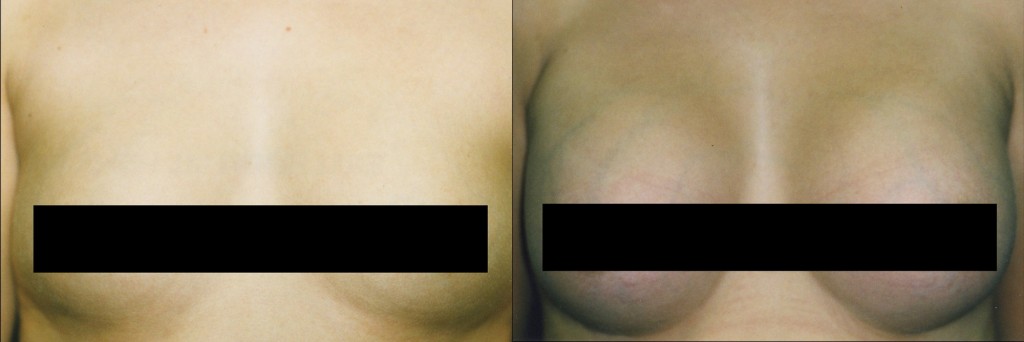
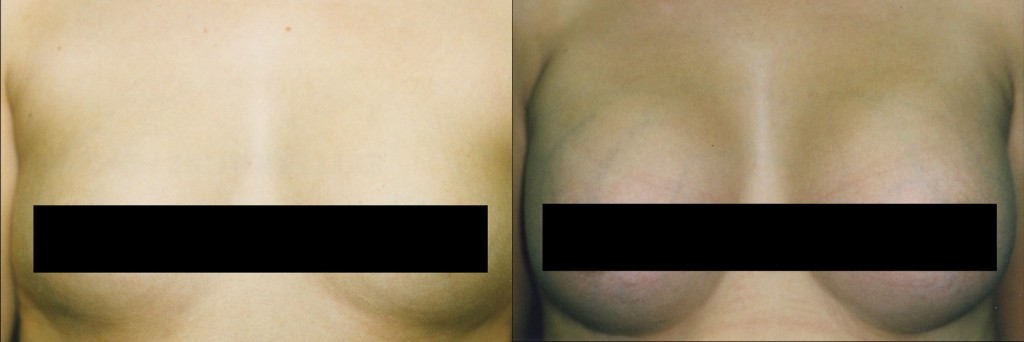
Breast Augmentation Before and After Photos using shaped breast implants.
The Breast Augmentation shown above was performed with Teardrop Shaped Breast Implants. These particular breast implants are taller than they are wide to better fit a taller torso. The teardrop shape allows for a gradual increase fullness from the upper aspect down to the lower breast. The asymmetrical cross-section allows more augmentation at the base, without adding excess width. Enhanced filling in the lower pole allows for enhanced projection beneath the nipple and better definition of the curve below the breasts. The importance of this is greatest when there is very little native breast tissue. The teardrop shaped breast implants pictured above were placed via an incision in the inframammary fold (the crease beneath the breast).
Round Breast Implants
Round Breast Implants can also give a teardrop shaped Breast Augmentation. Round breast implants add volume to the upper and lower pole of the breasts. When the pre-surgical breast is flat up top, but has fullness in the lower pole, placing a round breast implant can get a teardrop shaped breast augmentation. The best results for round breast implant breast augmentation are seen when the breast implant is placed behind the pectoralis major muscle (submuscular breast augmentation).
Submuscular Breast Augmentation with Round Breast Implants
The pectoralis major muscle helps to taper the augmentation in the upper pole of the breast. This results in a smoother transition from chest wall to breast, and helps minimize the abrupt half-a-coconut appearance more often seen in subglandular breast augmentation – when the breast implants is placed in front of the muscle.
Submuscular Breast Augmentation Before and After Pictures – Round Breast Implants

Breast Augmentation Before and After Pictures: Submuscular breast augmentation with smooth round breast implants. Notice the smooth transition from chest to breast at the top of the breast. The abrupt, well- defined transition is saved for the lower pole of the breast.
The above patient has a small amount of breast tissue before her Breast Augmentation. By placing a smooth round breast implant behind the muscle, a larger and teardrop shaped breast is created. An abrupt, sexy curve is maintained along the bottom of the breast. When enhanced upper pole fullness is desired, a pushup bra can be used to make the upper breast more full or even round.
Subglandular Breast Augmentation with Round Breast Implants
If enough breast tissue exists in front of the muscle, it is possible to get a teardrop shaped breast augmentation with round breast implants placed in front of the muscle. However, when less breast tissue is present, the shape of the implant begins to dominate. This is most often seen in female body builders. Since they have very little body fat, and breast tissue, there is very little to disguise the breast implant.
Female body builders, who have had breast augmentation, often have the breast implants placed in front of the muscle. This subglandular placement minimizes breast implant motion during competition, when the chest muscles are flexing maximally. The result of breast augmentation in front of the muscle can be seen monthly on the covers of muscle and fitness magazines, i.e. fairly round breasts.
They go by various less than flattering names including the “fake look” or “bolt ons.” The main problem is that the chest of a body builder is both overdeveloped, and lacking. The chest muscle is large; however, the breast tissue is smaller than the average woman’s. The combination results in the need to use larger breast implant volumes under thinner “soft tissue” coverage, and makes for rather obvious breast implants. In this situation, rounder implants give rounder results, and this can happen, to a lesser extent, even when the breast implant is placed underneath the muscle.
Submuscular Breast Augmentation with Round Breast Implant (Thin Coverage) Before and After Pictures

Submuscular Breast Augmentation with thin “soft tissue” coverage.
In the above patient, a smooth round breast implant was placed behind a thin pectoralis major muscle. With thinner soft tissue coverage, the upper pole of the breast can become more abrupt. In many cases, a teardrop shaped implant can provide a smoother transition.
Subglandular Breast Augmentation with Round Breast Implant (Thin Coverage)
With the Breast Implants in front of the muscle, there is less “soft tissue” coverage. The result is an even more obvious breast implant, and the larger the implant, the more obvious the augmentation. There can be advantages to this technique, and the tradeoffs may be worthwhile when evaluated on an individual basis.
For body builders, placing the breast implant in front of the muscle minimizes the deformity seen with flexion, and this is good for competition judging. Prepectoral placement also allows for lower placement on the chest, which can sometimes obviate, or at least delay, the need for a breast lift with breast augmentetion.
Subgladular Breast Augmentation with Round Breast Implant (Thin Coverage) Before and After Pictures

Submuscular Breast Augmentation with Round Breast Implant (Thin Coverage) Before and After Pictures
The above patient had her breast implants placed in front of the muscle via a periareolar incision. In her case, the risk of a flexion deformity was minimized, and a breast lift was not necessary. By placing the breast implant in front of the muscle, the implant could be placed at the inframammary fold (lower than the lower edge of her well developed pectoralis muscle) to fill the lower pole of the breast and avoid a double-bubble deformity. A dual-plane approach could provide similar positioning, but with a greater risk of flexion deformity. The cosmetic result could be enhanced with a teardrop shaped implant, or submuscular placement for a woman who is not a body building competitor.
Breast Augmentation Options
Breast Augmentation has evolved a great deal over the last 50 years. There are many options available to you in terms of incisions, breast implants and breast implant placement. While this blog, and my other websites, are designed to give you a good idea what the options are, they cannot take the place of a well thought out, in person, consultation with a Board Certified Plastic Surgeon. If you are considering Breast Implants seek a Board Certified Plastic Surgeon with a broad experience in multiple techniques of Breast Augmentation.
I realize this blog reaches around the country and the world. Referrals from friends, family or your primary doctor should be coupled with a visit to the agencies in your area that license physicians and surgeons and your National Plastic Surgery Professional Societies. In the US, just click on what you want to do:
Check if your doctor is Board Certified by the American Board of Plastic Surgery.
Check if your doctor is Board Certified by another American Board of Medical Specialties board. You will need to register to use this site, but it is safe, free and fast.
Check if your doctor has an unrestricted California Medical License. Read the disclaimer and click “Continue to Search” at the bottom. If you are not in California, Google your local medical board for a link.
If you are in the San Francisco Bay Area, I would be happy to see you in my Walnut Creek, CA office. Just give us a call at (925) 943-6353, or use the contact form to the left.
Posted in Breast Augmentation, Breast Implant Options, Home | No Comments »
June 24th, 2012 Dr. Mele
For the past 50 years, Board Certified Plastic Surgeons have had a selection of Breast Implants to choose from for Breast Augmentation. Before breast implants, injectable fillers like fat, paraffin, sponge and even free silicone were used. The lack of predictability and irregular results led to the search for a better method for breast augmentation. Breast Implants were that next step, and for 50 years they have provided the safest and most predictable technique for cosmetic breast enlargement. Recent developments in breast implant manufacturing continue to provide improvements.
Teardrop Shaped Breast Implant Before and After Pictures

Breast Augmentation using shaped breast implants. These breast implants are teardrop shaped and taller than they are wide. The tapered teardrop shape allows for fullness higher on the chest that is more gradual without excess width. Enhanced filling in the lower pole allows for enhanced projection and better definition of the curve beneath the breasts. These teardrop shaped breast implants were placed via an incision in the inframammary fold.
Breast Implant Variety is Good
Because we come in all shapes and sizes, breast implants are available in different shapes and sizes. In the 1990′s, after the temporary restriction of silicone filled breast implants for cosmetic breast augmentation, only one shape was available. The shape, still found in Moderate Profile Breast Implants, was available in multiple sizes, but all had the same profile. As the volume increased, the diameter and projection increased proportionately. These worked very well to increase the size of the breast for the average woman; however, there were limitations in how the breast implants could be individualized.
Low, Medium and High Profile Breast Implants
Eventually, multiple profiles became available. High profile Breast Implants allow greater volumes to be used on narrower chests by increasing the projection of the implant and narrowing the diameter. This can help prevent the augmented breast from becoming disproportionately wide on the chest, also known as too much “side boob.” On the other hand, Low Profile Breast Implants are wider and slightly flatter, to help reduce the gap between the breasts on a wider chest. For a wide chest, the increased width is advantageous.
Round Breast Implants
All the above implants are round. Round Breast Implants are symmetrical in shape across the center of the breast implant. This is a good thing for many breast augmentations. The natural breast tissue tends to be in the lower pole of the breast, so evenly augmenting the breast will maintain the fullness in the lower pole and give a teardrop shaped breast. This is great for a woman with nicely shaped small breast who desires a proportional breast augmentation.
Shaped Breast Implants
But what about a woman who is flat? For women who have very little breast tissue, whether this is the breast development they are born with, or whether this is an acquired deformity after a mastectomy, it is desirable to disproportionately augment the lower pole of the breast. Here is where shaped breast implants can help.
Shaped Breast Implants are shaped more like a desirable breast. They are tear-drop shaped, with a gradually tapered upper pole and enhanced filling in the lower pole. This allows your Board Certified Plastic Surgeon to preferentially augment the lower half of the breast, without over-exaggerating the upper pole.
First Generation Shaped Breast Implants
The first breast implants were shaped implants. They were Smooth Shaped Breast Implants with patches on the back to keep then from rotating. Unfortunately, the stress of these patches holding the implant shell in place could cause the implant to leak more frequently.
Textured Shaped Breast Implants
When Textured Breast Implants were introduced, it was noted that the fuzzy outer surface of the breast implant would attach to the inner surface of the pocket created to hold the implant. The attachment is like velcro, and prevents the implants from rotating, but still allows for easy replacement in case of deflation. Both saline and silicone breast implants are available in smooth and textured varieties.
Second Generation Shaped Breast Implants
Shaped Textured Breast Implants were very popular when first introduced. However, it became clear that there was still room for improvement. The texturing increased the incidence of rippling, and for saline implants, increased the risk of leakage. However, the biggest problem was that all textured shaped breast implants were filled with liquid – either saline or silicone.
By definition, liquids take the shape of their container, and even though the implants’ shells had the right shape, they were soft. The final shape of the breast augmentation was determined by the pocket that was created for the implant, and not just the shape of the implant shell. As a result, the shaped implants gave about the same shape as their round counter parts. Attempts have been made to manufacture double lumen implants that can resists external forces, but to date, this has not been successful.
Third Generation Shaped Breast Implants
With the advent of Highly Cohesive Silicone Gel Breast Implants comes the ability to create a shaped implant that can resist distortion from external forces. The gel inside these implants has “memory,” and even if squished, the implant will return to its original shape. These implants come in various volumes and profiles, and the vertical and horizontal diameters can be varied independently. Shaped implants are available with round bases, like their predecessors, but can also made with their height (vertical diameter) greater than width (horizontal diameter) and visa versa. Taller, narrow implants can be selected for longer, narrower chests, while shorter, wider implants can be used to match a shorter, wider chest wall.
More Options Equals More Choices
Under the right circumstances, shaped implants will help create a more aesthetic breast. However, shaped breast implants will not be the right choice for every woman. The use of shaped breast implants will require a greater attention to detail both for preoperative planning and intraoperative placement. Shaped breast implants also come with new and unique problems. For example, unlike a round breast implant, if a shaped breast implant rotates, the shape of the augmented breast will change.
As your choices for breast augmentation increase, so does the need for experienced plastic surgeons to guide you. In experienced hands, options provide the opportunity to improve results. Without experience, more options may only provide more confusion.
The Importance of Board Certification – Experience Improves Outcomes
Be certain to discuss all your options with a Board Certified Plastic Surgeon. Some choices will be easy to eliminate, but try not to limit your options before your consultation. By choosing a specific breast implant, approach or technique, before your appointment, you may be eliminating a better result. Get all the information you can, so that you can fully explore everything available for your breast augmentation.
As a patient, you bring the singular most important pieces of information with you. You provide the exact starting point and your goals. As a board certified plastic surgeon, with many years of experience in performing breast augmentation surgery, I can say that based on these two items, often the best methods of reaching your goal quickly becomes clear.
Considering Breast Augmentation?
If you are considering breast augmentation, find out what your options are. To schedule a personalized Breast Augmentation Consultation, call (925) 943-6353, or send me an email using the contact form on the left.
Next post: Examples of breast augmentation comparing round and shaped breast implants.
Posted in Breast Augmentation, Home | No Comments »
June 16th, 2012 Dr. Mele
I’ve spent a lot of time reporting about the newly FDA approved highly cohesive, high-strength silicone gel breast implants by Sientra, but what does FDA approved really mean?
The FDA (U.S. Food and Drug Administration) makes distinctions for approval depending on what is being approved. Since the FDA reviews everything from tongue depressors to artificial hearts, it makes sense that different levels of review exist. It also means that “FDA Approved” means something different for different medical devices, pharmaceuticals and medical equipment.
It may surprise you to know that breast implants are one of the most investigated medical devices in the history of the FDA. Since their introduction half a century ago, the FDA has mandated several large studies, involving tens of thousands of women. These studies have proven the efficacy and more importantly the safety of the current and the next generation breast implants, and the work is ongoing. Large scale investigations of both saline and silicone breast implants continue today. We are over half way through ten-year studies on the currently available breast implants. I am a primary investigator in these studies, and many of my patients have volunteered to participate in order to provide up-to-date safety data for the next generation of breast augmentation patients.
FDA Approved Breast Implants
Breast implants are classified as a medical device. When FDA review is needed prior to marketing a medical device there are two levels of approval:
- FDA Clearance - The FDA will “clear” the device after reviewing a premarket notification, otherwise known as a 510(k) (a section in the Food, Drug, and Cosmetic Act), that has been filed with the FDA. To acquire clearance to market a device using the 510(k) pathway, the submitter of the 510(k) must show that the medical device is “substantially equivalent” to a device that is already legally marketed for the same use.
- FDA Approval - The FDA will “approve” the device after reviewing a premarket approval (PMA) application that has been submitted. To acquire approval of a device through a PMA application, the PMA applicant must provide reasonable assurance of the device’s safety and effectiveness.
When it comes to breast implants, FDA approval means a lot. For the three companies currently FDA approved to sell breast implants in the US (Allergan, Mentor and now Sientra), the process was long, involving years of research and thousands of women. The process allowed the FDA to identify several quality control issues with the French manufacturer PIP, before their breast implants were allowed to be marketed in the U.S. PIP did not receive FDA approval, and sale of these adultered breast implants was blocked. The FDA single-handedly protected U.S. women from the problems PIP breast implants are causing around the world. Providing, the women did not go outside the U.S. for their surgery.
FDA Approved Radiation-Emitting Electronic Products – Huh?
I consulted the FDA web-site for the definition. A radiation-emitting electronic product is any product that uses electricity to power an electronic circuit that gives off any kind of radiation. Radiation means energy traveling across space. X-rays, microwaves, radiofrequency (RF) waves, laser, visible light, sound, ultrasound, and ultraviolet light are a few examples of the many types of radiation that may be produced by an electronic product. These devices include many of the latest fads in non-invasive, non-surgical cosmetic rejuvenation. But “FDA Approved” does mean the same thing for these devices, despite what is implied by the glossy adds featuring women too young to need the procedures.
The emphasis for all device approval is safety. The main goal of the FDA is to be certain that the device, when properly used by a trained professional, is not likely to cause injury. Even a low energy laser pointer can cause you serious injury, if pointed at your eye. Like with implantable medical devices, the FDA does a good job in ascertaining device safety.
The efficacy side of FDA approval, for external medical devices like lasers, ultrasound and R-F devices, is much less strenuous. While thousands of women were enrolled in breast implant studies, most radiation-emitting electronic products’ studies have low numbers of enrollees (10 – 40 is not unusual). As long as no one is hurt, and one patient shows some improvement, the device is “FDA Approved.” So it’s still buyer beware, especially if you are promised something that sounds too good to be true.
The Tool vs. the Professional
FDA approval is very important for medical devices. As a Board Certified Plastic Surgeon, I appreciate everything the FDA does to provide me with the best tools of the trade. While the proper tools are important, the person holding the tool is even more important. If you are seeking cosmetic surgery, be certain to find a Board Certified Plastic Surgeon to be your guide. We are very fortunate in the San Francisco Bay Area to have some of the best training programs and professionals in the world. With the right tools, in the proper hands, great things are possible.
Posted in Breast Augmentation, Home, Patient Safety | No Comments »
June 8th, 2012 Dr. Mele
The next generation of breast implants is still searching for its generic name. They have been called cohesive gels, gummy bears, highly-cohesive gels, form-stable, memory-gels and the latest entry is, high-strength silicone gel. Whatever the final name, the main difference between these new silicone gel breast implants, and their predecessors is the stuff inside. While “new stuff inside” already sounds like marketing, it’s not very descriptive when compared to the current terminology. Let me see if I can explain how we got here.

The "New Stuff Inside" is Sientra's High-Strength Silicone Gel.
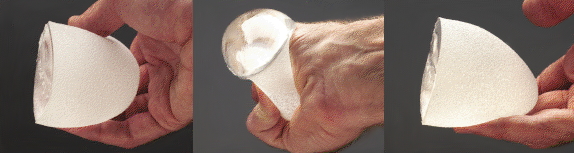
Left - Implant is cut in half. Since the gel does not flow, there is no leaking.
Center - Pressure on the shell causes the gel to evert, but it still acts like a solid.
Right - Pressure is released and the implant returns to its original shape. Still no leaking.
Cohesive Silicone Gel Breast Implants
When the concept first hit the market they were termed cohesive silicone gel breast implants, with emphasis on the cohesive gel. Most silicone gel breast implants have two components: a solid outer shell, and a soft center.
The Breast Implant Shell
In the most basic terms, the shell of a breast implant is designed to contain the filler. The shell of saline filled breast implants and silicone gel filled breast implants are very similar. Both are made of tough, yet flexible, silicone elastomers. The main difference being that saline breast implant shells have a valve built into them to allow the plastic surgeon to fill them during surgery. Silicone gel filled breast implants are filled and sealed at the factory, so no valve is necessary.
Breast Implant Fillers
There are currently two FDA approved fillers for breast implants in the United States: Saline and Silicone. Until recently, the terms saline implants and silicone implants were the only two terms we needed to describe a woman’s options for breast implants.
Saline Breast Implants
The saline in saline breast implants has not changed. It remains a sterile, physiologic solution of 0.9% NaCl in water. This is ideal as it is about the same saltiness as our bodies. Under normal circumstances, the saline stays inside the implant. However, saline was chosen as a safe filler just in case a leak develops.
Saline is used intravenously to hydrate us in cases where we are unable to drink. The same saline is used, right out of the IV bag to fill breast implants. The fill volume can be adjusted during the surgery. If the saline ever leaks, it simply hydrates the body. The additional fluid is quickly absorbed and circulates just like we drank it. There is no reaction to saline, but unfortunately, the implant deflates and will need to be replaced.
Silicone Breast Implants
Silicone breast implants are filled with silicone gel, a clear viscous fluid. The modern medical grade silicone gel used to fill breast implants does not flow like water, but is still classified as a liquid. New silicone filled breast implants are more like solids in that they can be made in specific shapes and will hold these shapes. This is the property that makes them unique, and this is where the generic name games begin.
Cohesive Silicone Gel Breast Implants
The first attempt at differentiating the new breast implants was to add the word cohesive in front of silicone gel breast implants. Cohesive means to adhere or stick together, which describes the way the gel resists flow and even though soft, lacks the ability to flow associated with liquids. It was an excellent choice except for one thing. All silicone gel is cohesive, even liquid forms of silicone tends to stick to itself. Instead of this term being reserved for the next generation breast implants, every company making silicone breast implants started emphasizing that silicone is cohesive.
Highly-Cohesive Silicone Gel Breast Implants
The next attempt was to add the word highly in front of cohesive silicone gel breast implants. The point being that the gel in highly cohesive silicone gel breast implants was more than just sticky. It stuck together like a solid. Again, a good word, but hard to strictly apply to only the new breast implants without confusion.
Gummy Bear Breast Implants
Derived from the analogy of slicing a Gummi-Bear candy, the new implants have also been dubbed Gummy Bear Breast Implants. The implants are soft, like fresh Gummi-Bears, and when cut in half, they act like solids. It is a good analogy, because the comparison is familiar. While people do not have experience with gummy bear breast implants, most do have experience with Gummi-Bear candy. The term has proliferated on the Internet; however, the manufacturers do not like it. Probably, this is because their lawyers tell them they can’t use it. Instead, each manufacturer has come up with their own term that describes the Gummi-Bear phenomenon.
Form-Stable Silicone Breast Implants
I first heard the term Form-Stable Silicone Breast Implants in association with Allergan’s 410 series. The term form-stable is used to describe the ability of the breast implant to maintain its shape. Unlike liquid filled implants, form-stable breast implants resist being deformed. If a form-stable breast implant is compressed, it will change shape; however, when the pressure is released, the implant returns to it original form. An extreme example of this is illustrated above. Even without the shell, the contents of a form-stable breast implant will return to its original shape.
Memory Gel Breast Implants
Mentor markets their entire line of silicone breast implants as Memory Gel Breast Implants. This includes the original, more liquid like, silicone gel filled implants, as well as their contour profile gel (CPG) models. The idea being that the implants have memory. Not the type of memory associated with what happened during summer vacation, but the engineering term of shape memory associated with plastic deformation. Essentially, it’s the same thing as form-stable.
High-Strength Silicone Gel Breast Implants
The new kid on the block, Sientra, is taking a swing at it with the term High-Strength Silicone Gel Breast Implants. The emphasis here is not so much on shape, although they were the first US manufacturer to get FDA approval for their shaped breast implants. The emphasis is on the strength of the bonds inside the silicone that allow the gel to maintain its shape. The pictures above illustrate what happens to even the most severely damaged breast implant when it is compressed. The gel is liquid enough to deform to pressure, but it high strength silicone gel has memory, making it form-stable.
What’s in a Name?
In the words of Gertrude Stein, “A rose is a rose is a rose.” When is comes to breast implants, however, many names apply. If you are considering Breast Augmentation, it is important to understand these differences. While terms like form-stable, memory-gel, highly cohesive and high-strength silicone gel are helpful, gummy bear is still the most accessible word for most people.
Maybe you have a better word to describe these new breast implants? Hopefully, after reading this you have a better feel for what we Plastic Surgeons are saying. If you have questions about gummy-bear breast implants, be certain to tune in to KRON4 at 11:00 AM on Monday, June 11, 2012, for my live show and call in with your questions. I can also be reached at my office for consultations at (925) 943-6353.
Posted in Breast Augmentation, Breast Implant Options, Home, Uncategorized | No Comments »
June 5th, 2012 Dr. Mele
The American Society of Clinical Oncology (ASCO) is meeting in Chicago this week, and some exciting new research is being presented in the medical treatment of some traditionally unresponsive cancers.
Plastic Surgeons and Cancer Treatment
Board Certified Plastic Surgeons perform more than three times as many reconstructive surgeries compared to
cosmetic plastic surgery procedures. Of these reconstructive plastic surgery procedures, more than 75% involve the treatment of cancer. The most common cancer by far is skin cancer, and so it accounts for the largest number of patients. Good reconstructive plastic surgery for skin cancer may not make the headlines, or Entertainment Tonight, like bad cosmetic plastic surgery does, but reconstruction after the removal of skin cancer is both rewarding and challenging.
Breast Reconstruction
Over the last few decades, public awareness of breast reconstruction after the treatment of breast cancer has grown. Growth of the procedure has paralleled growth in the number of methods for reconstruction and the evolution of breast implants. Every day, San Francisco Bay Area Plastic Surgeons perform breast reconstruction to replace the breast mound removed with a mastectomy. New, high-strength cohesive gel shaped breast implants will help us do a better job*; however, if better treatments were available, fewer patients would require a mastectomy in the first place.
New Immuno-Chemoterapy
This is why news from the ASCO’s annual meeting is so exciting. For the first time, studies are showing tumor shrinkage and increased survival for patients receiving drugs that are a combination of immunotherapy and chemotherapy.
The immunotherapy portion of the drug is programmed to enter only cancer cells that have specific mutations. Once inside the diseased cells, the chemotherapy portion is activated and destroys the cancer cell. The goal is to target only the cancer cells. The concept has been around for some time, but now it’s a reality. Studies are underway to measure the safety and effectiveness of this new type of cancer treatment.
Personally, I am most excited about the ability to target specific cells. The next step could be to replace the toxic chemotherapy with instructions for the cell to turn off cancerous growth and repair itself.
Other Difficult Cancers also Targeted
Other promising research was presented. Difficult to treat cancers like Melanoma, Lung Cancer and Gastrointestinal Stromal tumors are responding in early trials. Additional information regarding the timeline of these and other cancer treatments can be found on the society’s CancerProgress.Net
The American Society of Clinical Oncology also provides cancer information online at Cancer.net.
*Stay tuned for more information about shaped, gummy bear breast implants on KRON4′s Body Beautiful. I will share more information next Monday, June 11, 2012 at 11:00 AM live on Channel 4. Call in to the show with your questions about these new high-strength cohesive gel breast implants.
Posted in Breast Cancer Awareness, Home | No Comments »