PIP founder, Jean-Claude Mas, arrested after French breast implant manufacturing scandal.
The arrest of Poly Implant Prothese (PIP) founder, Jean-Claude Mas, in January, brought 2 years of investigations to its logical, albeit protracted, conclusion. However, the story goes back much farther, and there is much more work to do.
Poly Implant Prothese – PIP
PIP was founded in 1991 as a manufacturer of silicone breast implants covered with a polyurethane foam. When the US FDA restricted the use of silicone gel breast implants in 1992, the silicone breast implant market shrank. In 1995, France too placed restrictions on silicone filled breast implants. PIP expanded its market through innovation, and began offering pre-filled saline breast implants in 1996. It was with these pre-filled saline implants that PIP moved into the US market. 1996 was the first time I heard the name PIP.
PIP’s Short Lived Stay in the US – Thank You FDA
After a few years of use, it became clear to US plastic surgeons that PIP breast implants where not the same quality that US Board Certified Plastic Surgeons were used to with Inamed (formerly McGahn and now Natrelle under Allergan) and Mentor (now Johnson & Johnson). In general, breast implant failure rates are low in the first year and are more likely to leak the older they get, but the PIP saline implants seemed to leak much sooner and more often. Moreover, all PIP pre-filled saline implants experienced volume loss, even without obvious holes. A study published much later, in 2006, confirmed this. PIP’s popularity wained.
The FDA Goes to France
In May 2000, a decade before the current PIP silicone filled breast implant crisis, the US FDA performed an inspection of the PIP factory in La Seyne-sur-Mer (Southern France). The finding led to the immediate halt of all US PIP breast implant sales. The FDA issued a warning letter to PIP owner, Jean-Claude Mas, declaring its saline implants “adulterated.” The report sited 11 questionable manufacturing practices that were outside industry recognized best-practices. Whether the French Health Authority (AFSSAPS) was informed about the results of the FDA’s inspection or not, is unclear. If only the AFSSAPS had taken action then…
Silicone Gel Breast Implants are Back
By 2001, France removed its restrictions on silicone filled breast implants. PIP was still in business in Europe, and was expanding into South America, so again PIP innovated. In 2002, PIP launched an asymmetrical silicone filled breast implant. Fortunately, for all US women, the FDA had already given PIP the boot.
The Center of the Problem
On paper, these new breast implants were filled with NuSil, manufactured in California by NuSil Inc., a company founded by McGhan breast implant founder, Donald McGhan. In reality, PIP was not using NuSil to fill its breast implants. Instead, Monsieur Mas had his own recipe for a silicone filler, which I will call PIP gel. PIP more often used PIP’s non-approved silicone gel to fill PIP breast implants. The main reason, price. It cost about $23 to fill an implant with NuSil, but only $3 if PIP’s gel was substituted. This saved PIP about two million dollars in 2009. But the cheaper implants were also inferior in quality. The real cost was to come to the women receiving PIP breast implants, because PIP gel is made with industrial grade silicone, rather than the required medical grade silicone. Moreover, the failure rate of the PIP silicone filled breast implants, like the saline filled breast implants, seemed to come sooner and more frequently.
Knowing When to Duck
Although PIP was a French company, it was certified by TUV Rheinland in Germany. The approval came in 1997, and yearly inspections where performed in accordance to regulations. Unfortunately, guidelines also required TUV Rheinland to give PIP 10 days advance notice of their arrival. PIP used this time to hide all evidence of PIP gel. The paperwork was filed to look legit, and the regulators where none the wiser.
The European system had no requirements for unannounced inspection of the manufacturing facilities or even the breast implants. Once approved, the silicone filling of PIP implants was never retested.
More Acronyms – AFSSAPS
The AFSSAPS (Agence Francaise de Securite Sanitaire des Produits de Sante), does not certify medical products, but it can remove defective or dangerous products from the French market. In 2001, when silicone breast implants were reintroduced to France. The AFSSAPS tested the contents of PIP implants prior to approval. After that, private companies LEMI and LNE, to over. While strength and toxicity test were performed, no results are available about whether NuSil or PIP gel was used. The first random test was not performed until 2010, after PIP was under police investigation. The finding in the 2010 AFSSAPS report reads, “this one does not reach the degree of quality of a silicone gel intended for breast implants.”
European Regulators Blissfully Unaware
The FDA’s warning never reached Europe. Although the AFSSAPS watches the FDA site, it missed the PIP posting warning of problems in PIP’s breast implant manufacturing. There was, and still is, no system in place for sharing the information. Perhaps, this will now change, and countries can share information proactively. For a global economy, it makes sense.
It wasn’t until March of 2010, that two French health inspectors, acting on a tip, discovered six discarded plastic containers of Silopren along the outside wall of the PIP breast implant production facility. Silopren is a line of liquid silicone used mostly for industrial use, there are some medical uses for some of the Silopren product line, but externally for scar modification, and not as a filler for breast implants. PIP was not supposed to be using Silopren. Pip was supposed to be using NuSil. A week later, the factory was raided. It took another 8 months to track down Mas. The picture above is from the Interpol website.
European Regulators Under Scrutiny
French and European safety regulators now find themselves in an untenable position. European and South American governments are offering to pay for the removal of the estimated 300,000 defective PIP implants, before further harm is done. It is estimated that 10% of these implants have already leaked.
There is much to be learned from the PIP problems. Regulating medical devices is hard. It is a balance between allowing innovation and protecting from harm. In the elective surgery arena, the balance is tipped toward protection. However, in the case of PIP, there were many warning signs. Poor manufacturing, poor quality control, poor oversight and ignorance of the warnings from the FDA led to 10 years of inaction.
Low Price and Low Quality Often Go Together
Since in the US, PIP breast implants never achieved FDA approval, I never used them. I have not use the saline filled PIP breast implants either. I have, however, had to remove them. There were cheaper, but when it comes to enhancing one’s body cheaper is not better. Reputable, experienced and dedicated count, and this comes with a price. When it comes to plastic surgery, the lowest price is rarely the right answer.
What to do With PIP Breast Implants
If you had Breast Augmentation surgery in the US, with a reputable plastic surgeon, you do not have to worry about PIP silicone gel filled implants. However, if you had breast augmentation outside the US, you should check which implants were used. All PIP silicone breast implants should be replaced with new, FDA approved, breast implants, or at a minimum removed before they cause problems. If they have leaked, the sooner they are removed the better. If they haven’t leaked, it is recommended that you replace or remove them before they do. Either way, if you have PIP breast implants, find a Board Certified Plastic Surgeon today.
Today the number 1 cosmetic plastic surgery procedure is revealed. Often associated with Southern California, Los Angeles, Hollywood and Beverly Hills, it’s a perennial favorite in the San Francisco Bay Area and Walnut Creek too. The number 1 cosmetic plastic surgery according to the American Society of Plastic Surgery is Breast Augmentation with Breast Implants.
Breast Augmentation – The Most Popular Cosmetic Plastic Surgery – Breast Implants
Breast Implants are at the top of the list in our countdown of the top five cosmetic plastic surgery procedures. Here’s the recap:
And the number one cosmetic plastic surgery procedure is Breast Augmentation.
Top 5 Plastic Surgery Videos – Number 1 – Breast Enlargement
Today’s Top 5 Plastic Surgery Video features the most popular cosmetic plastic surgery, Breast Augmentation. This video is from a recent Body Beautiful appearance on the Bay Area’s News Station KRON4. The (415) phone number in this video was used for viewers to call in during the live show. If you have questions about Breast Augmentation or the variety of Breast Implants currently available, call us directly at (925) 943-6353.
Breast Augmentation Video
This breast augmentation video includes:
Breast Implant before and after pictures
Description of Breast Augmentation
Breast Implant placement (in front or behind the muscle)
Types of Breast Implants currently available
Age range for Breast Augmentation
New gummy bear implant announcement
Other breast enhancement procedures
Breast Implant Information? (Cosmetic Breast Enhancement)
If you have general questions about Breast Augmentation (Breast Implants), give us a call or use the contact form on the left. Whether you have always been considering increasing the size of your chest, or have lost breast volume due to weight loss, pregnancy or age, Dr. Mele can explain the options available to you, openly and honestly. To schedule your private consultation appointment, give us a call at (925) 943-6353. The office is open weekdays, 9 AM through 5 PM.
Always lurking in the top five, and one of the highest volume procedures for men, Rhinoplasty (Cosmetic Nose Surgery) has moved into the number two position according to the American Society of Plastic Surgeons (ASPS) annual statistics.
Second Most Popular Cosmetic Plastic Surgery – Rhinoplasty (Nose Job)
We are continuing our countdown of the top five cosmetic plastic surgery procedures. Number five was a tie between facelift and tummy tuck. Number four was blepharoplasty (eyelid lift). Number three was liposuction, and number two is rhinoplasty (cosmetic nasal surgery). The number one procedure will be posted next week.
Top 5 Plastic Surgery Videos – Number 2 – Rhinoplasty (Nasal Surgery)
Today’s Top 5 Plastic Surgery Video features the second most popular cosmetic plastic surgery, Rhinoplasty. This video is from a recent Body Beautiful appearance on the Bay Area’s News Station KRON4. The top plastic surgery procedure is yet to come, so stay tuned. The (415) phone number in this video was used for viewers to call in during the live show. If you have questions about rhinoplasty, please use the office number (925) 943-6353.
Rhinoplasty Information? (Cosmetic Nose Reshaping)
If you have general questions about Rhinoplasty (Nose Reshaping), give us a call or use the contact form on the left. Dr. Mele has many happy San Francisco Bay Area Rhinoplasty patients. To schedule your private consultation, give us a call at (925) 943-6353 to make an appointment.
The number three cosmetic plastic surgery procedure, Liposuction, has generated a lot of questions. The countdown will continue next week, but I wanted to insert a post to answer your questions — the most common being, “What’s the difference between regular liposuction and brand name liposuction.” I am always looking for the best way to do my job. I recently considered buying a Smart-Lipo machine, and here is what I found…
Tumescent Liposuction
Tumescent Liposuction is the breakthrough that allowed liposuction to become the safe and reliable treatment it is. The transition from “dry” techniques to “wet” techniques was a huge leap forward. All brand name liposuction techniques require the use of Tumescent Liposuction.
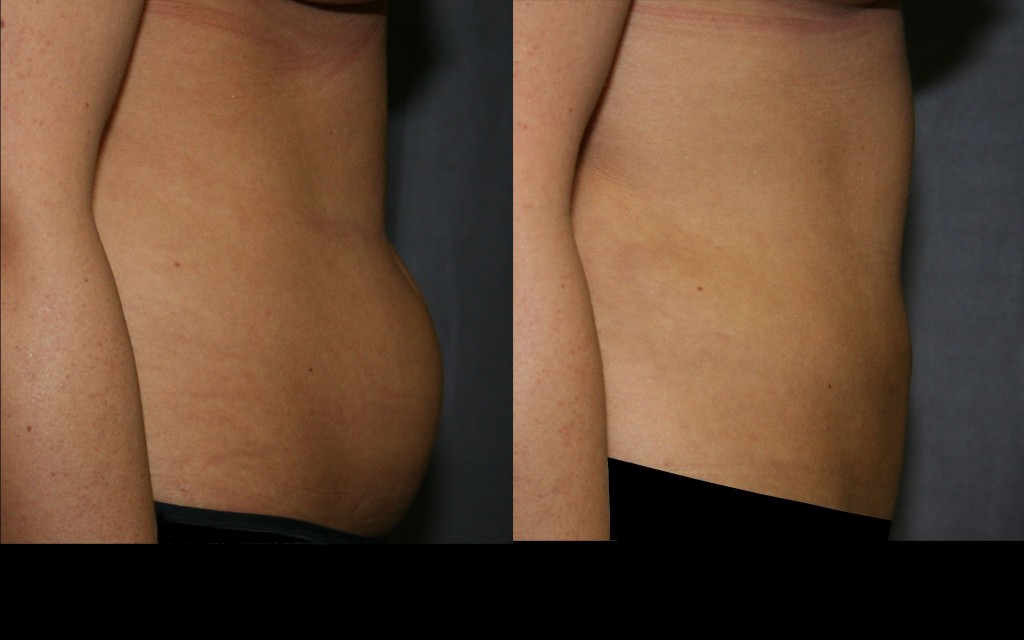
Tumescent Liposuction Before and After Pictures
Tumescent Liposuction of the Abdomen - With good skin tone, fat can be removed and the skin remains smooth. This is Dumb-Lipo not Smart-Lipo, no laser, no ultrasound, just reliable tumescent liposuction.
Brand Name Liposuction
Brand name liposuction is viewed more as a marketing ploy than as a giant leap in the advancement of liposuction. Smart-Lipo is the cleverly named poster child for this. Smart-Lipo makes dramatic claims about its skin shrinking ability, but as you can see from above, good skin doesn’t need a laser to shrink. The claims are based on a “study” of 10 patients who had side by side tumescent liposuction and Smart-Lipo. More on this below.
Liposuction is Designed to Remove Fat
When the skin is tight, removing fat leads to improved proportions and a nice smooth result. The key feature of Liposuction is its ability to remove fat and leave the skin uninjured. Incisions are required, but these are small, and can be placed out of the way. Elastic skin will shrink to the smaller dimensions after the fat is removed, but the amount of shrinkage varies widely. When there is a frank excess of skin, skin tightening is required. Since we don’t yet have a reliable skin shrinking ray, the excess skin needs to be surgically removed. Tummy Tucks, Body Lifts, Facelifts and Eyelid Lifts all tighten skin by surgically removing the excess.
Liposuction and Loose Skin
The most important thing for you as a consumer to know is that liposuction plus loose skin usually equals bad results. Skin that is already folding, in most cases, will fold more after the fat supporting it is removed. It’s like removing stuffing from an already under stuffed pillow. The skin collapses, and becomes irregular in contour. There are exceptions to this rule, and I have had patients who have had dramatic skin tightening after tumescent liposuction, but this is the exception rather than the rule.
Skin Shrinking Rays – The Holy Grail
The holy grail of plastic surgery would be a skin shrinking ray. If we could shrink wrap skin by shining a light on it, we could perform facelifts, breast lifts and tummy tucks without a scar. So whenever a device claims to shrink skin, I need to know more. Smart-Lipo is one such device.
Smart-Lipo Skin Shrinkage
Smart-Lipo claims to shrink skin 25% more than liposuction. Now liposuction is not good at shrinking skin, so 25% more shrinkage is not very impressive, but the claim is still worth investigating. The article was published in the Aesthetic Surgery Journal and is a side by side comparison in 10 patients undergoing abdominal liposuction. For purposes of full disclosure, the study was funded by Smart-Lipo, and the author of the publication is a paid spokesperson for the Smart-Lipo machine.
In the study, one side of the abdomen was treated with tumescent liposuction, and on the other side, tumescent liposuction plus Smart-Lipo was used. Defined areas of the skin were measured before and after surgery at one and three months. For the side undergoing tumescent liposuction, the reduction in area ranged from 6 to 27%, and for the laser liposuction side from 9 to 27% at the one month mark. At three months, for the side undergoing tumescent liposuction, the reduction ranged from 2 to 23%, and for the laser liposuction side from 7 to 23%. No further measurements were reported. The ranges of results are similar, and completely overlap, so lets look at the average result.
The study only includes three months of follow-up. It takes a year for the skin to fully heal after surgery, but at three months, the results of liposuction should be apparent, and the results from the laser should be a their maximum. Unfortunately, one patient dropped out, so the three month numbers are based on only nine patients. The average reduction in surface area was 13% for the tumescent liposuction side and 16% for the laser liposuction side.
Significant Shrinkage?
While going from 13% to 16% average shrinkage looks like a 23% improvement in shrinkage, this is not a scientifically significant result. Due to the large range of outcomes (2 to 23% and 7 to 23%) and small sample size (9 patients), the difference is NOT statistically significant (using a Students t-Test with Summary Data). The p value is 0.321, which means there is a 32.1% chance that the results are due to random luck. In order for data to be deemed “significant”, the p value should be less than 0.05, and stricter studies would demand p values of less than 0.01. The smaller the number the less likely the results are random chance. Translation to English: p=0.01 means there is only a 1% chance that the results are due to luck, or conversely, a 99% chance that what is stated is in fact true.
It’s like to tossing a coin twice, and getting heads twice. If this was your only experience with flipping coins, you might assume that the coin will always give heads. However, unless you have a two headed coin, we know guessing heads will be wrong half the time. The problem here, like in the Smart-Lipo study, is the sample size. With a sample size of two, there is a 25% chance of getting heads twice in a row. (probability due to chance = 25% or p=0.25). It’s important to note that a p value of 0.25 is better than the 0.312 in the study.
Sticking with the coin analogy for little longer, for 10 flips, the chances of getting heads 10 times in a row is 1 in 1024 or less than 0.1% (p=.001). So, if you flip a coin ten times, and get heads ten times, it’s either a rare occurrence, or you do have a two headed coin. Random chance is diluted by repetition. This is why we want studies with 100′s or 1000′s of subjects.
Not so Clear Cut
Unfortunately, comparing tumescent and laser liposuction does not give heads or tails results. There is a lot of overlap in the outcomes, so a proper study will require more than 10 patients. Because the benefit of laser liposuction, if any, is small, closer to 100 patients are required. The 9 included in the Smart-Lipo study are not enough.
Marketing Lasers is Cool and Science is So Boring
The science is boring. It takes a lot of time and effort to gather and understand the results. It is much easier to jump to the succinct conclusion of the manufacturer funded study and turn off the thinking cap. Unfortunately, this type of “evidence” is becoming more and more common, even in respected peer reviewed journals. I am all for publishing the data. In this a case a disclaimer regarding the funding of the study and the relationship of the author to the company were provided. In this case, a framing editorial would certainly have helped frame the weight of the evidence. Simply put, deriving significant values from insignificant data is not possible.
Independent Research Still Largely Missing
I am happy to see some independent efforts underway by neutral professionals to evaluate the claims. I suspect there is a kernel of truth in Smart-Lipo’s claim, but I also suspect that the shrinkage will not be enough to improve patient satisfaction. I want a difference significant enough that I can see it with my naked eye. Because if I can’t see it, you won’t be able to see it either. We still have not found the Holy Grail.
What if it Was True?
So, what if we repeat the study with 1000 patients? Will we find the above data valid? Even if it is true, the amount of shrinkage varies so widely that individual results cannot be guaranteed. The study only followed people for 3 months. What happens at 6 months or a year? From other studies we know that the effects of laser treatments fade with time. When does the small improvement disappear? It takes a year for the body to fully heal from injury, so a minimum of one year’s follow-up is required.
Perhaps most importantly, Laser Liposuction is being compared to tumescent liposuction, which is not know for its ability to shrink skin. In fact, the greatest limitation of Tumescent Liposuction is its inability to reliably and significantly shrink loose skin. So, even accepting the still unproven claim that Smart-Lipo causes 25% more skin shrinkage than tumescent liposuction, 25% more than not enough skin shrinkage, is still not enough skin shrinkage.
This fact has been demonstrated in other studies comparing laser liposuction on one half of the body to tumescent liposuction on the other half of the body. Patients, doctors and independent reviewers could not tell which side was which. This type of research seems a lot more important than if a tattoo on the skin shrinks, or if the skin resists a suction cup better.
Thankfully, larger independent trials are currently organizing. These will take time, so I will reserve my final judgement until then. At this point in time, I’m sticking with Dumb-Lipo. It’s safe and effective, and I can’t burn anyone with it.
The Bottom Line
No matter what plastic surgery procedure you are considering, the tool is not as important as the person holding it. I don’t tell my plumber, Aaron, what brand of wrench to use. I just want him to fix my pipes. I know he will do the job right, even if all he has is pliers, because I trust him, and I know he’s not going to stop until the the job is done correctly. I explain the problem; Aaron provides the solution. He uses the right wrench; I get my sink fixed. It’s a good deal. You should feel the same way about your plastic surgeon. Good plastic surgery is a partnership based on trust.