November 25th, 2011 Dr. Mele
This month, Sparkah.com has named the Top 100 Cosmetic Surgeons / Plastic Surgeons in San Francisco of 2012 and Beyond, and I am happy to share with you my inclusion in the top 10. The San Francisco Bay Area is home to some of the best trained plastic surgeons in the nation, and a big Thank You goes out to all my patients who placed me among the very best, and or course to Sparkah for including my private plastic surgery practice at the top of its list.
As mentioned last week, talking about non surgical plastic surgery in the san francisco bay area, the San Francisco Bay Area is my home.
It’s certainly not the cheapest place to live, but like plastic surgery, you get what you pay for: great weather, great culture, beautiful scenery and a large variety of what makes life worth living. From beaches to mountains, sports to the arts, there is something for everybody. It’s a great place to live, work and play. I am glad that my Walnut Creek Plastic Surgery practice has been included as a part of what is great in our San Francisco Bay Area neighborhood.
Thank you for the opportunity to continue to contribute. Whether you are looking for facial plastic surgery like a facelift, eyelid lift or rhinoplasty, or body work like a breast augmentation, tummy tuck or liposuction, Joseph A. Mele, III, MD, Inc., will be here for you in 2012 and beyond.
Inclusion in the Top Plastic Surgeons in San Francisco to See In 2012 is based on:
- Years of Experience
- Online Reviews
- How Easy it is to Reach Them on Twitter
- School Background
- Popularity Online
To view the original posting click here.
Posted in About Dr. Mele, Home | No Comments »
November 19th, 2011 Dr. Mele

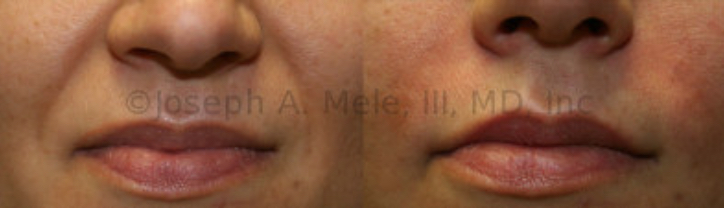
Dermal Filler to Treat Facial Wrinkles - Immediately after Perlane injections to Facial Wrinkles in the Naso-Labial folds with typical post-injection redness and swelling. The redness lasts about 24 hours, and can often be concealed with makeup.
Time flies when you are having fun, and I really enjoy being a Board Certified Plastic Surgeon in the beautiful San Francisco Bay Area. Clear sunny skies the weekend before Thanksgiving, and the rich diversity of the Bay Area’s culture remind me daily that it’s a great place to live, and to practice plastic surgery.
Experienced Hands
I am a board certified surgeon, who after completing my general surgery chief residency, spent three years as a fellow, specializing in plastic surgery right here in San Francisco. As a Board Certified Plastic Surgeon, my practice incorporates a wide variety of plastic and reconstructive surgery, but the majority of my time is spent performing cosmetic plastic surgery in Walnut Creek, San Ramon and Concord, California.
More Than 10,000 Procedures Performed
Time really does fly when you are having fun. A few years ago I performed my 10,000th procedure in private practice. Whether I am performing immediate breast reconstruction in the hospital, complex body shaping procedures after massive weight loss at an accredited surgery center, or a straight forward scar revision in my Walnut Creek plastic surgery office , the goals remain the same: maximum results, minimum recovery and happy patients.
“The noblest art is that of making others happy” – P.T. Barnum
Minimally Invasive Treatments
Sometimes less is all that is needed. A facelift is more than is necessary to correct moderate nasolabial folds (the lines that run from the sides of the nose to the corners of the mouth). As shown in the picture above, we have effective minimally invasive options in the form of dermal fillers like:
- Restylane
- Juvederm
- Perlane
- Radiesse
These provide a quick fix with minimal down time. They are called liquid facelifts, but they are not meant to be a substitute for facial plastic surgery. These dermal fillers reduce facial wrinkles in three ways:
- Physically filling the wrinkle
- Reducing skin folding by thickening the skin
- Coercing the body to build collagen
Correction – Right Where You Need It
The beauty of facial fillers is the simplicity with which they work. They do not require an extensive medical work up, and treatments are well tolerated. Brand-name fillers are supplied in pre-filled, single-use syringes that provide a sterile, consistent product. Since Restylane, Juvederm and Perlane are HAs, a normal component of your skin and joints, the risk of allergy is extremely low. They are great products to work with, and they work well, right where I put them.
Experience Counts
Now matter how great the product, the most important factor in having your wrinkles treated, is the person doing the injections. Precise correction is imperative. Enough filler must be used to maximize improvement. Too much will give unnatural results; too little leads to under-corection and minimal results. It is also important to place the dermal fillers smoothly to avoid lumps and bumps.
Injectables, by their very natural, are fluid. Care must be taken in the initial placement, and caution used in the hours after injecting to avoid displacement. Forceful squeezing of Restylane, Juvederm, Perlane of Radiesse can mold the result, for better or for worse. After a few hours, the gel is set, and displacement is unlikely.
Recovery After Injectables
Another attractive feature of injectable fillers is the relatively short recovery period. There may be some initial swelling and redness over the area injected, but this tends to resolve in a day or two. Bruising occurs in 10-15% of injections, and this can take several days to resolve.
Ice and elevation help speed the return to normal activities. It is important to inform your doctor if you are taking any blood thinners, and this includes over the counter pain medications like aspirin, ibuprofen (Motrin, Advil), Aleve, as well as, vitamin and herbal preparations like Vitamin E, Fish Oil, Ginsing, Ginko and many others. It is best to let your doctor know before you show up for your injection to avoid a delay in treatment.
Timing of Treatments
Dermal Fillers (Restylane, Juvederm, Perlane, Radiesse) and Muscle Relaxers (Botox, Dysport, Xeomin) last for months. If you are planning your wrinkle treatments around a specific date, do not procrastinate. Since swelling and bruising can last several days, it is ideal to have the treatments three weeks before your goal date. This provides time for correct, recovery and touch-ups in the event that it is necessary.
Dermal Filler Treatments
Dermal filler treatments are offered and performed every day in my office. For new patients, the procedure can be performed at the time of consultation, as long as there are no contraindications. If you are interested in finding out more about dermal fillers, give us a call at (925) 943-6353 or use the contact form on the left.
Also ask about Botox and Dysport. Since the Botox and Dysport not packaged for individual use, treatments are grouped around the first and third Wednesday of each month, or by special arrangement.
Posted in Home, Wrinkle Reduction (Non-surgical) | No Comments »
November 12th, 2011 Dr. Mele
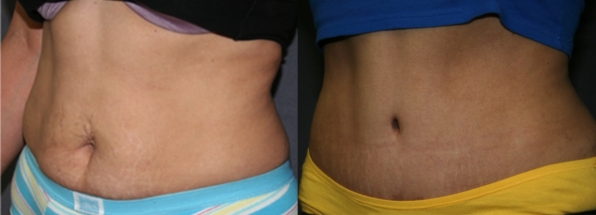
Tummy Tuck (Abdominoplasty) can remove excess skin and fat from your belly. It is not weight loss surgery, but a body shaping procedure, designed to optimize your shape.
Tummy Tuck Before and After Pictures (Abdominoplasty)

Tummy Tuck Before and After - Left: Before Abdominoplasty with loose skin, muscle laxity and lower abdominal fat. Right: After Abdominoplasty with tight skin, firm muscles and removal of disproportionate fat. Liposuction (Liposculpture) was also performed on the sides
Sometimes less is more
I am all for using the smallest hammer to get the job done. Sometimes a tummy tuck is more surgery than is needed to get a great result. Sometimes less, a Mini-Tummy-Tuck or Liposuction, is sufficient.
Abdominoplasty and Liposuction are not interchangeable. While liposuction can remove disproportionate fat, a tummy tuck does much more. A tummy tuck can correct loose skin and lax muscle. It is not just a matter of getting better results.
Sometimes Less is Worse
Doing liposuction instead of a tummy tuck is often not a decision between good and better. Liposuction performed on an area with loose skin may make you look worse. Liposuction, even laser liposuction and ultrasonic liposuction, do not shrink skin well enough to convert tummy tuck candidates into liposuction candidates. Liposuction under loose skin can be expected to remove the skin’s support causing additional folding and visible irregularities, lumps and indentations, in the skin.
The decision between Liposuction or Tummy Tuck should be discussed with a Board Certified Plastic Surgeon near you.
What does a Tummy Tuck (Abdominoplasty) do?
Tummy Tucks
- Tighten the abdominal wall’s muscular layers
- Remove loose skin from below and above the belly button
- Reduce the superficial abdominal wall fat that accumulates on the lower belly
Why do Women and Men have Adbominoplasty?
Common reasons for Abdominoplasty are:
- Pregnancy
- Fluctuations in Weight
- After bariatric (weight-loss) surgery
- Stretch marks of the lower abdomen
- Aging
- Heredity
- Previous abdominal surgery
Who is a Good Candidate for a Tummy Tuck?
Abdominoplasty may be a good choice if:
- You are healthy.
- Your weight is stable.
- You have realistic expectations.
- You do not smoke.
When not to have Abdominoplasty
Most Board Certified Plastic Surgeons will advice postponing your Tummy Tuck if:
- You are trying to become pregnant.
- You are planning significant weight loss.
- You are continuing to gain weight.
- You have uncontrolled medical problems.
- You continue to smoke.
Pregnancy and large fluctuations in weight will diminish and potentially undo the benefits of abdominoplasty. Uncontrolled medical problems should always be addressed, but uncontrolled medical problems can significantly increase the risks associated with surgery. Smoking increases the risk of wound healing problems after procedures like tummy tucks, facelifts and breast reduction by 600%. It is best to stop smoking prior to having surgery, and once stopped, why not quit? It will improve your health and appearance.
Tummy Tuck Consultation
If you are considering rejuvenating your belly, make a consultation appointment with a Board Certified Plastic Surgeon. There is no better way to get the specific information you need to make an informed decision. To schedule a personal plastic surgery consultation with Dr. Mele, send us a request via the contact form to the left, or give us a call at (925) 943-6353.
Posted in Home, Tummy Tuck (Abdominoplasty) | No Comments »
November 6th, 2011 Dr. Mele

On April 12, 1961, Soviet cosmonaut, Yuri Gagarin, used a space capsule like this to become the first human in orbit. That same year, the first breast implant was developed by American plastic surgeons Thomas Cronin and Frank Gerow.
Breast implant capsules have a bad reputation. Normally, they are only discussed when they are causing problems like capsular contracture or breast implant malposition. However, like a space capsule, the breast implant capsule provides protection, and without breast implant capsules, there would be no breast augmentation.
What is a breast implant capsule?
Whenever a breast implant is used for breast augmentation, your body makes an encapsulating sheet of scar that lines the breast implant’s pocket. This normally thin, soft scar is called the “capsule”, and it is incredibly important in maintaining your breasts’ enhancement.
Have you ever wondered how breast implants stay in place?
The capsule is responsible for keeping the breast implants in the proper position beneath the breasts. It forms in just a few weeks after breast augmentation surgery and keeps the breast implants from freely sliding around. Optimal breast implant position is a combination of careful placement during surgery and a proper capsule. The capsule will quickly line the surgical pocket and provide a smooth, strong interface between the breast implant and the soft tissues of the chest. By reinforcing the pocket, the capsule helps to maintain optimal breast implant placement.
The capsule protects the breast implant.
Not only does the capsule help keep the breast implant in position, it also protects the implant. The interior of the capsule is smooth and allows for nearly frictionless movement within its boundaries. The outer layers of the capsule provide enhanced vascular circulation and helps protect the breast implant from infection.
When good capsules go bad.
So what can go wrong with breast implant capsules? The perfect capsule is firm enough to maintain proper breast implant positioning, but soft enough to not be felt. Problems occur at the extremes, so like Goldilocks the capsule needs to be just right, not too hard and not too soft.
Too soft
When the Breast Implant Capsule is too soft, it does not provide enough support for the implant. Gravity pulls the implants down when standing or to the side when laying down. The larger the breast implants, the greater the force. Stomach sleeping also pushes the implants apart. A healthy capsule can resist the tendency toward Breast Implant Malposition, but a good bra helps too.
Treatment for implant malposition can include a capsulorrhaphy, to tighten the capsule, and close off the areas where the implant should not be going. If an overly large breast implant in compounding the problem, a smaller implant can help reduce recurrence. The use of an acellular dermal matrix (ADM) has also become more popular as a way to line, reinforce and thicken the capsule.
Too hard
When the Breast Implant Capsule is too hard, it can compress the implants, and cause Capsular Contracture. Capsular contracture can also result in breast implant malposition. If the capsule is tight only on one side, it will push the breast implant toward the soft side. If the capsule is tight all the way around, it can make the implant feel hard.
Treatment for capsular contracture includes capsulectomy, removing the thickened capsule, and capsulotomy, incising the capsule to allow it to expand. Both these techniques are performed in the operating room. An older, non-operative technique called closed capsulotomy was a way to split the capsule without surgery by forcefully compressing the implant. This has been largely abandoned as it has less predictable results, may lead to uncontrolled bleeding or implant rupture, and violates most breast implant warranties.
Just Right
The most common types of capsules are grade I followed by grade II. Grade I capsules are soft on not detectable from the outside, Grade II capsules feel firmer, but are not tight enough to cause visual changes. Both usually provide adequate support to allow the breast to age naturally, securely on the chest. If you are considering breast augmentation, or you have breast implants and are considering breast implant revision surgery, give me a call at (925) 943-6353 or contact my Walnut Creek Plastic Surgery Office using the contact form in the left column.
Posted in Breast Asymmetry, Breast Augmentation, Breast Implant Revision Surgery, Home | 1 Comment »