Thanks to you and other happy patients, I have again received the Patients’ Choice Award. More than 800,000 patient reviews and ratings were gathered for the 2009 Patients’ Choice Award, and this top rating has only been given to a select few of the nation’s doctors.
Ratings are compared in the following areas:
Bedside manner
Amount of time spent with patients
Courtesy of my staff
Appropriate follow-up
Overall opinion of me as a physician
The award is selected on merit by American Registry, in partnership with LexisNexis, Vitals and Castle Connolly Medical’s America’s Top Doctors.
In the last few decades, plastic surgery has moved from a secretive, back door affair, to main street, and the Facelift (Rhytidectomy) is no exception. Mini-facelifts and “weekend facelifts” like the Lifestyle Lift®, QuickLift™ are household words, and nothing says mainstream more than a brand name, late night informercial, but has it gone too far?
I had never heard of astroturfing until the LifeStyle Lift came along. It illustrates the hazards of purchasing a procedure from a corporation with a large marketing budget, rather than from a Board Certified Plastic Surgeon. More importantly, is the one-size-fits-all facelift a good idea?
The One-Size-Fits-All Facelift
To my eye, facelifts are individualized procedures. Each face is different and every face ages differently. When I evaluate a new patient for a facelift, I evaluate many specific areas. I can tailor my approach to maximize the benefit to the areas that need it the most. The advantage of knowing how to do more than one type of facelift is that I can choose the method that is most likely to help your specific needs.
Sometimes a mini-facelift is enough. Sometimes the traditional full facelift is necessary. Sometimes a deeper plane also needs to be addressed. Should the facelift be en-block or bidirectional? Differences between the mini and full facelifts are explained in my post: Facelift (Rhytidectomy) v. Mini Facelift (Mini Rhytidectomy). Mini and full facelift before and after pictures are also included. Which approach to use is a decision I make after I see you. With mass marketed mini-facelifts, one-size-fits-all, the treatment is largely determined before the evaluation. It’s akin to selecting a tool, before knowing what you are supposed to do with it.
The Buck Stops Here
When I see you in my office for any procedure, I want all the information I can get before selecting a plan. I want to know:
Where are the problems?
What needs to be addressed?
Is it fixable?
Are the goals realistically achievable?
How best to proceed is determined after defining the goals, reviewing the options and building trust. My goal is to provide you with sufficient information so that there are no surprises. A good result takes communication and teamwork throughout the process. A good result takes careful planning and keeping all the options open until the best method is defined.
A facelift is not a one-size-fits-all commodity. Honest discussion beforehand, yields better results and higher satisfaction. If there was one, singular best way to do a facelift, every plastic surgeon would do the same procedure every time. The variety in approaches to the facelift, reflects the variety seen in the face.
Body Beautiful
The 800 number in the video below was only used for viewer questions during the live broadcast. If you have questions, or would like to schedule a consultation appointment for a facelift, please call my Walnut Creek Plastic Surgery office at (925) 943-6353.
Information in this video is provided for general informational purposes only. Specific recommendations can only be made after a careful history and physical examination are performed. Some of the topics covered include:
Brand name mini-facelifts (Lifestyle Lift®, QuickLift™, …)?
The importance of investigating your doctor before scheduling an appointment
Who will take care of you if there is a problem?
How to find a Board Certified Plastic Surgeon
Viewer questions are answered about Blepharoplasty (Eye Lid Surgery)
The other segments of this broadcast can be found here:
The two most important aspects of any surgical procedure are predictability and safety. The facelift (rhytidectomy) is no exception. If you are considering a facelift, you want to know:
What will a facelift can do for my face?
How can I have a facelift in the safest possible manner?
The video segment from KRON4′s Body Beautiful answers these questions, and explains:
The goals of facelift surgery
How to make it safe
The facelift addresses three main areas:
The Cheeks – Nasolabial Folds and Marionette Lines
Sometimes called the “parentheses,” because they bracket the mouth, the nasolabial folds are the wrinkles that run from the base of the nose to the corners of the mouth. The creases that continue from the corners of the mouth down to the chin are called marionette lines.
These areas are frequently treated with Hyaluronic Acid (HA) fillers like Restylane®, Perlane® and Juvederm®. Now that all the HA fillers come with a local anesthetic (Lidocaine) added, it is a more comfortable procedure. Facelifts reduce nasolabial folds and marionette lines in an entirely different way. By elevating the cheeks, and reducing the amount of skin that folds over them, the depth and shadowing of these aging folds are reduced. For deeper lines, a combination of filler and lift may be necessary. Your own cells can be used to fill the area too. When performing a facelift, I will often use a dermal graft to further reduce the facial folds in the nasolabial and marionette areas.
The Neck
The facelift includes the cheeks, jawline and neck. If you only have loose skin on the neck, then a necklift may suffice, but most of the time, both areas age in parallel. If you have loose neck skin, or bands on the front of the neck from the platysma muscle, a facelift can attenuate them.
The Jawline and The Jowls
The jawline is the boundary between the face and the neck. As we age, this boundary becomes blurred. The jowls begin to break up the youthful smooth contours, and the definition between the face and neck becomes less distinct. Since the face and neck are both treated, the jawline between them is also addressed with a facelift. San Francisco Bay Area patients have come to expect the best in facelift surgery. Rejuvenation without distortion is the key. A clean jawline goes a long way toward a youthful face.
Facelift Safety
The safety of a facelift is enhanced by a thorough preoperative workup. This includes everything done leading up to the surgery. If you have high blood pressure, being certain that is it well controlled before surgery is imperative. If you smoke, stopping four weeks before surgery reduces the risk of healing problems by a factor of six.
Doing the facelift procedure safely is also important. The proper facility and equipment help ensure that you are properly monitored the day of surgery.
Last, and certainly not least, the training of you Plastic Surgeon is important. A well trained surgeon is a safe surgeon. By selecting a Board Certified Plastic Surgeon, you can be certain they have the most specialized and thorough training available. Members of the American Society for Aesthetic Plastic Surgery (ASAPS) are uniquely qualified in the realm a Cosmetic Plastic Surgery. As a condition of membership, I have to be a Board Certified Plastic Surgeon and specialize in the Cosmetic aspects of Plastic Surgery.
On With the Show
The 800 number in the video below was only used for viewer questions during the live broadcast. If you have questions, or would like to schedule a consultation appointment for a facelift, please call my Walnut Creek Plastic Surgery office at (925) 943-6353.
This video is provided for general informational purposes only. Specific recommendations can only be made after a careful history and physical examination are performed. Some of the topics covered include:
The changing acceptance of the Facelift
The increasing popularity of Facelifts (about 100000 facelifts are performed a year)
The goals of the Rhytidectomy
The hazards of overcorrection
The differences between male and female Facelifts
Facelift do’s and don’t's
How to assess preexisting medical conditions – preoperative optimization
Should you see your primary medical doctor before having surgery?
Smoking and Facelifts
The importance of a Board Certified Plastic Surgeon
The importance of an Accredited Surgery Center
Can other facial rejuvenation procedures be safely combined with a facelift?
The other segments of this broadcast can be found here:
Almost 100,000 facelifts were performed by Board Certified Plastic Surgeons in the United States last year. It is one of the most frequently requested cosmetic plastic surgery procedures I perform. While rhytidectomy means wrinkle removal, the goal is to achieve a youthful, rested appearance that maintains expression.
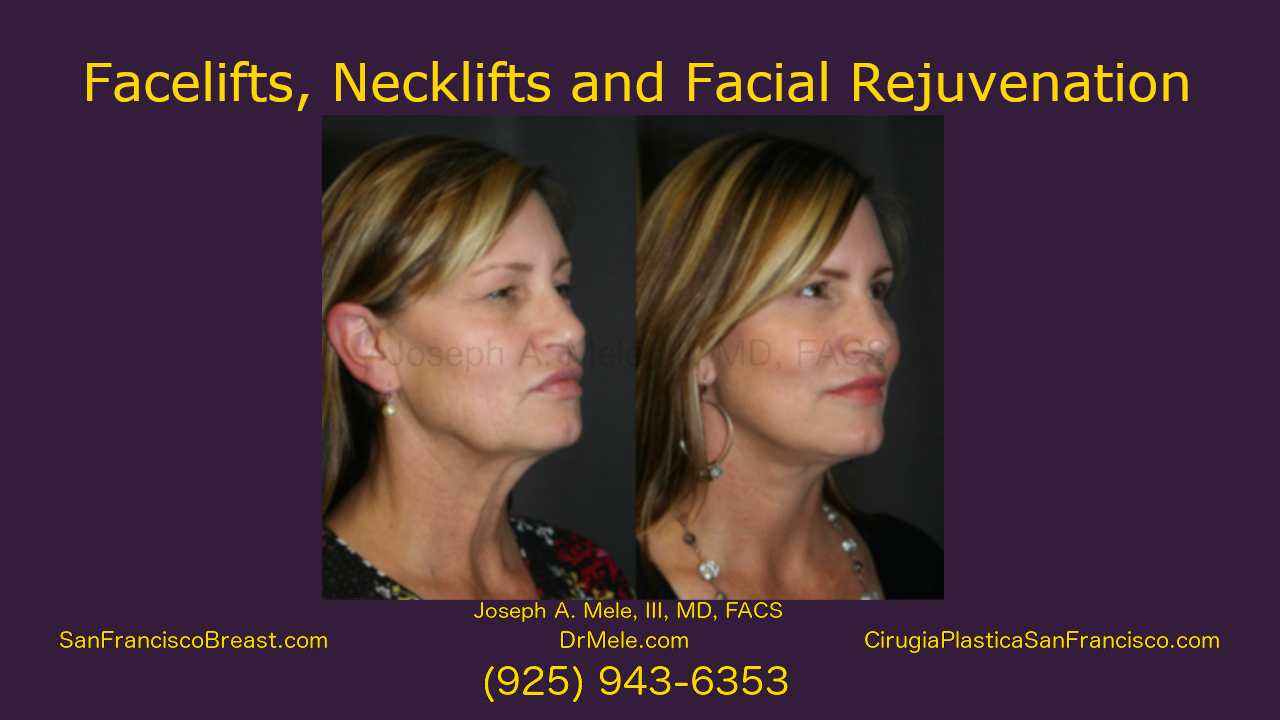
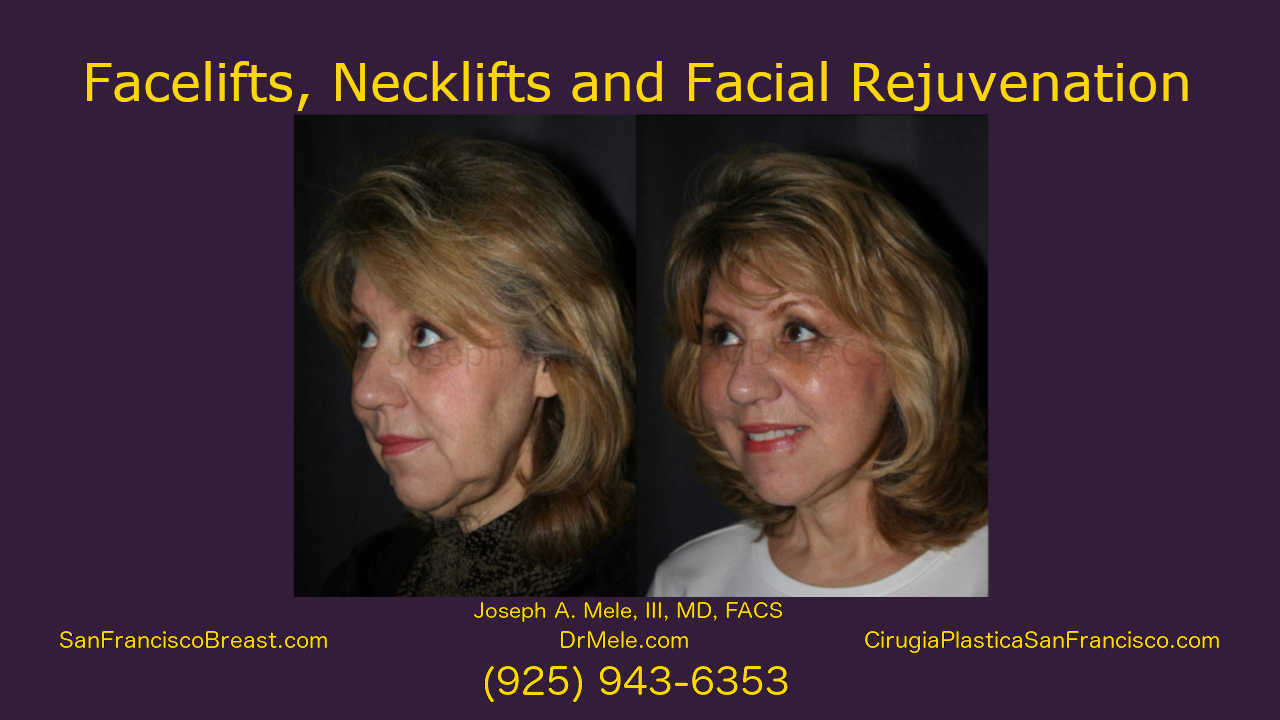
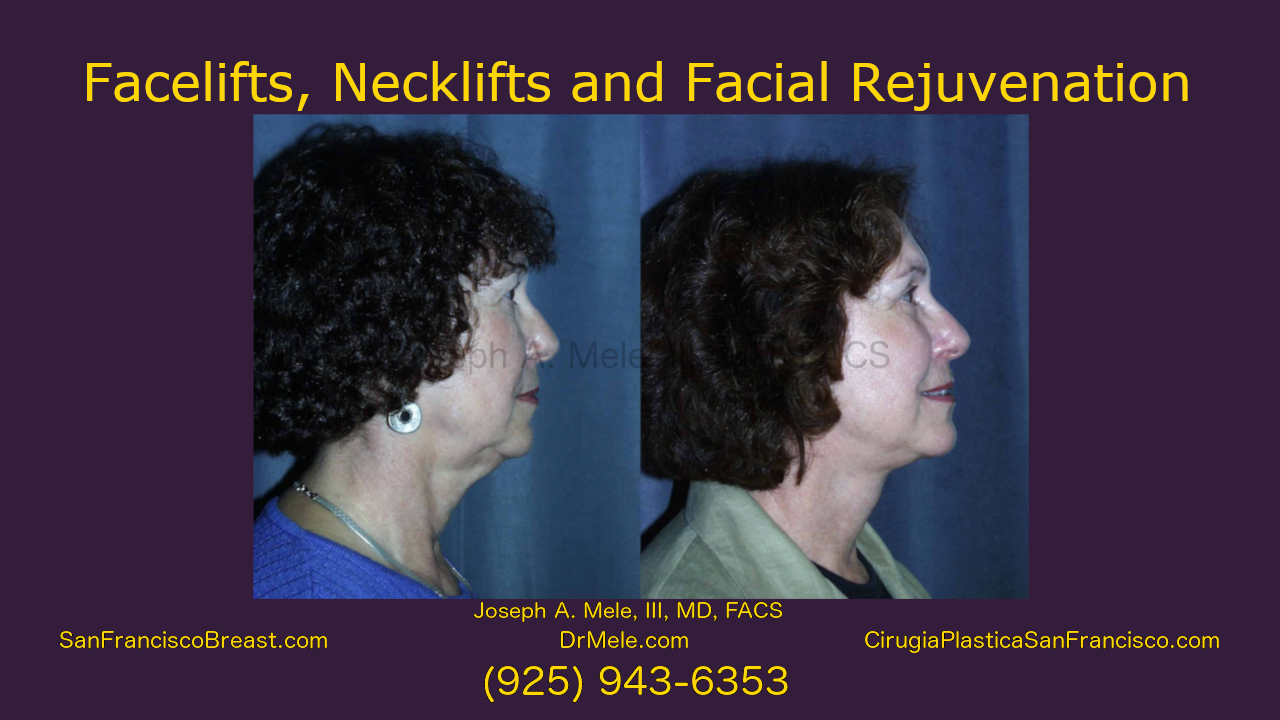
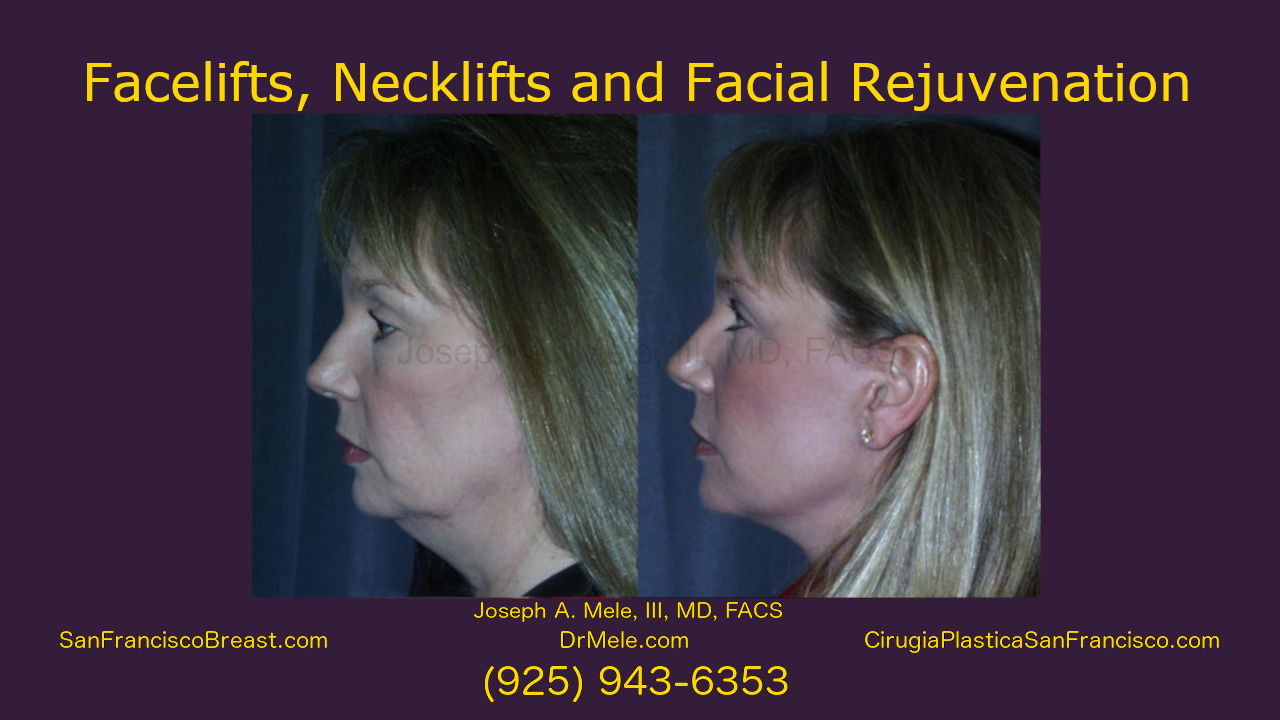
This video segment, taken from my appearance on KRON4′s Body Beautiful, discusses the changes that occur with a facelift. Facelift before and after pictures are included. The specific areas of treatment are compared for the rhytidectomy and mini-rhytidectomy. The pro’s and con’s of the facelift are contrasted with the mini-facelift. San Francisco Bay Area residents had their questions about facelifts and necklifts answered live.
The 800 number in the video below was used for the live broadcast. If you have questions, or would like to schedule a consultation appointment, please call my Walnut Creek Plastic Surgery office at (925) 943-6353. Questions can also be asked using the contact form on the lower left aspect of this page.
This video is provided for general informational purposes only. Specific recommendations can only be made after a careful history and physical examination are performed. Some of the topics covered include:
How popular is the Facelift procedure?
Before and after pictures of Facelifts
Before and after pictures of Mini-Facelifts
Description of the Facelift
What is a Mini-Facelift?
What areas of the face and neck are addressed with a Facelift?
How is a Necklift different from a Facelift?
Can Liposuction take the place of a Facelift?
How is the definition of the neck restored?
The other segments of this broadcast can be found here:
The name for the facelift procedure, or rhytidectomy, comes from the Latin word rhytid meaning wrinkle. Rhytidectomy literally means wrinkle removal. While Board Certified Plastic Surgeons remove wrinkles from all over the body, in Cosmetic Plastic Surgery, the term rhytidectomy is used almost exclusively to describe the surgical procedure that removes wrinkles from the face.
While the facelift is the gold standard for facial rejuvenation, there are many options to consider. This video segment, taken from my appearance on KRON4′s Body Beautiful, discusses the changes that occur in the face as we age. It reviews treatments like botulinum toxin (BOTOX Cosmetic, Dysport) and fillers (Restylane, Perlane, Juvederm), mini-facelifts and the facelift. San Francisco Bay Area residents were able to call in with their questions and have them answered live on the air.
The 800 number in the video below was only used for viewer questions during the live broadcast. If you have questions, or would like to schedule a consultation appointment, please call my Walnut Creek Plastic Surgery office at (925) 943-6353.
This video is provided for general informational purposes only. Specific recommendations can only be made after a careful history and physical examination is performed. Some of the topics covered include:
Loss of facial volume as we age
The effects of gravity
Restoration of volume with fillers
Reducing facial animation lines with Botox/Dysport
What is a facelift?
What areas of the face are addressed with a facelift?
Is the neck included in a facelift?
How is facial volume replacement addressed?
Is it supposed to look tight?
The other segments of this broadcast can be found here:
Rhytidectomy (Facelift) San Francisco – Part 1 of 4 (You are here)
Dr. Joseph Mele, MD, is an Active Memeber of the Alameda-Contra Costa Medical Association.
The Alameda-Contra Costa Medical Society (ACCMA), our local county medical society, was established almost 140 years ago. The ACCMA is affiliated with both the California Medical Association (CMA) and with the American Medical Association (AMA).
As per its Web Site, The purpose of the ACCMA is to:
Provide a forum for the full and frank interchange of ideas among physicians
Secure intelligent unity and harmony within the profession
Make effective the opinions of doctors in all scientific, medical, public health, medical economic, and social affairs in which the medical profession has a valid interest or public responsibility
The list of the ACCMA’s achievements are truly remarkable including:
The first woman elected president of any national medical society (1895)
Established, with its member physicians, health care for low-income patients (1932)
Created a non-profit insurance company (1936) which later became Blue Cross of California
Created the Alameda-Contra Costa County Blood Bank(1945)
Guaranteed Medical Care for all Alameda County Citizens (1947)
Created the first medical society-sponsored group professional liability insurance plan (1947)
Organized the first multi-casualty airport disaster drill, conducted at Oakland International Airport (1956)
Formed the first physician well-being committee (1968)
Established the first doctor-owned professional liability insurance company in California: Medical Insurance Exchange of California (MIEC) (1975)
Formed the Alameda-Contra Costa Physicians Committee (ACCPAC) as its local political action committee (1989)
Created the Credentials Verification Service (CVS) (1996)
Dr. Mele is an Active Member of the California Medical Association (CMA)
The California Medical Association (CMA) was formed as the State Medical Society of California on March 12, 1856. The initial membership totaled 75 physicians who held their first meeting over 154 years ago at Pioneer Hall on J Street in what is now Old Town Sacramento. In 1923, the association was renamed the California Medical Association. At its 150th anniversary the membership totaled 35,000.
The CMA continues to support the people of California. It has studied the effects of lack of access to care for the poor since the 1930s, and tried to get legislation passed in the state and nation that would establish compulsory health insurance. They continue to advocate for health insurance for all, via voluntary participation, through legislation, policy and the courts.
I was privileged to see how the society works first-hand as the California Society of Plastic Surgeons Young Physician Representative to the CMA, dealing with issues such as access to care and the distribution of vaccines. The CMA continues to work closely with County Medical Societies to assist with local problems, with State Legislators for statewide medical issues, and with the American Medical Association for national health issues.
Dr. Mele is a Lifetime Member of the American Medical Association (AMA)
The American Medical Association (AMA) was founded in 1847 at the Academy of Natural Sciences by Nathan Davis. With it, the first minimum standards for medical education were established. The original goals of the AMA where to:
advance the science of medicine
improve the standards for medical education
develop a program of medical ethics
improve the health of the public
The often quoted Journal of the American Medical Association (JAMA) was established in 1883. This was not the first journal created by the AMA. Indeed, the Archives of Ophthalmology, Archives of Otology and the Journal of Cutaneous Diseases (now Archives of Dermatology), all preceded the JAMA.
Through the 1900′s the AMA had a tremendous amount of influence over medicine in North America. In public health, it helped to craft national legislation for the control of tuberculosis (TB) and smallpox. In medical education, it inspected and accredited medical schools and curriculums, set standards for internship and specialty training, and encouraged the recognition of specialty boards. It formed many other more influential bodies, including:
There are over 814,000 doctors licensed in the United States of America. State medical societies used to require that their members were also AMA members. After several states dropped this requirement in 1971, the AMA lost over 11,000 members. Today approximately 15-20% of practicing physicians are members.
As the number of physician member decreases, so does funding that comes from dues. Increasingly, the association’s income comes from advertising, CPT and ICD-9 code licensing, and information technology. This has caused controversial decision making in the recent past. The Sunbeam scandal is one glaring example. Despite the controversies, the AMA remains a potent political force, with the ability to influence regulations locally and nationally.
Dr. Mele is a Fellow of the American College of Surgeons (FACS)
Just the FACS Ma’am
Ever wonder why some doctors have FACS after their name? It means they are members of the American College of Surgeons (ACS). FACS stands for: Fellow of the American College of Surgeons. To be a member, a surgeon’s education, training, professional qualifications, surgical competence and ethical conduct have passed a rigorous evaluation, and have been found to be consistent with the high standards established and demanded by the College.
The American College of Surgeons
Established in Chicago, in 1913, the society has 73,000 American Surgeons and more than 4,000 surgeons from other countries. The college’s main activities include the:
Annual Clinical Congress and other sponsored continuing medical activities
Commission on Cancer to improve the care of cancer patients
Committee on Trauma to improve the management and prevention of injuries
Division of Advocacy and Health Policy monitors legislative and regulatory issues affecting the field of surgery
Sponsoring of the Residency Review Committee for Surgery and the Surgical Specialties including Plastic Surgery
Office of Public Information provides general information about surgeons and surgical care
Surgical Education and Self-Assessment Program (SESAP) a resource for surgeons lifelong learning, and to prepare for Board Certification
So if you are a patient, the letters FACS after a surgeons name mean the American College of Surgeons has independently evaluated and accepted their qualifications.
The previous two posts were about Rhinoplasty and Chin Augmentation. Sometimes combining procedures gives the best result. The Mommy Makeover, for example, combines breast enhancement with a tummy tuck. The two areas are anatomically independent, but by addressing two areas simultaneously, the recovery periods can be combined, and the results appreciated more quickly. When the two procedures are anatomically related, like when Rhinoplasty and Chin Augmentation are combined, simultaneous treatment allows for the creation of the optimal facial proportions and a pleasing cosmetic result.
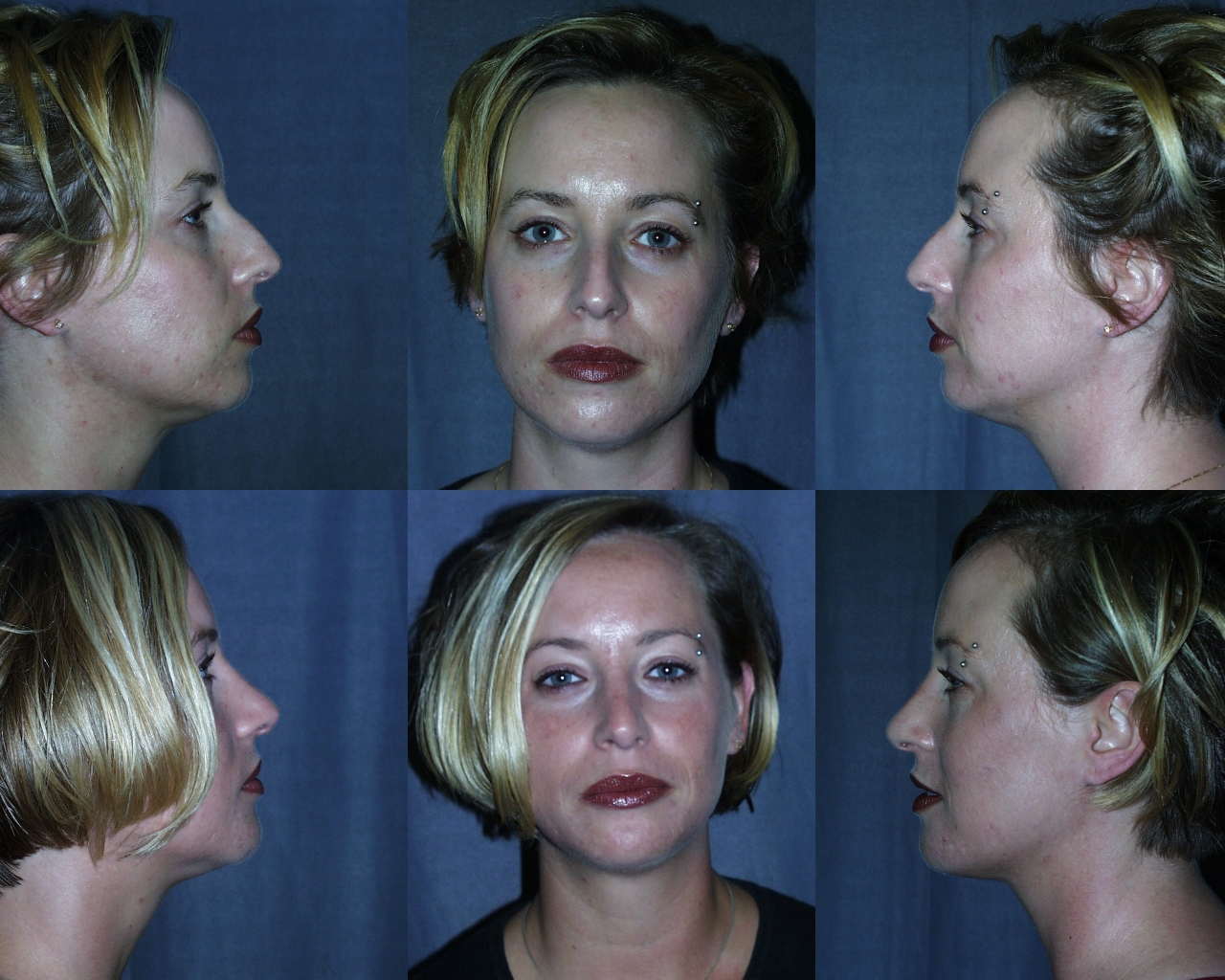
Rhinoplasty and Chin Augmentation to refine the nose, improve the jaw line and create more balanced proportions of the face.
The Balanced Nose and Chin
The woman above presented with complaints of a bump on her nose (a dorsal hump) and a weak nasal tip that curved downward. She also had a small chin (microgenia) with a chin prominence well behind the projection of her lips. A rhinoplasty and chin augmentation were performed to smooth the dorsal hump, define and elevate the nasal tip and bring the chin forward. By combining the procedures, not only could each complaint be addressed, but the mid face and lower face profiles could be made harmonious.
How the Nose and Chin are Related
A small chin makes the nose appear larger, and visa versa. Modifying one will have the opposite effect on the other. In other words, if you make the chin larger, the nose will appear relatively smaller. By combining the procedures, the aesthetic balance of the nose and chin can be addressed, while each individual area is enhanced.
How to Choose a Plastic Surgeon for Combination Procedures
Combination procedures are best performed by a Board Certified Plastic Surgeon who is experienced with each component, and with the synergy that the combination provides. If you are looking to combine surgeries, you want a Board Certified Plastic Surgeon with experience in a wide range of cosmetic plastic surgery procedures, and the ability to seamlessly combine them.
How to Check if Your Plastic Surgeon is Board Certified