November 23rd, 2009 Dr. Mele
Dear Patient,
The Healthcare plan in the Senate today will unfairly discriminate against you.

Raising the price of medical care.
I’m writing you today about an issue that affects not only plastic surgeons but everyone who utilizes our services for anything from Botox to Tummy Tucks.
No doubt, you’ve heard of the current healthcare bill before the US Senate? Page 2045 Sec. 9017, Excise Tax on Elective Cosmetic Medical Procedures included in the “Patient Protection and Affordable Care Act”. This dense legalese translates to a tax on all cosmetic procedures as partial payment for the healthcare overhaul our current administration is attempting to implement.
So what’s the problem? YOU would be paying this tax, the FIRST time this country has levied a tax on patients for medical procedures. What’s at stake?
• This is a discriminatory tax. According to the American Society for Aesthetic Plastic Surgery and the American Society of Plastic Surgeons Annual Statistics, 91% of all cosmetic procedures are requested by women.
• This will not have considerable consequences on the wealthiest patients but, as usual, affects the middle class. Working women, soccer moms, and scores of others who carefully save and budget to improve their appearance and self esteem will be penalized for doing so. 90% of all cosmetic plastic surgery patients have an income of less than $90,000.
• Procedures such as breast reduction that have been cited in the literature for improving self esteem and quality of life would be taxed as well. The procedure relieves chronic pain and changes lives for the better. This is the best of what medicine has to offer.
• Procedures not performed by plastic surgeons, such as Lasik surgery to improve vision, would also be taxed. It is likely that all procedures where payment is denied would be subject to taxation.
• Your doctor as tax collector: This provision places physicians in the role of tax collector and holds physicians liable should an individual fail or refuse to pay the tax. Is that the relationship you want with your medical provider? It is not the relationship I want with my patients.

The bill is large, and every sentence effects your medical care.
Please help us stop this arbitrary and penetrative tax. To find your Senators please click here: http://www.senate.gov/general/contact_information/senators_cfm.cfm For your Representatives click here: https://writerep.house.gov/writerep/welcome.shtml
I urge you to personally inform the government that you are against this tax – together we can fight for your right to no government interference in medical care and stop this discriminatory measure against women!
You may recall that over the summer President Obama claimed he opposed any new taxes on households making less than $250,000 a year. According to the July 2009 issue of Gaurdian, while publicly making this claim, President Obama’s aides, and top Democrats were pushing for a cosmetic tax. According to Politico Treasury Department economic adviser Gene Sperling made the proposal. This cosmetic plastic surgery tax would be a tax on primarily women who earn less than $90,000 a year. A very small percentage earn more than $250,000 a year.
I can understand sin taxes on alcohol and tobacco which increase the cost of healthcare if those dollars are used for healthcare. It’s like forcing people to save for a known future expense (if they live that long). I cannot understand a tax on what the government decides is unnecessary surgery. Especially when the procedures relieve pain, improve vision, and otherwise decrease the need for further intervention.
My staff and I fight daily for patients’ rights to medical care. I debate with insurance companies about what is cosmetic and what is reconstructive surgery. There is no obvious line. Insurance companies are rewarded monetarily by denying claims.
If you are a proponent of the “public option”, you might be surprised to know that private insurance companies deny a smaller percentage of claims than government programs. Medicare currently denies more the six percent of claims. If they deny a claim, they don’t pay it. This saves them money. If they will get another 5%, or as originally proposed 10%, reward for denying claims, more procedures will be deemed unnecessary, and you, the patient, will be responsible not only for the cost of the procedure, but also for the tax on it.
The best thing about plastic surgery, both reconstructive and cosmetic plastic surgery, is that it helps people. It improves function, relieves suffering and makes people happier. And making people happy, makes those around them happier, and improves our society at its base. I would much rather spend my time doing that than talking about the above, but both are important.
Next week I will stop the politics, and get back to what I do best – Cosmetic Plastic Surgery in San Francisco’s East Bay Area community of Walnut Creek. In the mean time, get the word out. Inform your friends and tell your Senators how you feel.
To find your Senators please click here: http://www.senate.gov/general/contact_information/senators_cfm.cfm
To find your Representatives click here: https://writerep.house.gov/writerep/welcome.shtml
EDIT: Allergan has organized on online petition here. This is another good way to get your voice heard; however, the most important way is to contact your Senators and Representatives directly. The feedback I am getting is that not enough people are speaking up, and this law is scheduled to take effect January 1, 2010, only a few weeks from now.
Posted in Home, Uncategorized | 4 Comments »
November 19th, 2009 Dr. Mele
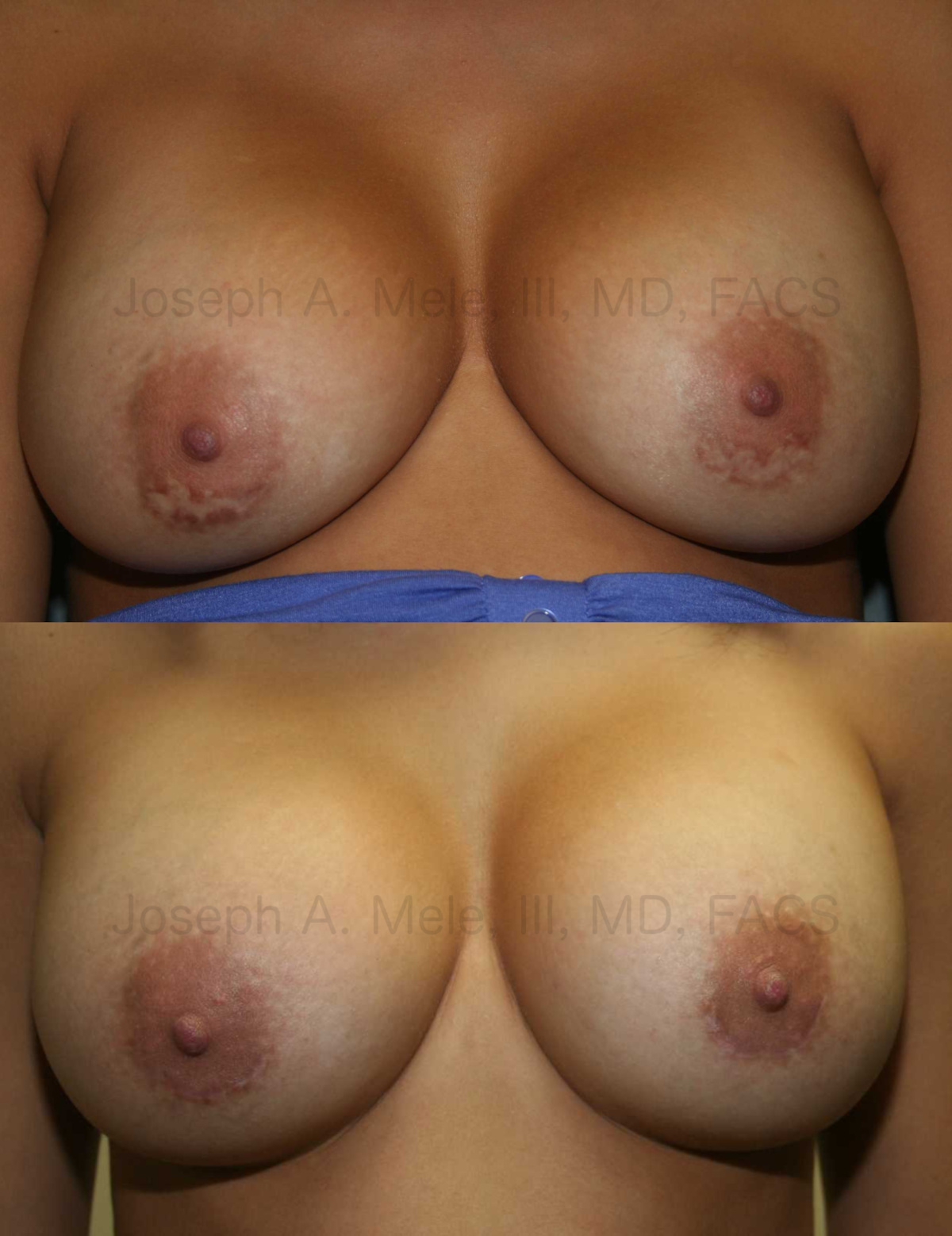
The previous example of scar revision was a keloid scar revision. Keloid scars tend to be raised and larger than the original injury. The following scar revision is for an irregular, hypopigmented and wide-spread scar. It may have been more hypertrophic in the past, but was mature, soft, flat and pale prior to revision. This patient presented over a year after breast implant placement. The implants were inserted through an incision normally placed around the lower edge of the areola (the pigmented skin around the nipple). In this case, the scar was too high, and did not heal well.

Wide spread periareolar scars below the nipples after breast augmentaion.
This is noticeable because the scar is white, wide and irregular within the tan skin of the areola. This incision was not placed at the edge of the areola, making the white scar even more noticeable. This is also a poor scar. It is very wide for this location. This scar not a fine line, it’s not a line at all, but rather, an irregular blotch.
The periareolar incision is one of my favorite incisions for breast augmentation because a nice, fine, discrete scar is the normal result. The original scar was not of my making. Since I’ve done hundreds, if not thousands of breast augmentations using this approach, I felt very confident that this particular scar could be improved.
The plan was to excise the previous scar, and obtain a narrow scar that follows the contour of the areola. With the new scar placed at the junction between the areola and the normal skin, the scar’s location is disguised.

After scar revision the periareolar scars are thin, fine and follow the natural contours.
This scar revision was performed in the office, under local anesthesia, without complications. The resultant scar is narrow and follows the natural contour of the areolas. Close up views are included below for comparison.
 Before scar revision - Right breast with wide white irregular misplaced scar. |
 Before scar revision - Left breast with wide spread hypopigmented scar. |
 After scar revision - Right breast with thin soft pale scar following the natural curve of the areaola. |
 After scar revision - Left breast with less noticeable and improved scar. |
Scar revision can be a very rewarding procedure. The scars cannot be completely erased, but by making scars less noticeable, they can be forgotten.
Posted in Breast Augmentation, Breast Implant Revision Surgery, Home, Scar Revision (Keloids) | 4 Comments »
November 14th, 2009 Dr. Mele
So how can hypertrophic and keloid scars be improved? What options are available to treat unsatisfactory scars? Here are some of the different scar treatments utilized.
Excision and Primary Closure
This is probably the most common scar revision technique. It often involves making a lens-shaped excision, to remove the scar and a small amount of the surrounding normal skin, then careful re-closure of this new wound. Wide undermining is sometimes employed, to reduce the tension across the repair.
Z-Plasty or W-Plasty
These are techniques for rearranging the scar. Their names are derived from the pattern of the resultant scar. Z-plasty may be used to lengthen a scar if it is pulling too tightly, or to change the direction of a scar, to make it less conspicuous. Both can be used to align scars with an existing wrinkle or landmark and make the scars less noticeable.
Layered Closure
Deep, dissolvable sutures (stitches) are used to bring the edges of the skin together. These do not need to be removed. Thinner sutures are used for the fine tailoring, to line-up the two edges of the wound. The superficial sutures are sometimes not dissolvable. Non-dissolvable sutures decrease the amount of inflammation at the surface. Non-dissolvable sutures need to be removed. How long before removal depends on the location and nature of the scar. For example, sutures on the face often can be removed in less than a week, while those on the sole of the foot may need to stay for two weeks.
Buried Dermal Flap
Sometimes the scar is indented (concave). If this is the case, something is needed to fill in the missing volume beneath scar. Several options are available including: a portion of the original scar, deeper layers of the surrounding normal skin or occasionally an artificial filler can be used. The filler brings the level of the revised scar up to that of the surrounding skin.
“Dog Ears”
Occasionally a discrepancy in the length or positioning of the sides of a wound result in a raised portion at the ends of the scar. These are referred to as “dog ears”, as they stand up and are often found in pairs (one at each end of the incision). Revision requires lengthening or changing the direction of the original scar in order to smooth out the ends.
Skin Graft and Flaps
Skin grafts and flaps are not needed for most scar revisions. They are reserved for scars, such as burn scars, that cover a large area. Sometimes scars are too large to simply excise and close. More complicated techniques like tissue expansion, composite flaps and microvascular transplantation (free flaps), have evolved to move “normal” skin into the proper position.
Dermabrasion
This is the same technique use for treating wrinkles, and is useful for surface irregularities, or scars with obvious shadows or highlights. Dermabrasion can be performed shortly after a scar revision, or after the scar has matured. Dermabrasion appears to work better if used at 4 months rather than 8 months after the revision. This has led some plastic surgeons to use dermabrasion at the time of the revision.
Lasers (Laserbrasion)
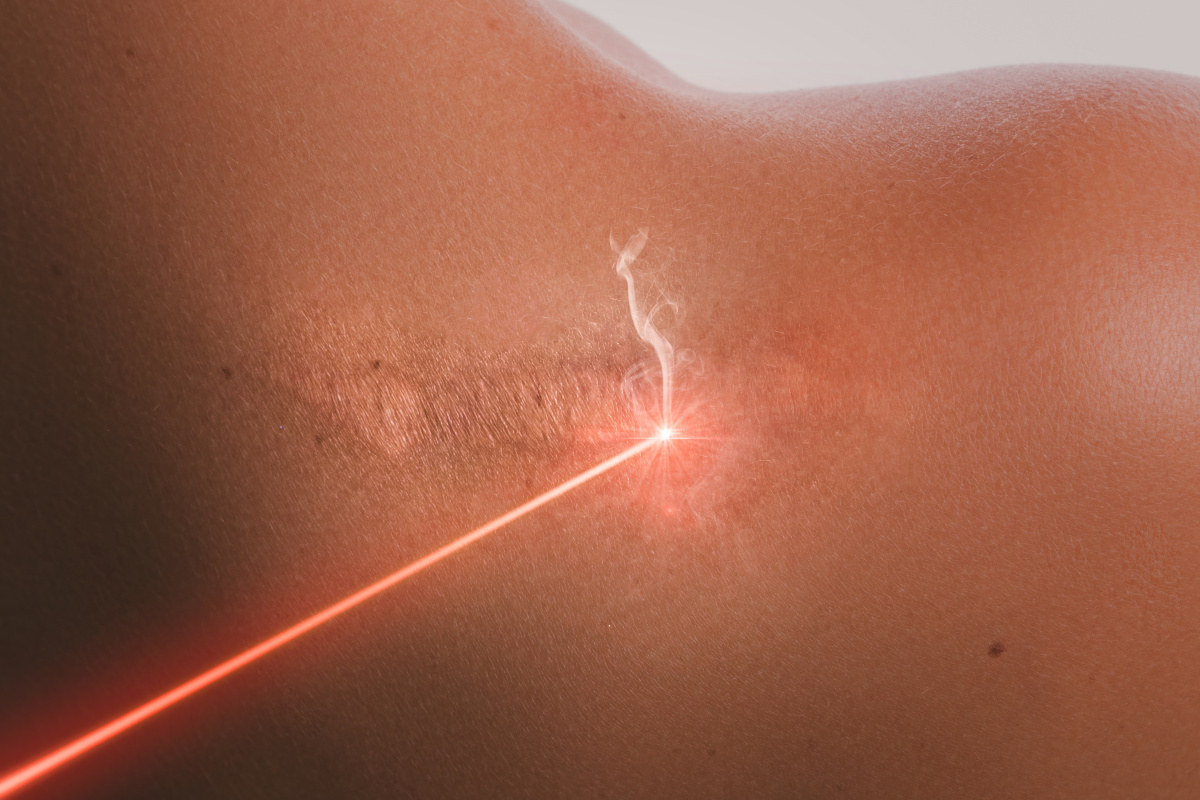
There are many types of lasers. The CO2 and Erbium lasers work very similarly to dermabrasion. They remove the outer layers of the skin, and can be used to take down high points.
The blue-green Argon and flashlamp pumped dye lasers, are more selectively absorbed by blood vessels and skin pigments, and can be used to treat red, purple or pigmented scars.
Pressure and Massage
These modalities can be used alone or in conjunction with the methods listed above. Pressure and massage cause realignment of the fibers in the scar and surrounding skin, and can dramatically flatten and smooth raised scars. This may be why Vitamin E works – the continuing replication ensures adequate scar massage is performed.
Gel Sheeting
Both Mineral Oil and Silicone Gel impregnated sheeting seem to decrease the time needed for a scar to soften and mature, and as a result may lead to the accelerated formation of smoother scars. Sheeting can also be used alone or with other treatments. The drawbacks include the possibility of dermatitis (irritation of the skin), foliculitis (irritation or infection of the hairs) or scar ulceration. The sheets must be worn 12 hours a day and treatment may be needed for as long as 18 months.
Steroids
Occasionally injectable steroids are used to slow scar formation. Drawbacks include the possibility of lightening the color of the surrounding normal skin. If steroids are used at the time of repair/revision, the wound will require extra support. Frequently this means sutures must be left in longer.
Bleaching agents
Topical skin bleaches, such as hydroquinone, can sometimes fade a darker scar, or even prevent its occurrence. It takes several months for its effects to be seen and longer to reach optimal results. This can be used separately or with a surgical scar revision.
Anesthesia
Local anesthesia is usually all that is necessary to perform scar revision. Occasionally for larger scars, or younger patients, regional or general anesthetic is needed. If so, this will be discussed prior to surgery. Many times epinephrine (adrenaline) is added to the local anesthetic, to minimize any bleeding.
The Risks
For scar revision, as with any surgical procedure, there are potential risks that accompany the potential benefits. Here are some of the more common risks:
Hematoma/Seroma Formation
Fluid tends to collect in the operative site. A small amount is normal. If a large collection of fluid accumulates, then it must be removed. Usually this is easily treated in the office by aspiration; occasionally the wound may need to opened temporarily. It is important to remove large fluid collections as these may become infected or put too much tension on the wound.
Infection
As with any scrape or cut, an operative site can become infected. A dose of antibiotics can be given just before surgery to minimize this risk. Occasionally antibiotics may be continued for several days after surgery. Even with these precautions, an infection can occur.
Dehiscence (Reopening) of the Wound
This can occur if too much tension is placed on the wound, before it has fully healed. If dehiscence occurs the wound must be cleansed, and if appropriate, sutured again.
Milia (Whiteheads)
Milia frequently occur around scars. These represent blocked glands, or trapped surface skin cells. They can be treated in the office, by gently unroofing them. Once adequately treated, they tend not to recur.
Hyperpigmentation/Hypopigmentation
The resultant scar can become darker (hyperpigmented) or lighter (hypopigmented) compared to the surrounding skin. Too much pigmentation can occur as a direct result of exposure to the sun. A sunblock, no less than SPF 15, is recommended until the new scar is fully matured (approximately one year). If the scar is under clothing, this is less of a problem. If the scar is on the patient’s face or neck, a hat is recommended. Skin bleaches are also available to lighten a darkening scar. A light scar on a dark skinned person is more difficult to treat, but options such as make-up and tattooing can be utilized.
Recurrence
Despite the most meticulous, careful repair, there is always the possibility that another unsatisfactory scar may result. This is why a careful dialogue between you and your plastic surgeon is critical. You need to know the chances for improvement, and which aspects of the scar are likely to improve. Knowing where we are going can be as important as getting there.
Next time: another example of a scar revision.
Posted in Home, Scar Revision (Keloids) | 1 Comment »
November 9th, 2009 Dr. Mele
The evaluation of a scar encompasses the following ten points, the first and last may be the most important.
1 – Time Since Injury
Scar revision is usually performed on mature scars. Depending on your age, this normally requires one to two years of healing. In general, the younger you are, the longer it takes for a scar to mature.
A mature scar has entered the “resting” phase of healing, and can be recognized as a soft, pliable scar in which the redness has faded. Sometimes the maturation process can be accelerated with the use of pressure, massage, steroids or silicone gel sheeting.
There are times when waiting will not help; however, this is the exception rather than the rule. Examples include cases of gross misalignment, i.e. a step-off at the border of a lip, or an injury causing severe distortion, i.e. exposure of an eye or inability to straighten a joint.
2 – Nature of the Injury
The type of injury and the mechanism of injury can influence the treatment. Whether an injury is from a surgical scar or an animal bite is important in planning a revision. A carefully planed operative incision is more likely to heal in an optimal fashion, and as a result, is less likely to require a scar revision. A injury which is not planned, such as an animal bite, or a wound which was infected, tends to give a worse scar and will be more likely to require from revision.
3 – Location of the Injury
Scars of the head and face, in general, respond more favorably to revisions. Areas below the clavicle can often still be improved; however, they are less likely to improve. A triangle on the chest, formed by the shoulders and the lowest portion of the sternum, is a “danger zone”. The thicker skin in this area, and the pull of the underlying muscles, can produce a widespread and darkened scar, even under otherwise ideal conditions.
The orientation (direction) of the scar can also be important. When possible, the scar revision is positioned perpendicular to the underlying muscle to provide a narrower scar and improve its appearance. Wrinkles tend to run in the same direction, and this may also disguise the scar.
4 – Age of the Patient
Older people tend to require scar revisions, less often than younger ones. Younger people heal more exuberantly, and over a longer period of time. This leads to a higher incidence of hypertrophic (excess) scars in the young. Because of this exuberant wound healing, it is also necessary to delay scar revision longer if you are younger.
5 – Ethnicity
The darker the hair, skin, and eyes, the more likely a noticeable scar is to form. Wounds in darker skin tend to be darker, wider, lumpier and more problematic than wounds in lighter skin. The biochemical reasons for this are still largely unknown. It is due in part to innate differences in the healing, and in part to how the scar appears as light reflects off of it. This is outlined below.
6 – Skin Tone and Light Effects
For someone with fair skin, light reflecting off a scar may go unnoticed, but the same scar in darker pigmented skin will be easily spotted. What catches the eye is the difference in brightness between the reflected light, and the surrounding skin’s color.
7 – Healing of Previous Injuries
Healing varies from area to area. A previous injury can be an indicator of what type of scar to expect. If nearby scars are all widespread, raised and darkly pigmented, then chances are higher that a revision will also be widespread, raised and darkly pigmented.
8 – The Nature of the Scar
As a simplification, scars can be separated into four groups: a fine line scar (the desired result, flat and thin); a widespread scar (flat but wide); a hypertrophic scar (raised and wide); and a keloid scar (raised and extending outside the original zone of injury). The more the original scar is like a keloid scar, the less likely a revision of this scar will result in a fine line scar.
9 – Loss of Skin
If a significant amount of skin is lost at the time of the original injury, then closure of that wound may result in increased tension at the site of repair. Tension is the enemy of fine line scars. The greater the tension, the higher the risk of a wide scar.
10 – Perceptions and Expectations
This may be the most important part of the evaluation. If your expectation is that your scar will become completely invisible, you will be disappointed, no matter how much improvement is achieved. However, if you understand what makes their scar more obvious, and understand which of these features can be expected to improve (and conversely which will not improve) then an informed decision can be made. If your decision to proceed with the revision is based on realistic goals, then we all achieve greater satisfaction with the results. A scar will always remain a scar. If we improve its appearance, we can make it less noticeable.
Posted in Home, Scar Revision (Keloids) | No Comments »
November 4th, 2009 Dr. Mele
Before I get into the details of how to evaluate a scar, I would like to provide a quick example of scar revision. Scars that present for revision come in two categories: Keloids and Hypertrophic scars.
Keloids scars are scars that grow larger than the area of injury. They tend to be raised, and are often itchy. They frequently continue to grow with time, and are different, on a cellular level, than hypertrophic scars.
Hypertrophic scars are wide or raised scars that maintain the pattern of the original injury. They may be wide-spread, and can range in color from white to red or purple. Often after a year they stop changing.
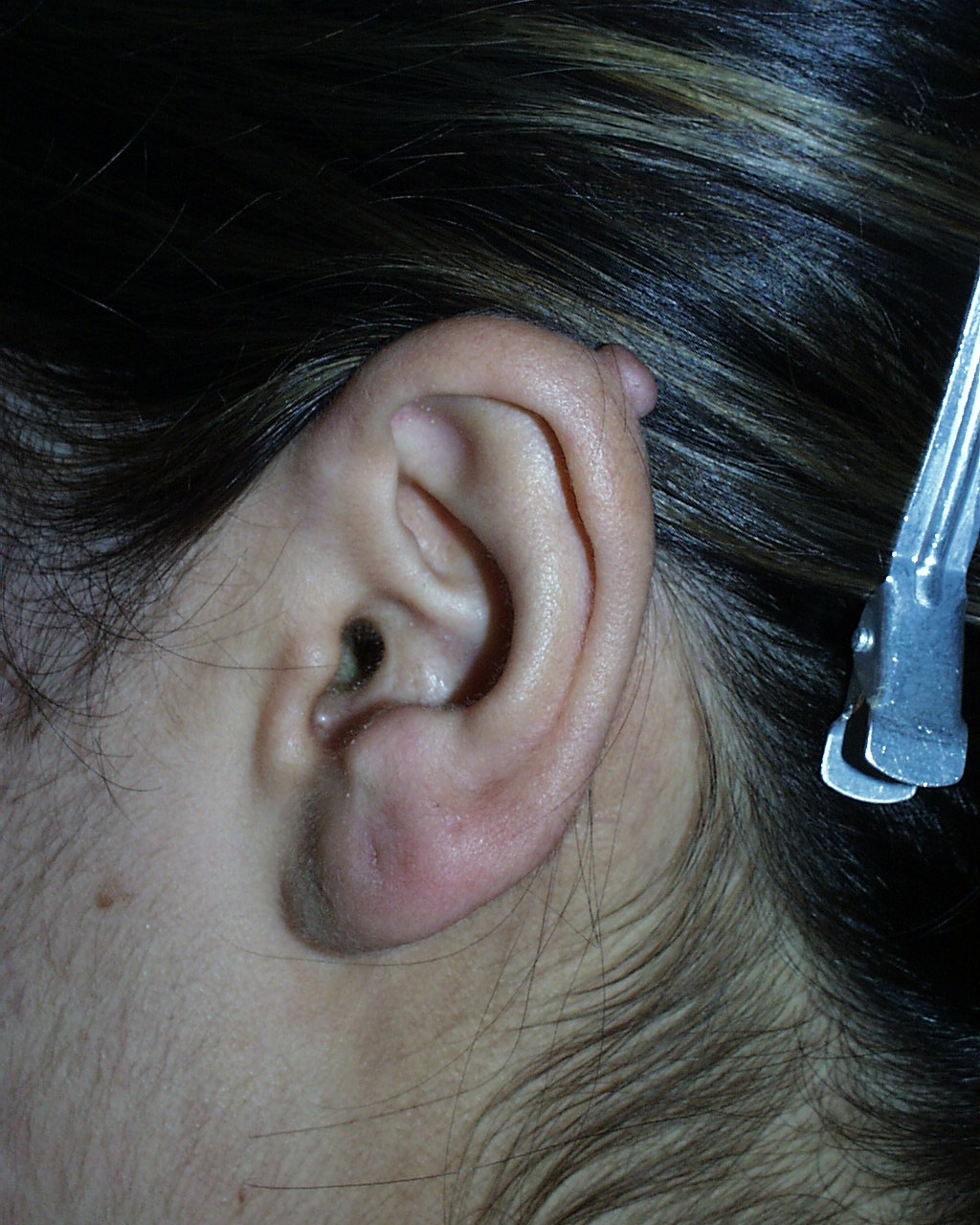
The scar in the picture is from a single clean piercing of the upper ear. In response to a small injury, a relatively large raised itchy red/purple scar has formed. This scar is larger than the original piercing, so it is clinically consistent with a keloid scar.
 Keloid scar at 1 o'clock on the helix of the ear. |
 Keloid of the ear - view from behind. |
This keloid scar was treated with depo steroid injections combined with direct excision and repair. This may sound simple, but realize, that resecting this keloid causes an injury which is hundreds of times larger than the small needle stick that started the keloid. In this case, an excellent result was achieved.
 Side view of ear after resection of keloid. |
 Keloid scar revision - no recurrence. |
The keloid was removed, the base remains smooth and flat with no itching, and most importantly, there has been no recurrence. Keloids are among the most challenging scars to revise, due to their high rate of recurrence.
Next time, the details on how to evaluate a scar, so that the correct treatment can be initiated.
Posted in Home, Scar Revision (Keloids) | 1 Comment »