As a Walnut Creek Plastic Surgeon, scars are something I am frequently asked about. Here I will try to help you understand the indications, goals and likely results of scar revision. This information is for general information purposes. This may provide a framework to help you with discussing scar revision; however, it cannot replace an in person consultation. In order to pick the best plan for you, a careful history and examination would need to be performed first.
What Makes a Good Scar?
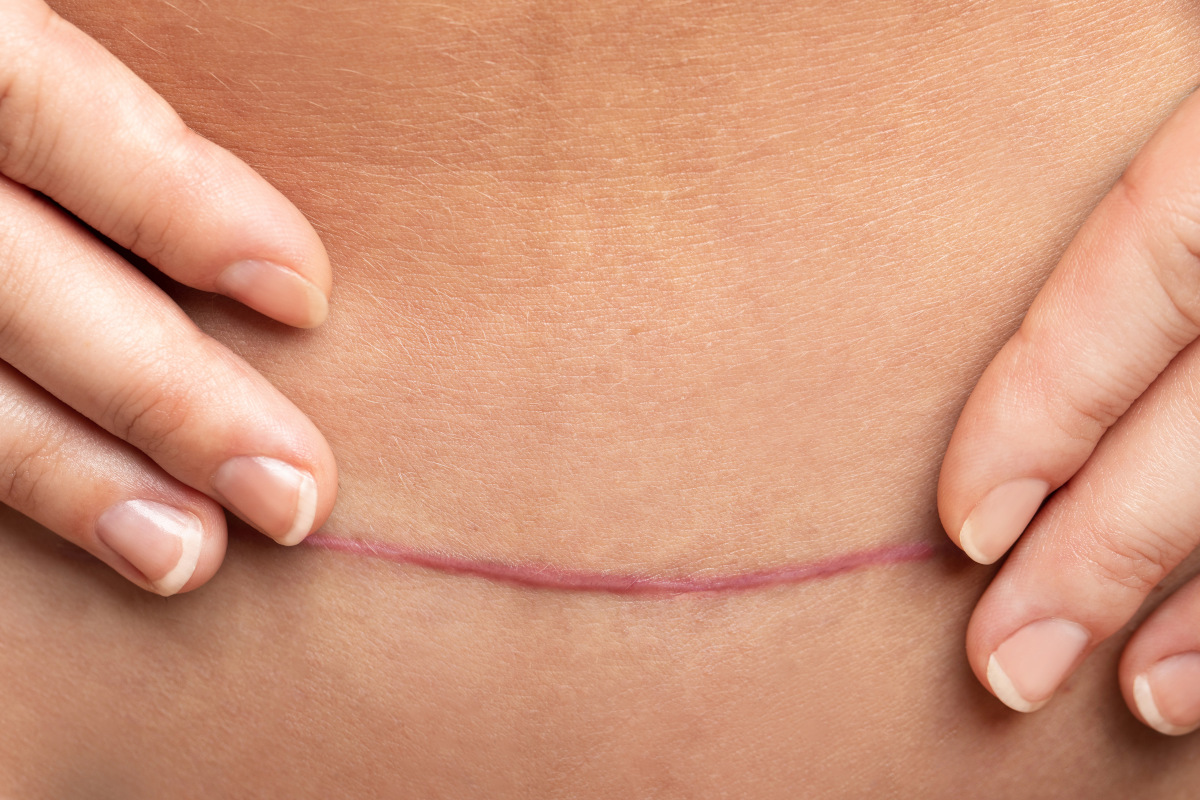
A good scar matches the surrounding skin. It is smooth, flat, thin and matches the surrounding tissues in color and texture. It is painless, soft and does not restriction motion or cause distortion of adjacent structures.
The ideal scar revision would remodel a scar into a smooth surface, resembling the surrounding skin in all respects. If this were possible, a scar would be virtually invisible. Unfortunately, a scar cannot be completely erased, but a scar can often be improved, by reducing the qualities that make it obvious.
The Goals of Scar Revision
The goal of scar revision is to get as close as possible to the ideal result, and make the scar less noticeable. Here are some as some qualities that plastic surgeons try to create in the revised scar:
A fine line scar (narrow is best)
Falling within, or parallel to, naturally occurring lines, wrinkles, contour junctions, or resting skin tension lines (perpendicular to the underlying muscle fibers).
Free of contour irregularities (no lumps or depressions).
Without abnormal pigmentation (not too dark, not too light).
Void of contractures or distortions of the surrounding tissue. (not too tight)
In planning a scar revision, it is important to first determine what makes the scar apparent, and focus on the methods most likely to improve these attributes. For example, if a scar is raised, silicone gel sheeting can help to flatten it. However, using silicone gel sheeting on a dressed scar is not likely to help. The correct tool for the job can only be selected after deciding what the job is.
How Does Scar Revision Help
There are many different ways to treat a scar, and most help in at least one of the following ways:
Improving the direction of the scar.
Decreasing the width of the scar.
Dividing the scar into smaller segments.
Correcting misalignment or distortion of adjacent tissues.
Improving surface irregularities.
Improving pigment discrepancies.
There is too much information to cover it all in one post, so I will leave it here for now. Next time, I will provide some more details about how to evaluate a scar, and to see if a revision is likely to help.
Most plastic surgeons offer more than plastic surgery. Despite the latest glossy ad you may see, there is still nothing that replaces the quality, safety and predictability that today’s cosmetic plastic surgery provides. On the other hand, not every wrinkle needs surgery.
Unlike a facelift, the so called liquid facelift, fillers, cannot correct skin laxity, and unlike a browlift, Botox® and Dysport® cannot lift a sagging brow, but they can help with the wrinkles. I use both these wrinkle reducers to delay and sometimes to enhance the results of my surgical procedures. If you have lines that look like “elevens” between the eye brows, or folds that look like “parentheses” around the mouth, there are non-surgical treatments which can reduce the length and the depth of these lines, and it can be done during a short office visit.
Starting at the Top.
BOTOX Cosmetic from Allergan
Dysport from Medicis
Botox and Dysport can reduce the lines that develop on the upper face. Both products are FDA approved to reduce the frown lines we get between our eyebrows; moreover, they are used off-label, to do much more. In many cases, a skilled plastic surgeon can reduce the following:
Transverse forehead lines
Frown lines (the “elevens” between the eye brows)
Laugh lines or crows feet (around the eyes)
Mild brow ptosis (mild sagging usually of the outer eyebrow)
Botox and Dysport are not fillers. They reduce wrinkles at the source, by inhibiting the muscle action causing them. Care must be taken with these medications, to inhibit the offending muscle actions while always trying to preserve normal animation.
The Mid and Lower Face
Restylane from Medicis
Perlane from Medicis
Juvederm from Allergan
Radiesse from BioForm Medical
Since Botox and Dysport reduce expression, they are not ideal for the mid to lower face. We can look normal without the ability to frown, but we need to be able to smile. This is why fillers are ideal for the correction of the lines around the mouth.
The most popular fillers in the US today are hyaluronic acid (HA) based. HA is a clear gel, and a normal component of our skin and joints. There is no allergy to it, unless we are allergic to ourselves. The most popular HA fillers are:
Restylane
Perlane
Juvederm
The most common areas treated with fillers are:
The parentheses (nasolabial and marionette lines bracketing the mouth)
The lips for enhanced fullness
The fine lines around the mouth (smoker’s lines even if you don’t)
Other mild to moderate wrinkles of the face
Radiesse is also a filler, but it is not an HA. It is white and gives a firm result. Good for deep lines like the nasolabial folds and marionette lines (i.e. the parentheses), but not as good superficially like in the lips where it may be seen or felt. Radiesse is also good for mild enhancement of the chin and cheek bones.
It is important to have a face-to-face evaluation with your plastic surgeon to determine if you are a good candidate for a procedure. This includes non-surgical procedures. When performed by a trained professional, the treatment should be simple and easy. If you are in the San Francisco Bay Area, and would like to have a consultation appointment in my Walnut Creek Plastic Surgery office, give me a call at (925) 943-6353. More information on non-surgical wrinkle reduction, check my main web site, www.DrMele.com .
Though not common, possible adverse reactions should be discussed with your plastic surgeon prior to initiating treatment. The most common problem with all these products is mild bruising, so you do not want to have your injections the day before you want your results. The results last for months, so allowing a couple weeks for the optimal results to develop is recommended.
There is some crossover between the botulinum toxins and the facial fillers. Sometimes deeper lines on the upper face may need a little filler to improve the wrinkle reduction and speed the results. Less frequently, Botox and Dysport are used on the lower face, to treat facial asymmetry, lip lines and neck (platysmal) banding. These are special cases and require careful selection in order to provide the best results.
The California State Capitol - Sacramento California
Amid an avalanche of bills that Governor Schwarzenegger had to consider this week, two will directly effect every cosmetic plastic surgery patient in California.
AB 1116, the Donda West Law, requires that all patients undergoing elective cosmetic surgery have a medical history, physical exam and signed clearance for surgery. and these are to be completed within the 30 days before surgery is performed.
Now this is nothing new for Board Certified Plastic Surgeons, American Society of Plastic Surgery members and American Society for Aesthetic Plastic Surgery members. I would not consider doing surgery without these safe guards in place. It is a simple way to identify patients who are more likely to get into trouble, and well worth the effort to complete.
Every patient I have operated since I opened my practice in 1997 has had a medical history, physical exam and a signed written clearance for surgery. Not because it was the law, but because it was part of my responsibility to my patients as a professional. It is how I was trained to operate.
Cosmetic surgery is elective. This means there is no emergency, and no harm is done by waiting. While at times the need may seem urgent, and I always try to accommodate your schedule, there is also the time to be safe — to review your medical history; to perform a focussed physical examination; and to obtain pertinent labs and test. This may take a little longer, and may cost a little more, but dotting all the i’s and crossing all the t’s is the best way to have a safe and predictable cosmetic surgery. Moreover, paying attention to details is exactly what I want my Plastic Surgeon to do.
This law is more the result of a doctor not doing what he was trained to do, than an indictment of how the vast majority of doctors practice. Most doctors care about their patients, and their results, so for most doctors, and their patients, this law will have no effect. We are already taking these precautions in our daily practice.
All Active American Society of Plastic Surgery members, myself included, are required to use accredited hospitals and surgery centers. Accredited hospitals and surgery centers already require a current history and physical examination be present and signed, in your patient chart, prior to surgery.
Another bill, AB 832, addresses oversight and monitoring of ambulatory surgical clinics. My hope is that this will also lead to improvement or elimination of those centers that are not up on patient safety, and that it will not become a costly burden on an important vehicle for patient care. Ambulatory surgery centers provide state of the art surgical care for patients who are healthy. Because these facilities limit the types of procedures they perform, they can be focused and more efficient than hospitals which have much higher overhead, and much sicker patients.
I respect and depend on our excellent local hospitals. Without them, I could not care for those patients who are really sick. The unfortunate victims of trauma, those who are critically ill, or those who have multiple medical problems, are not candidates for ambulatory care centers. They require the additional resources, and teams of doctors, nurses and technicians, that are only available in large institutions.
I maintain admitting and operating privileges at John Muir Medical Center in Walnut Creek, CA, across the street from my Walnut Creek office; John Muir Medical Center in Concord, CA (formerly Mt. Diablo Medical Center); and San Ramon Regional Medical Center in San Ramon, California. All are top notch, and we are lucky to have three such facilities in the Tri-Valley. But the vast majority of my cases are done in neighboring ambulatory surgery centers.
The down side to hospitals, they have sick people in them. This may seem obvious, but when you are a healthy patient having elective plastic surgery, you don’t want to be around sick people. Major hospitals also have major emergencies, and these emergencies have to have priority. For emergencies there is harm in waiting, so elective surgeries get bumped, and carefully planned schedules get delayed and sometimes cancelled.
These are just two of the reasons that ambulatory surgery center were born. Since only elective surgery is performed, few surprises arise. You are screened with a medical history, physical exam and pertinent test, so few surgeries are cancelled. The procedures are predictable, so schedules tend to be kept on time. It makes for a safe secure and very predicatable environment for elective surgery.
Without ambulatory surgery centers, doctors and surgeons could not provide the cost efficient, high level of care, to the large numbers of people needing that care, in the state of California. Our hospitals are crowded and frequently full. Every flu season, elective surgery is cancelled in hospitals because there are not enough hospital beds. If no bed, or nurse is available to care for you after surgery, you can’t have surgery. This decision is frequently made at 5:00 PM the night before and elective case, and no one is happy about it – you, your doctor or the hospital. Ambulatory surgery centers do not have this problem.
AB 832 requires the State to convene a workgroup no later than February 1, 2010, to consider and develop recommendations for state oversight and monitoring of ambulatory surgical clinics. Surgical clinics are defined as a place owned, leased or operated as a clinic or office by one or more physicians or dentists, which provide ambulatory surgical care.
My hope is that AB 832 will result in legislation similar in spirit to the Donda West law, in that, the Donda West law requires actions be taken that all good doctors would do as part of their normal practice. While it is unfortunate that some doctors need to have a law to do what is best for their patients, the Donda West law is not restrictive for those thoughtful surgeons who practice safely. The documentation required by the Donda West law is not just for site inspectors to review, but is directly useful to all those caring for the safety of my patients. The Donda West law did not require theoretical rationalizations to justify it’s passage, because it does require that all doctors do the proper preparation for elective surgery, like we were taught in our training.
The third bill, SB 630, will impact the lives of children in California born with cleft palates. It was sponsored by a group in which I am an active member, the California Society of Plastic Surgeons. This law clarifies existing law to require dental coverage needed for medical reasons for patients with cleft palates. Most California Plastic Surgeons do not do dental procedures, but most our young patients benefit from dental procedures as part of the multidisciplinary approach to repairing cleft palates. I am proud to be a member of a group that is willing to fight for the complete care of our patients, not just for the care we provide.
or How an Engineering Major Becomes a Plastic Surgeon
The Eiffel Tower (click for a closer view)
I have a short biography on my web site which includes a list of honors and degrees received. The fact that I get the most questions about, however, is my undergraduate major.
Electrical and Computer Engineering is the not a common premed major. I started at the University of California, Davis, with the goal of becoming a doctor, and with a major in biological sciences. Bio Sci is probably the most commonly selected premed path.
I graduated from high school, with advanced placement credits in math, chemistry, physiology and physics. In order to receive these credits, I had to take the more vigorous coursework in college. This put me on the same track as the Engineering majors, and I found out I enjoyed Engineering.
Engineering involves system analysis – looking at a specific situation and determining why it does or doesn’t work. While usually applied to a structure or a machine, this analysis can also be applied to the human body. Fluid dynamics can be applied to the circulatory system. Circuit analysis helps understand the nervous system, and structural analysis provides insight into why things sag.
System analysis, and studying the integration of systems, helped me understand the volumes of facts required for my premed classes then, and still provides a frame work in which to organize the Plastic Surgery decisions which I am called on to make daily.
I think the questions about my Engineering Major arise because Cosmetic Plastic Surgery is seen as a creative and artistic endeavour, while engineering is seen as rote and rigid. In reality, a great plastic surgeon needs to understand both the artistry and the science behind the art. The most beautiful building in the world will not provide much joy if it falls over. Form must be balanced with function.
Great Plastic Surgery, like great Engineering, combines precision with style. The Eiffel Tower is one of the most recognized structures in the world. It is an icon for Paris and all of France because it has style. It is aesthetically pleasing, and it is pleasing to the eye because of the artistry. However, it is standing today, 81 stories and 120 years after the opening of the Exposition Universal, because of the engineering.
Next week I will get back to cosmetic plastic surgery. As always if you have any question, feel free to send them. A contact form is provided on this blog (to the left) and on my main web site.
If you are also a UC Davis alumnus this week end is Homecoming. Will I see you at Pajamarino?
Whether you are considering breast enhancement, or already have breast implants, this video discusses the most frequent reasons why corrective surgery is needed and includes before and after pictures and live viewer questions.
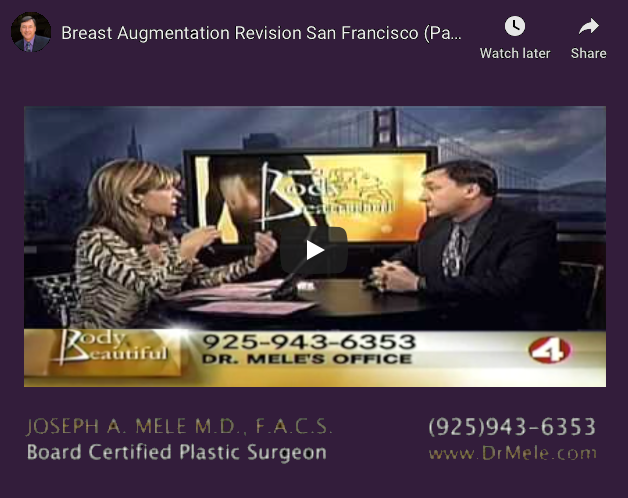
This is part two of two from an episode of KRON 4′s Body Beautiful with Vicki Liviakis that aired last month. This video discusses breast augmentation revision surgery, including before and after pictures and viewer questions.
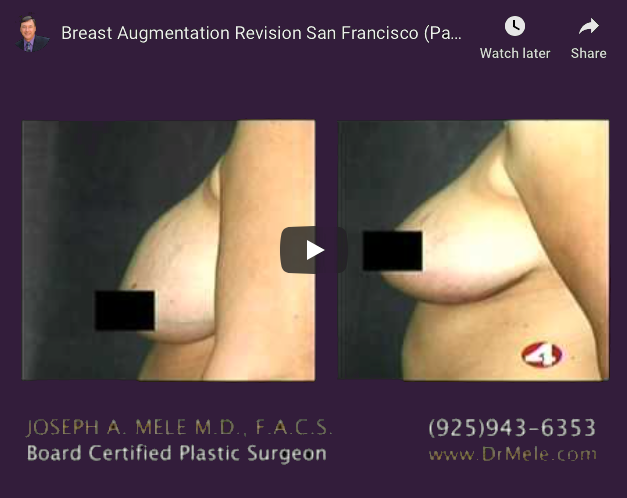
Specific examples are shown. The first patient (shown below) had breast augmentation in her twenties. Years later, she had children and was not happy with the changes in her breast resulting from pregnancy and breast feeding. Before and after breast augmentation revision surgery pictures are shown. In her case a breast implant exchange and breast lift and were performed to adjust for lost volume and improve the shape of the sagging breasts.
A different patient had breast implant bottoming out. In her case the implants had fallen below the inframammary fold leaving the nipples high and flattening out the normal curve beneath the breast. Corrective beast augmentation surgery included breast implant implant exchange to adjust the volume, and the inframammary fold was reconstructed internally to raise the implant and form a distinct curve beneath the breast.
The caller in this video had a question about ruptured silicone gel implants that were placed in the 1970′s. If any breast implant has ruptured, it needs to be removed. Most frequently, a ruptured breast implant is replaced at the same operation. Silicone gel implants in particular should be removed sooner than later. A ruptured silicone gel implant, over time, can cause increased scarring and hardening of the breasts, as the body tries to wall off the free gel. If not treated promptly, this type of scarring can lead to further problems than may not be correctable.
Silicone gel filled implants placed before 1985 seem to have a higher deflation rate than the new silicone breast implants. In fact, the outer shell of silicone breast implants has changed twice since the 70′s. The first change, in the mid 80′s, was to decrease the rupture rate. The second change, in the mid 90′s, was to reduce gel bleed (the ability of the silicone gel to leak through outer shell without a rupture). Both US FDA approved breast implant manufactures, Allergan and Mentor, offer lifetime replacement of their implants should they fail, and often provide financial support should this occur within ten years of your breast augmentation procedure. For details of the Mentor and Allergan (Natrelle) Breast Implant Warranties click on the manufactures names. It is best to get the information direct from the manufacturer; however, the Mentor site has been going through some changes, perhaps with the merger with Johnson & Johnson, so if you can’t link there, JustBreastImplants.com also has information on breast implant warranties.
Breast Augmentation is currently the most frequently performed cosmetic plastic surgery procedure. Whether you are considering breast enhancement, or already have breast implants, this video discusses the most frequent reasons why corrective surgery is needed.
Breast augmentation revision surgery is sometimes necessary even in the best of hands. Revision surgery can range from simple, like changing breast implants after deflation or changing sizes, to more complicated, like when treating breast ptosis (sagging) or capsular contracture. The best way to reduce your risk of needing breast revision surgery is to choose a qualified Board Certified Plastic Surgeon.
If you need breast revision surgery, choosing a well trained Board Certified Plastic Surgeon with a broad experience in breast enhancement surgery is the best way to get a satisfying result. By choosing a Board Certified Plastic Surgeon who specializes on cosmetic surgery, you get a doctor who is well trained and well rehearsed in a wide range of treatment options.
Breast implant revision in San Francisco is no different than in other areas of the United States. Sometimes the results of the breast augmentation where just not what was expected. Other times, the result were great and either the breasts change, the implants change or the desires change. When these situations arise, breast augmentation revision surgery could be your best option to get back into the shape you want.
This is part one of two from an episode of KRON 4′s Body Beautiful with Vicki Liviakis that aired last month. This video discusses breast augmentation revision surgery. Part two will include more discussion, before and after pictures and viewer questions.
The best way to be certain your plastic surgeon is appropriately trained to perform breast augmentation surgery is to make sure that he or she is a Board Certified Plastic Surgeon. By choosing a Plastic Surgeon who is a member of the American Society of Plastic Surgeons (ASPS), you can be certain that their credentials have been verified. ASPS members are held to higher standards in ethical care of patients and continuing medical education requirements. ASPS standards are above and beyond those required by State licensing boards and hospital credentialing committees.
A small percentage of ASPS members are also members of the American Society for Aesthetic Plastic Surgery (ASAPS). ASAPS members are ASPS members who specialize in the cosmetic side of Plastic Surgery. ASAPS members must meet the standards of ASPS, apply independently for membership to ASAPS and demonstrate a commitment to cosmetic plastic surgery both in education and in patient care.
ASPS is the largest plastic surgery specialty organization in the world. Founded in 1931, the society is composed of board-certified plastic surgeons who perform cosmetic and reconstructive surgery. ASAPS is the leading organization of board-certified plastic surgeons specializing in cosmetic surgery of the face and body, and I am proud to be an active member of both.
Next time I will talk more about the reasons for breast augmentation revision surgery and how a qualified Plastic Surgeon can help.