July 27th, 2009 Dr. Mele
There’s a new kid in town, at least for Walnut Creek plastic surgery. While Dysport® has been a mover and shaker Europe for years, the US FDA has only recently approved Dysport® for use in San Francisco plastic surgery procedures.

The Number 1 Contender
VS

The Champ
Dysport® (abobotulinumtoxinA) is very similar to Botox® (botulinum toxin type A). While Botox® molecules are all the same size, Dysport® has some variation in size which may explain the slight differences. Since the drugs are very similar, for most people the effectiveness will be the same. The European experience has reported similar outcomes with Dysport® and Botox®. European studies also show a faster onset of action for Dysport® and maybe a longer lasting result with Dysport®. Here are some of the details:
Onset:
Dysport® has a slightly faster onset of action. In other words, the desired effects can be seen faster with Dysport®. Botox® may take 3-7 days for effects to be seen, while Dysport® may take 1 to 5 days. Since there is wide individual variation in the time it takes for these products to work, I’m not certain this is a hugely beneficial, but the advantage goes to Dysport®.
Onset Advantage: Dysport®.
Longevity:
The effects of Dysport® and Botox® last 3-4 months.; however, there is wide individual variation (1 to 12 months). While some reports show Dysport® lasts longer than Botox®, others show no difference. There is no clear winner here.
Longevity Advantage: Unclear (perhaps Dysport®)
Dose:
Dosing is different for the two drugs. Mostly this is due to the way the assay is performed rather than one toxin being stronger than the other. Like any drug, as long as you are given the correct dose for your problem, it doesn’t matter. While there is not a linear correlation, 2.5 Dysport® units give about the same result as 1 Botox® unit.
Dose Advantage: It just doesn’t matter.
Price:
Unsurprisingly, the introduction of Dysport® has temporarily halted the ever increasing rise in the price of Botox®. In fact Dysport®’s slightly lower price has caused Allergan to issue discount coupons. The $50 coupons help offset the price difference and will help Botox® compete, at least until the coupons expire in October. Two other competing products are also in development by Mentor and Merz.
Price Advantage – Consumer
With the current Botox® coupons it is a wash. Since it’s a fixed $50 off for Botox®, lower doses (one area) may be slightly cheaper to treat with Botox®, while treating multiple areas may be less with Dysport®. When the coupons expire in October the advantage will clearly go to Dysport® … unless Botox® has something else up its sleeve.
Another recently FDA approved product for wrinkles is Hydrelle. I can no longer recommend this product. I would suggest using Restylane®, Perlane® or Juvederm®. All three are now available with Lidocaine, all three seem to have fewer adverse reactions and superior customer service. Details here.
Posted in Home, Wrinkle Reduction (Non-surgical) | No Comments »
July 25th, 2009 Dr. Mele
The topic for this week is what’s new in plastic surgery. Cosmetic plastic surgery is always changing. We are constantly looking for new and improved ways to provide lasting results. Innovation is constantly supplying new products that provide better results, faster results or less expensive results are always under development and here are a few that have made it.
Surgical Products:
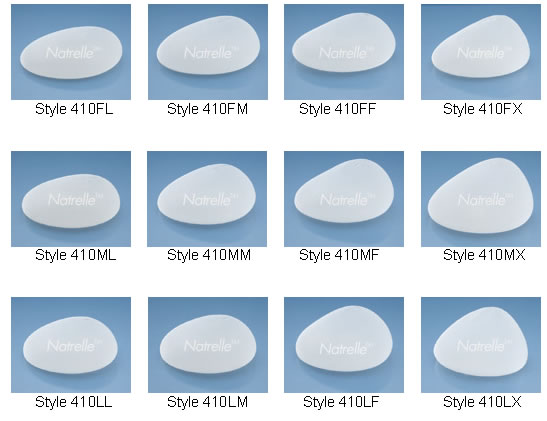
The next major step forward in the cosmetic plastic surgery procedures category will probably come in the area of breast augmentation. Silicone breast implants are evolving. The change has been seen in Europe and Canada; however in the United States we continue to wait patiently. FDA approval of gummy-bear breast implants has been pending for several years. The research is done, additional information has been supplied and the FDA just needs to take a vote. Since the vote has been pending for several years, your guess is as good as mine as to when gummy-bear implants will available for San Francisco Breast Augmentation.
These new implants are form stable, silicone gel implants that can’t leak. They are a soft solid that can be formed into specific shapes. In certain situations this is a superior implant with fewer risks. Given the two implants that are currently approved, the decision to approve this implant seems inevitable.

Natrelle Style 410 Highly Cohesive Breast implants (Gummy Bear Implants) come in 16 basic shapes, and each shape comes in many sizes.
Non-surgical Products
Two other new products area currently available for minimally invasive office procedures:
Number one is Dysport® (Medicis and Ipsen) – Botox® (Allergan) competitor.

Dysport® the first FDA approved Botox® competitor.
Number two is Hydrelle® (Coapt Systems)- a new dermal filler (hyaluronic acid) with a numbing agent (lidocaine) added for pain control – a competitor for Restylane® (Medicis), Perlane® (Medicis) and Juvederm® (Allergan).

Hydrelle the first FDA approved wrinkle filler with a numbing agent added.
I can no longer recommend this product. I would suggest using Restylane®, Perlane® or Juvederm®. All three are now available with Lidocaine, all three seem to have fewer adverse reactions and superior customer service. Details here.
Posted in Breast Augmentation, Breast Implant Revision Surgery, Home, Wrinkle Reduction (Non-surgical) | No Comments »
July 22nd, 2009 Dr. Mele

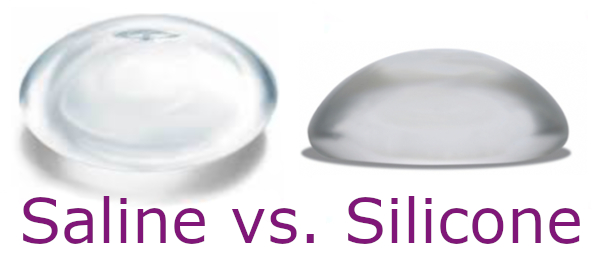
Pictured above are a silicone filled breast implant (left) and saline filled breast implant (right)
So which filler is better Silicone or Saline?
That has been the question since the introduction of the modern breast implants in the 1960′s. All the latest breast implants are made with a silicone shell. The difference is what is placed inside the shell to give the desired boost in breast volume.
The first breast implants were developed in 1962 by two Texas plastic surgeons Thomas Cronin and Frank Gerow with Dow Corning. These were smooth tear dropped shaped silicone implants filled with a cohesive silicone gel. They had a Dacron patch on the back to fix the orientation. This was necessary because they were smooth and could spin, thus losing the desired orientation.
Saline filled implants followed a few years later. A French plastic surgeon, Henri Arion, was the first to use them. He was trying to make an implant that could be placed through a smaller incision. Unlike silicone breast implants which are pre-filled, saline filled breast implants are filled after insertion. The shell can be inserted through a smaller opening without the risk of damaging the implant. A filling tube is left attached to add the desired volume. A valve built into the implant allows the tube to be removed without the saline leaking.
Since the mid sixties little has changed. The shells are more durable and less leaky. Texturing was added, eliminating the need for the Dacron patch for shaped implants. The cohesiveness of the silicone gel has been modified. The implants have received ongoing FDA approval and remain safe and effective for augmenting the breast.
In my Walnut Creek breast augmentation practice I am often asked which is better – saline or silicone gel? If there was a clear advantage then in a free society the better implant would be used more frequently. In the case of breast implants, even with the recent silicone gel breast implant controversies the use is about 50:50 with the edge going to saline.
In other words, about half the San Francisco breast augmentations patients are choosing saline and half are choosing silicone gel breast implants. This is because both implants have advantages and disadvantages. I go into detail about saline breast implants vs silicone gel breast implants on DrMele.com, but here are the top five advantages and disadvantages of saline and silicone gel filled breast implants.
Saline Breast implants
Advantages
- Peace of mind for those who are unsure of silicone gel
- Leaks are easily detactable
- Increased projection when desired
- For purely cosmetic breast augmentation can be used at age 18
- Slightly lower capsular contracture rate
Disadvantages
- Higher risk of rippling
- More easily palpable (feels less natural in most cases)
- Increased projection when not desired
- Stiffer result
- Slightly higher leakage rate
Silicone Gel Breast Implants
Advantages
- Softer more natural feel
- Lower risk of rippling
- Decreased projection when desired
- Moves more like a natural breast
- More profiles (shapes) available
Disadvantages
- Leaks are harder to detect
- Decreased projection when desired
- Slightly higher capsular contracture rates
- Body makes scar in response to a leak
- For purely cosmetic breast augmentation can be used at age 22 or older
There are other aspects to consider in specific situations so it is important to discuss these differences with your Board Certified Plastic Surgeon during your initial consultation. Board certification can be checked easily on-line for free on the American Board of Medical Subspecialties site. Also all members of the American Society for Aesthetic Plastic Surgery (ASAPS) and the American Society of Plastic Surgeons (ASPS) are Certified by the American Board of Plastic Surgery.
These are the premier surgical societies for plastic surgery in the United States and I am proud to be an Active Member of both ASAPS and ASPS. I also have Certified and maintain Board Certification with the American Board of Plastic Surgery and with the American Board of Surgery. When I add a post about how to choose a plastic surgeon, I will add the link here, but I consider Board Certification, and Membership in the ASAPS and ASPS three of the most important prerequisites. It is also a good idea to check you Plastic Surgeon’s standing with your state’s medical board. Here is the link for the physician license lookup for the Medical Board of California.
Posted in Breast Augmentation, Breast Implant Options, Breast Implant Revision Surgery, Capsular Contracture, Home | 2 Comments »
July 16th, 2009 Dr. Mele
If you are considering breast augmentation, size matters. Every day in my Walnut Creek cosmetic plastic surgery practice I get asked. “What breast implant volume is right for me?” While it’s a simple questions, there is no simple answer. The correct answer comes from a thoughtful discussion of goals, an objective measurement of the body and a dash of art.

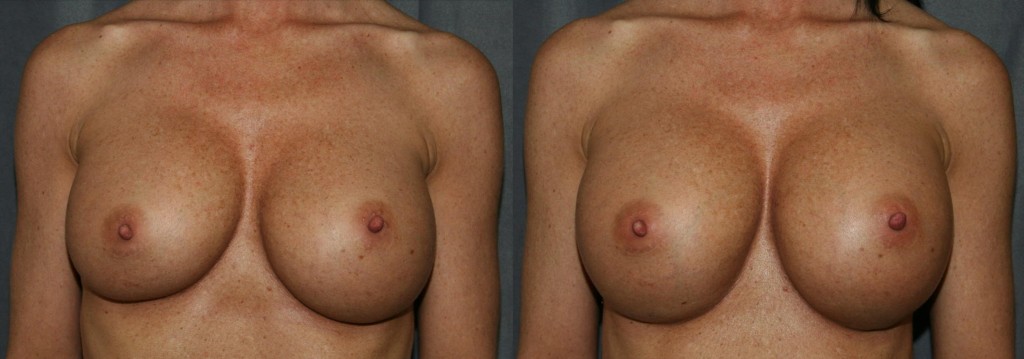
Breast Augmentation Before and After Pictures
Factors to consider before breast augmentation are: desired breast size, location of scar, location of implant, type of implant, the chest wall anatomy and of course the natural breast tissue, Additional information can also be found on DrMele.com. A Board Certified Plastic Surgeon can help you with the options. This blog post concentrates on the most subjective of these aspects, the size.
There is no textbook answer when it comes to choosing breast size. There are formulas and graphs of breast volumes and dimensions; however, there is no table which translates your current dimensions and desired size into the “correct” implant. Certain rules of thumb do apply, and these can guide the selection of an appropriate implant.
A wise family practice doctor once told me, “If you listen to your patient they will tell you what is wrong.” It may seem too simple, but the most import question I can ask if you are considering breast enlargement is, “What size would you like to be?” By carefully listening the the answer I can learn the range of results desired. Most patients are looking to increase their bust one or two cups sizes. Some are seeking to restore volume lost during pregnancy or weight loss. Others are seeking what nature has not provided. What ever your motivation, it is important to think about the desired size and be honest with your response.
Trial the size. Play with it. Go bigger. Go smaller. Get a bra that is the desired cup size and try it on. Pad it out and wear it. Get used to the size. See what clothing works best. In this way you will learn what truely makes sense for you.
I encourage you to then bring the result with you to your consultation appointment. If you are using a Ziplock® full of rice to stuff your goal bra, bring it in. If you see a picture of a bust that looks good to you, bring it in. If you see before and after pictures that apply, bring them in.
Most my patients are looking for a proportionate result. Something that matches their body — often plus but occasionally minus a little bit. It is important that you are comfortable with the size, because this a a big step towards the ultimate goal, which is for you to be comfortable with the result of your breast augmentation. A little homework can really help get you where you want to be.
Posted in Breast Augmentation, Breast Implant Options, Breast Implant Revision Surgery, Home | 1 Comment »
July 9th, 2009 Dr. Mele
Prevention
How can we prevent capsular contracture? There is some evidence that bacteria may play a role in capsular contracture. Proper surgical technique, placement of breast implants behind the muscle, using saline instead of silicone filled implants, minimal handling of the implants, and irrigation of the surgical pocket with antibiotics can minimize the formation of capsular contracture. Postoperative massage may also help prevent contracture formation.
Treatment
How is capsular contracture treated? Many non-operative treatments exist and none are perfect. Massage, ultrasound, vitamin E, antibiotics, steroids and the latest leukotriene inhibitors (Accolate) have been tried with occasional anecdotal improvement.
Breast Augmentation Revision Surgery

Before and after pictures of breast augmentation revision for capsular contracture of right breast. Both implants were also replaced with larger breast implants.
Operative treatments are the most effective, and are usually reserved for Grade III and IV capsules. Open procedures include opening the scar (capsulotomy) or removing part or all of the scar (capsulectomy) to make more room for the implant. Sometimes changing the implant or the location of the implant with respect to the pectoralis muscle is recommended. Before and after pictures and a description of breast augmentation revision surgery can be found in part 1 of this three part mini-series about capsular contracture.
Closed capsulotomies, vigorous manual compression to disrupt the capsule, have fallen out of favor as the procedure can also disrupt (break) the implant. This procedure nullifies the current warranties offered by Allergan and Mentor.
Recurrence
Capsular contracture can recur after release, but my Walnut Creek breast augmentation revision patients are happy to find out that having a previous contracture does not seem to increase the risk of subsequent capsular contracture. The reported rates of capsular contracture range widely from 10% to 50% in some studies. The most common capsular contractures are Grade I and Grade II which do not normally require additional surgery. Grade III and IV are less common and are more commonly treated operatively.
Posted in Breast Augmentation, Breast Implant Revision Surgery, Capsular Contracture, Home | 1 Comment »
July 8th, 2009 Dr. Mele
In response to questions asked about the case study of capsular contracture previously posted, I am expanding the information into a short three part mini-series on San Francisco breast augmentation revision surgery (click for Part 1) and capsular contracture in general. Part 1 is the breast implant revision surgery case study. Part 2 is this posting with more information about what capsular contracture is. Part 3 will be about the prevention on treatment of capsular contracture.
Capsular contracture, or tightening of the scar that contains the implant, accounts for about one third of all breast augmentation revisions. According to the American Society of Plastic Surgeons, it is second only to a desire to change sizes. What is capsular contracture? How can it be prevented? How is it treated? San Francisco breast augmentation revision patients want to know.
It is desirable that a scar form around the breast implant. The scar, which forms the pocket that the breast implants sits in, is called the capsule. The capsule is very important.
If no scar, or a very weak scar forms, the implant is more likely to migrate. Gravity can pull the implant down (call bottoming-out) or the natural curve of the ribs can cause the implants to move laterally to the axilla (the armpits). The implants can also move together causing symmastia (connected breasts). A good capsule helps to secure the implants in their desired position, and helps maintain the desired results.
Capsular contraction occurs when the scar in the capsule is too tight or too thick. While Wikipedia defines capsular contracture as an abnormal response of the immune system, it is more likely an exaggerated normal response. If it is tight all around the implant, it can make the breasts feel hard and immobile. If it is tight on just one side, it can push the implant. For example, when the scar is tight on the bottom, it moves the implant up. This is the opposite of bottoming out.
*Capsular contracture is graded (Baker grades) as follows:
- Grade I-Naturally soft. Not palpable
- Grade II-Increased firmness. Scar is palpable. No visual distortion.
- Grade III-Firm to touch. Immobile causing visual distortion.
- Grade IV-Same as Grade III and painful.
Grades I and II are the most frequent results and are not usually treated. Grades III and IV are less frequent, and are often treated with a revision breast augmentation.
Posted in Breast Augmentation, Breast Implant Revision Surgery, Capsular Contracture, Home | 2 Comments »
July 6th, 2009 Dr. Mele
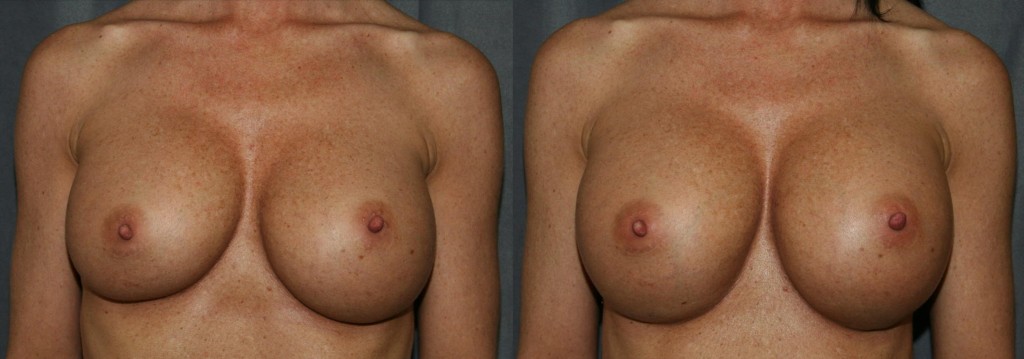
Breast revision surgery has become an important part of my walnut creek plastic surgery practice. Today’s post is a case presentation of breast augmentation revision surgery for a woman who developed capsular contracture.
The patient presented after a previous breast augmentation. She was naturally flat and two Mentor moderate profile 525 cc saline filled implants accounted for the majority of her breast mound. She had developed firmness in her right breast after a flu-like illness and the right breast became progressively smaller, higher, and firmer, but was not painful (Baker’s class III*). She was primarily concerned about restoring her symmetry; as is often the case however, she also desired a little more volume.

Before and after pictures of breast augmentation revision for capsular contracture of right breast. Both implants were also replaced with larger breast implants.
The picture on the left shows the breasts before surgery. The right breast mound with capsular contracture is tight, high, laterally displaced when compared with the right breast mound. Her right nipple is also lower.
An open capsulotomy was performed on the right breast for capsular contracture. Utilizing the previous periareolar incisions, the right capsular contracture was released and both implants were exchanged for Allergan Natrelle style-15 752 cc silicone gel implants. The right implant was lowered to a more symmetrical position. This and the capsular release allowed some upward migration of the nipple without having to do a lift and without adding any new scars.
San Francisco breast augmentation patients who are dissatisfied with their appearance due to capsular contracture will want to consider breast augmentation revision surgery. It can be performed on an outpatient basis and recovery is often simpler than the origin breast augmentation. Capsular contracture can recur after revision surgery, but the chances of this are not increased by the fact that it has happened before.
Posted in Breast Asymmetry, Breast Augmentation, Breast Implant Revision Surgery, Capsular Contracture, Home | 1 Comment »